

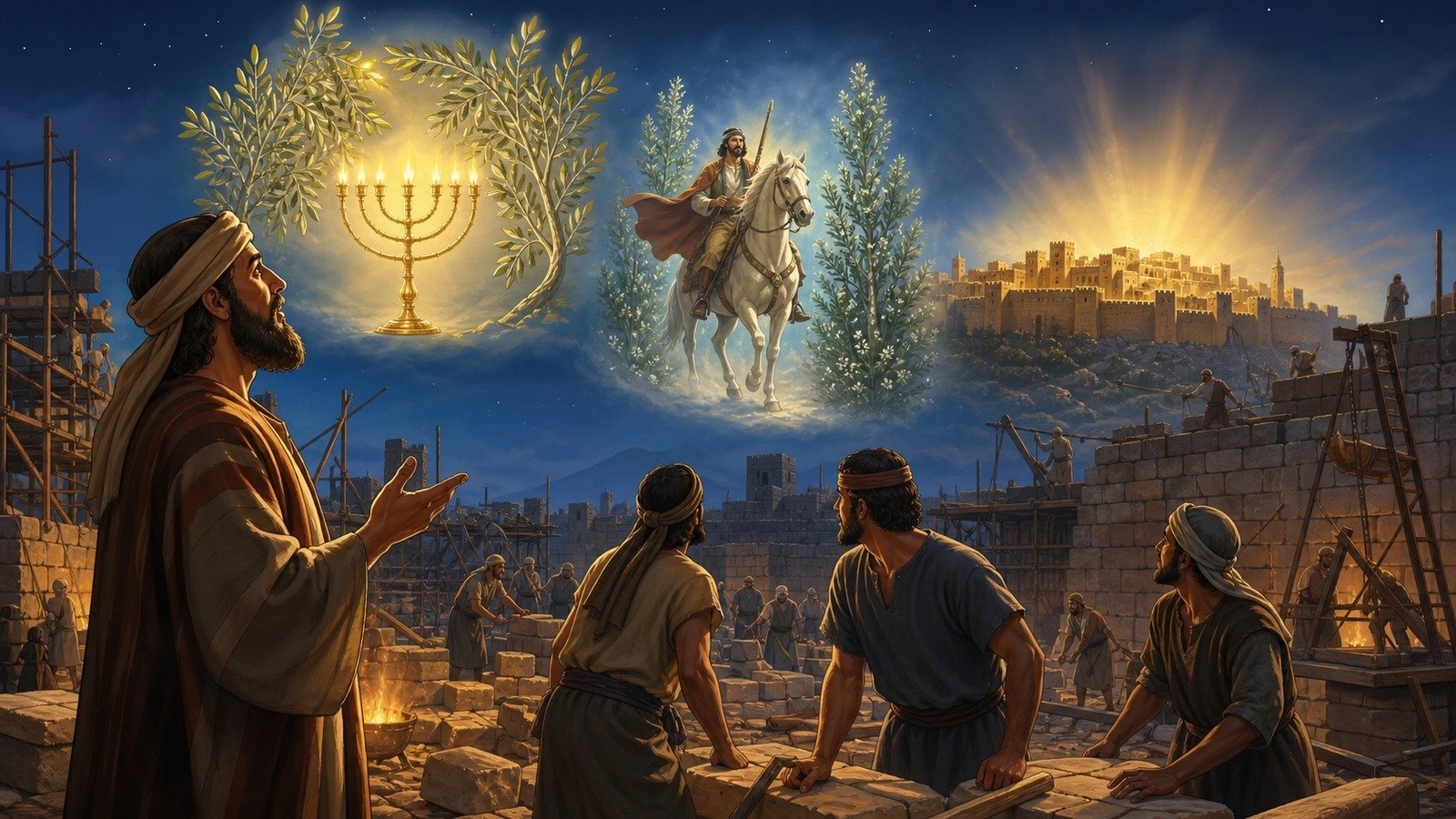
Alongside Haggai, Zechariah supplements the rebuilding effort with a series of encouraging night visions and a promise of the Temple's future glory, sustaining momentum through to completion.
Further context
3 min readZechariah starts two months after Haggai and works alongside him, and the two are a study in contrast. Haggai is short, blunt and entirely practical. Zechariah produces eight visions in one night, full of horses, horns, scrolls, lampstands and a woman in a basket, and then fourteen chapters of material that has been quoted in the New Testament more than almost any other prophetic book.
The opening call is a summary of the whole exile in one sentence: do not be like your ancestors, to whom the earlier prophets proclaimed, turn from your evil ways. They would not listen. Where are your ancestors now? And the prophets, do they live for ever? But did not my words overtake your ancestors?
The night visions come in a sequence. Horsemen patrolling the earth and reporting that the whole world is at rest, which is bitter comfort for a people whose ruins are quiet because nobody is fighting over them. Four horns and four craftsmen. A man with a measuring line going to measure Jerusalem and being told the city will be too big for walls, and that God himself will be a wall of fire around it. The high priest Joshua standing before the angel in filthy clothes with Satan accusing him, and the clothes being taken away and replaced. A gold lampstand with two olive trees supplying it, and the message that goes with it: not by might nor by power, but by my Spirit.
The second half of the book contains the material later readers found most striking. A king coming to Jerusalem righteous and victorious, lowly and riding on a donkey, on a colt, the foal of a donkey. Thirty pieces of silver weighed out as wages and thrown to the potter in the house of the LORD. They will look on me, the one they have pierced, and will mourn for him as one mourns for an only child. Strike the shepherd, and the sheep will be scattered. Every one of those is quoted or alluded to in the Gospels, several of them during the last week of Jesus' life.
The vision of the high priest in filthy clothes deserves one more sentence, because it is doing something specific for that congregation. Joshua is the grandson of a man executed by the Babylonians, standing as the representative of a community that had just been through the exile, and the accusation against him is not answered but dismissed, and the clothes are changed. What is being addressed is a priesthood that knew perfectly well why the temple had been destroyed.
The scholarly argument about the book divides it at chapter nine, on grounds of style and subject matter, and proposals for the second half range from the same prophet late in life to material from a considerably later period.
What both halves share is a rebuilding project that looks small. The answer given to that, twice, is a question: who dares despise the day of small things?
The eight night visions are dense and strange: a man among myrtle trees with horses behind him, four horns and four craftsmen, a man with a measuring line, a high priest in filthy clothes being reclothed while Satan stands accusing him, a golden lampstand fed by two olive trees, a flying scroll, a woman in a basket carried off to Babylonia, and four chariots with coloured horses.
The high priest scene is the one that has carried most weight. Joshua stands in filthy garments, the accusation is dismissed, the clothes are removed and replaced with clean ones, and a clean turban is put on his head.
The later chapters contain material quoted repeatedly in the Gospels: a king coming to Jerusalem righteous and victorious, lowly and riding on a donkey; thirty pieces of silver thrown to the potter in the house of the LORD; the shepherd struck and the sheep scattered; and they will look on me, the one they have pierced.