

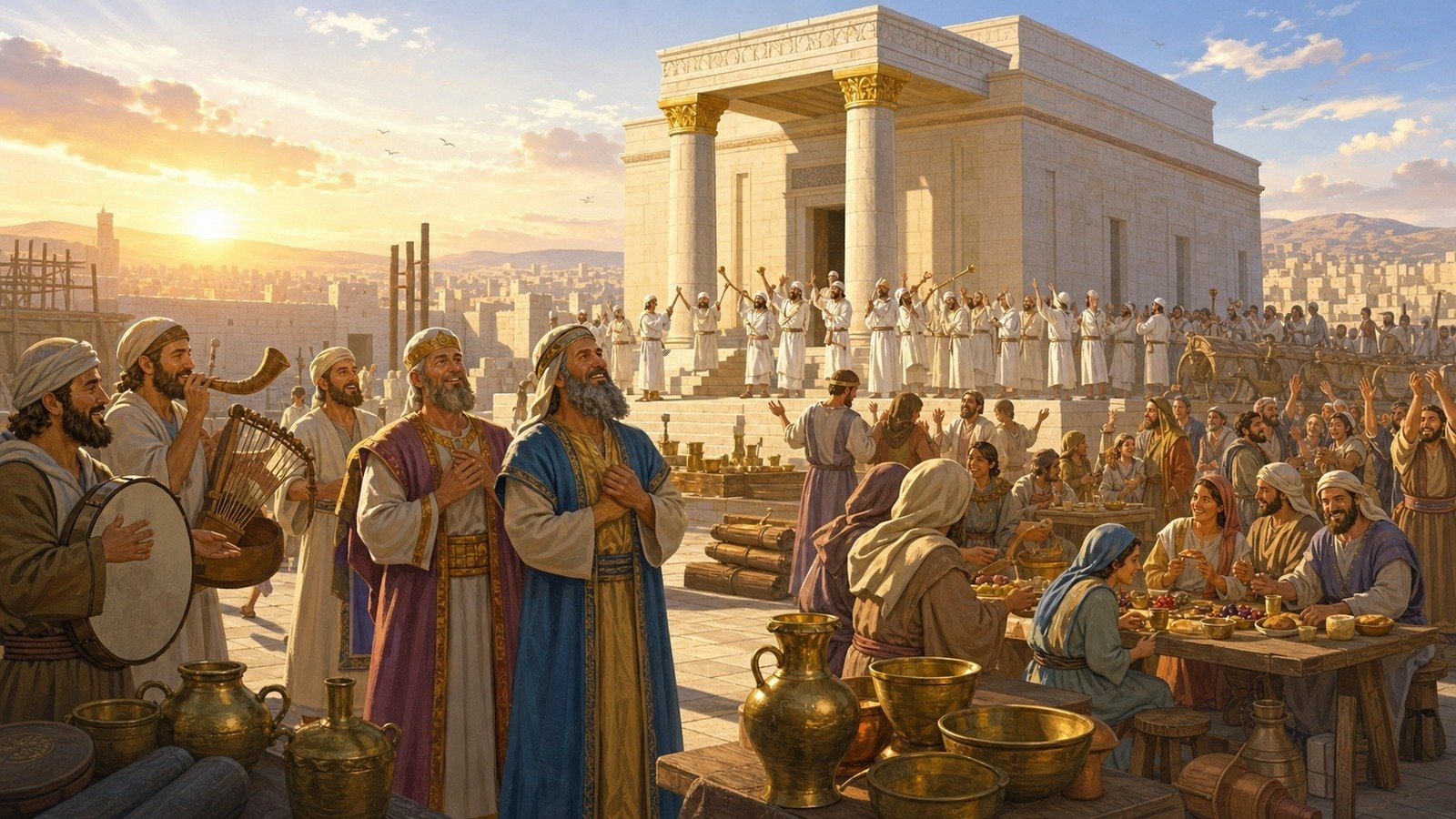
Darius I confirms Cyrus's original decree after a records search and orders the rebuilding funded from the royal treasury; the Temple is completed and dedicated roughly seventy years after its destruction, and Passover is celebrated there for the first time since the exile.
Further context
3 min readThe work restarts on prophetic authority rather than on a permit, and that is what triggers the enquiry. Tattenai, the governor of the province west of the Euphrates, arrives with colleagues and asks who authorised the building, and takes down the names of the men responsible.
What is preserved next is a piece of imperial correspondence quoted in Aramaic, and it is remarkably even-handed. Tattenai's letter reports what he found, quotes the Judaeans' answer in their own words, including a summary of the exile and a claim that Cyrus had issued a decree, and asks the king to have a search made in the royal archives to establish whether that is true.
The search is made and the memorandum is found, not in Babylon but at Ecbatana in Media, which was Cyrus's summer capital and where a document from his first year would plausibly have been filed. It specifies the dimensions of the building and states that the costs are to be paid from the royal treasury.
Darius then issues a ruling that goes considerably further than the original. The governor is to stay away from the site. The expenses are to be paid in full from the provincial revenues, and specifically from the taxes of that province, so that the work will not stop. Young bulls, rams, male lambs, wheat, salt, wine and olive oil are to be supplied daily without fail, so that they may offer sacrifices and pray for the well-being of the king and his sons. And a penalty clause: anyone who changes this edict is to have a beam pulled from his house and be impaled on it, and his house made a pile of rubble.
The building is finished on the third day of the month Adar in the sixth year of Darius, which is early 515 BC, seventy years after the destruction of the first one and about twenty-one years after the return.
The dedication is celebrated with a hundred bulls, two hundred rams and four hundred male lambs, and a sin offering for all Israel of twelve male goats, one for each tribe, which is a claim about the whole nation made by a community drawn mainly from two tribes.
The priests and Levites are installed in their divisions according to what is written in the Book of Moses. Then Passover is kept, by the returned exiles and by all who had separated themselves from the unclean practices of their neighbours in order to seek the LORD.
That last clause matters. The community that had refused help with the building from the peoples around it accepts, at the dedication, anyone from those peoples who joins it on its own terms. The line being drawn was never ancestry.
The scale is modest against Solomon's dedication, where the figures ran to tens of thousands of animals over fourteen days. What this community has instead is a functioning building, an imperial subsidy written into provincial tax law, and a governor instructed in writing to leave them alone.
The Persian investigation that precedes the dedication is a model of how the empire actually worked. Tattenai, the governor of the province beyond the river, arrives and asks who authorised the work, takes down the names of the builders, and writes to Darius asking for a search of the archives rather than stopping anything.
The reply is better than the Judeans could have hoped. The memorandum is found at Ecbatana, the original decree is confirmed, and Darius adds instructions of his own: the costs are to be paid in full from the royal revenues of that province, and whatever is needed for the sacrifices is to be supplied daily without fail.
He also attaches a penalty clause for anyone who interferes, involving a beam pulled from their house.
The temple is finished on the third day of the month Adar in the sixth year of Darius, which is around March 515 BC, about seventy years after the first one burned.