

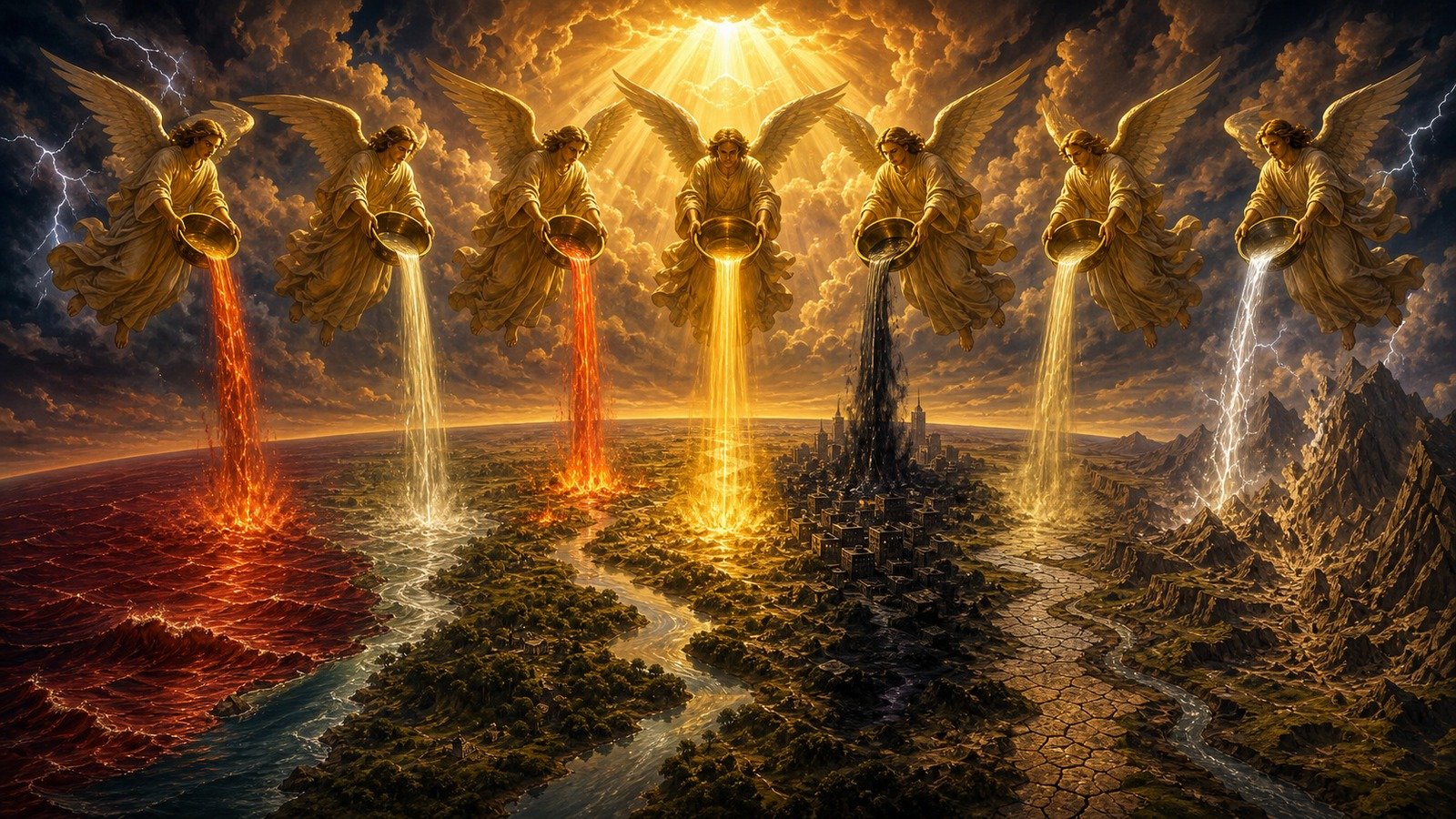
Seven angels pour out bowls of judgement in turn, bringing sores, seas and rivers turned to blood, scorching heat, darkness, the drying of the Euphrates, and finally a catastrophic earthquake, ending with the declaration "It is done."
Further context
3 min readA loud voice from the temple tells the seven angels to go and pour out the bowls on the earth, and they do it one after another with no interval between them.
The first brings ugly, festering sores on the people who have the mark of the beast. The second turns the sea to blood like that of a dead person, and every living thing in it dies. The third turns the rivers and springs to blood.
At that point the angel in charge of the waters says something that reads as a defence of what is happening: you are just in these judgements; for they have shed the blood of your holy people and your prophets, and you have given them blood to drink as they deserve.
The plagues of Egypt are the pattern throughout, and the sequence of sores, blood, darkness and hail follows them closely. What is different is the response, which is stated three times: they refused to repent and glorify him, they cursed the name of God, they cursed God and did not repent.
The fourth gives the sun power to scorch people with fire. The fifth is poured on the throne of the beast, and its kingdom is plunged into darkness, and people gnaw their tongues in agony.
The sixth dries up the great river Euphrates to prepare the way for the kings from the East. The Euphrates was the frontier with Parthia, and a dried-up river meant an invasion route opened. Three impure spirits like frogs come out of the mouths of the dragon, the beast and the false prophet, and go out to gather the kings of the whole world for battle at a place called in Hebrew Armageddon.
That name most probably means the mountain of Megiddo, a fortified town commanding the pass through the Carmel ridge on the road between Egypt and Mesopotamia. More battles have been fought on the plain below it than almost anywhere on earth, from Thutmose III in the fifteenth century BC to Allenby in 1918. There is no mountain there, which is one of the puzzles of the name.
The seventh is poured into the air, and a loud voice from the throne says: it is done.
Then lightning, thunder and the most severe earthquake that has ever occurred. The great city splits into three parts, the cities of the nations collapse, every island flees and the mountains cannot be found, and hailstones weighing about forty kilograms fall on people, who curse God because of the plague of hail.
The bowls repeat the trumpet judgements in the same order and without the limiting fraction. Where the trumpets struck a third of the sea, the bowls turn all of it; where a third of the sun was darkened, the sun now scorches. The same targets, and no restraint.
Between the sixth and seventh bowl a single sentence interrupts the sequence, spoken in the first person: look, I come like a thief! Blessed is the one who stays awake. It is the only place in these chapters where the voice of Jesus breaks into the narrative directly, and it is addressed to the reader rather than to anyone in the vision.
Megiddo's mound has been excavated down through more than twenty occupation layers, and a well-preserved gate, stables and a water tunnel are visible on the site.