

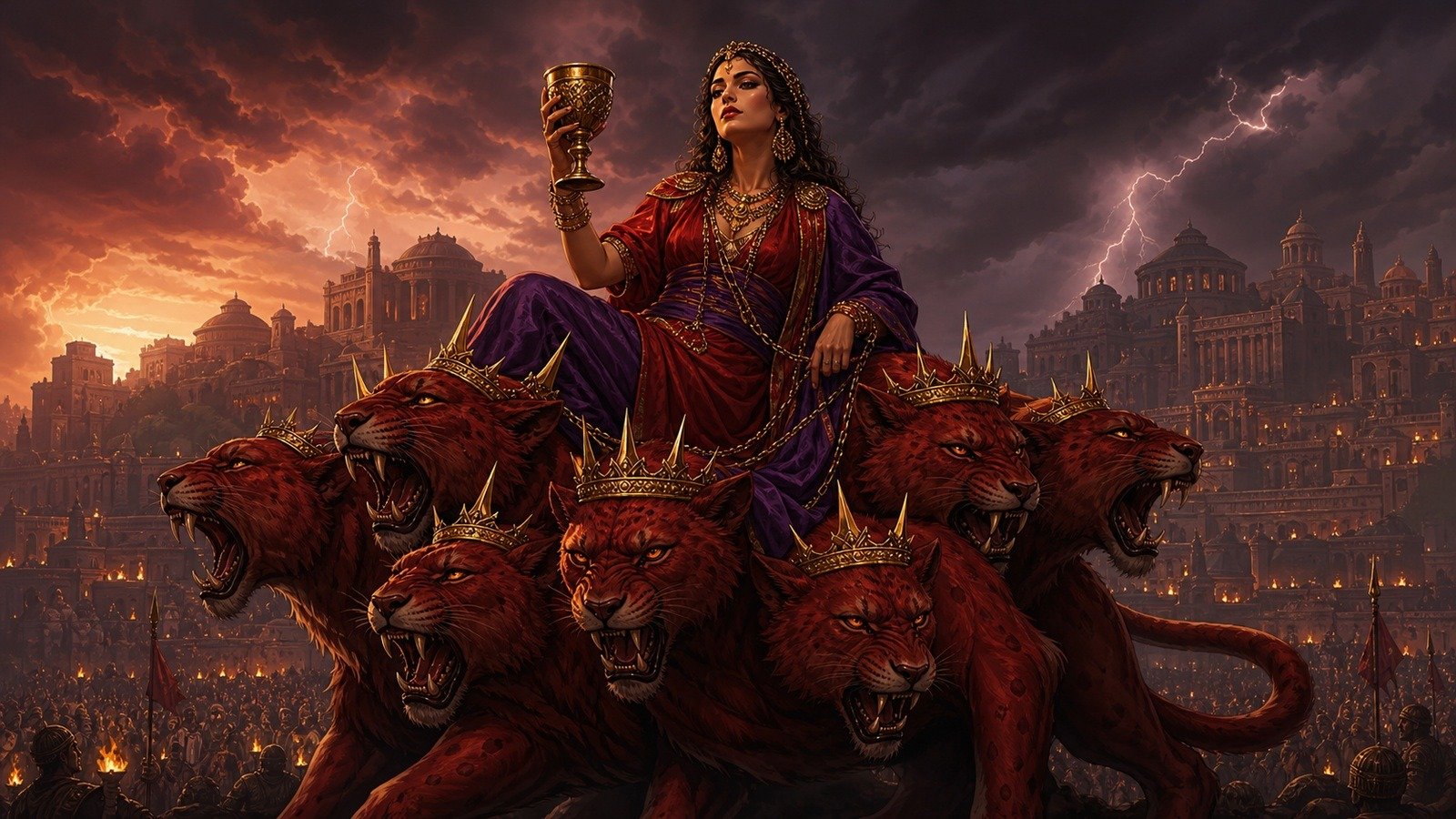
John is shown a woman named "Babylon the Great," dressed in extravagant wealth and riding the scarlet beast, identified as the corrupting power behind the nations, whom the beast and its allies will eventually turn on and destroy.
Further context
3 min readOne of the seven angels who had the bowls invites John to come and see the punishment of the great prostitute who sits by many waters.
He is carried in the Spirit into a wilderness and sees a woman sitting on a scarlet beast covered with blasphemous names, with seven heads and ten horns. She is dressed in purple and scarlet, glittering with gold, precious stones and pearls, holding a golden cup filled with abominable things, and on her forehead a name is written: mystery, Babylon the great, the mother of prostitutes and of the abominations of the earth.
Roman prostitutes are described in ancient sources as wearing a headband with their name on it, which is the detail behind the forehead.
The angel then does something unusual for this book: he explains the vision, and the explanation is unusually specific.
The seven heads are seven hills on which the woman sits. Rome was known throughout the ancient world as the city on seven hills, and coins of Vespasian show the goddess Roma seated on them.
They are also seven kings. Five have fallen, one is, and the other has not yet come; and when he does come, he must remain for only a little while. Every attempt to identify those seven with a list of emperors runs into trouble over where to start counting and whether to include the three who ruled briefly in the chaotic year after Nero, and no proposal has convinced anyone but its author.
The ten horns are ten kings who have not yet received a kingdom, who will give their power to the beast for one hour.
Then the woman herself: the woman you saw is the great city that rules over the kings of the earth. For a first-century reader that sentence had one referent.
The last turn is the strangest of all. The beast and the ten horns will hate the prostitute. They will bring her to ruin and leave her naked; they will eat her flesh and burn her with fire.
The system devours what it was carrying.
The invitation to see the punishment of the prostitute is issued by one of the angels holding the bowls, and the same angel takes John to see the bride at the end of the book. Two women, two cities, two guided tours by the same guide.
Sitting on many waters is drawn from Jeremiah's oracle against the historical Babylon, which sat on the Euphrates and its canals. Rome sat on the Tiber, and the explanation offered a few lines later reinterprets the waters as peoples, multitudes, nations and languages.
John says that when he saw the woman he was greatly astonished, and the angel asks him why, which is one of very few places where his own reaction is recorded and questioned.
Purple and scarlet were the two most expensive dyes in the empire, and the woman is described wearing both at once, which is the ancient equivalent of an unmistakable display of money.
The cup she holds is golden on the outside and full of abominable things, which is the same shape of image used against whitewashed tombs in an earlier confrontation.
Mystery written on her forehead has been read as part of the name and as a label attached to it, and translations differ. Either way the word means something disclosed rather than something withheld, which is how the book uses it throughout.