

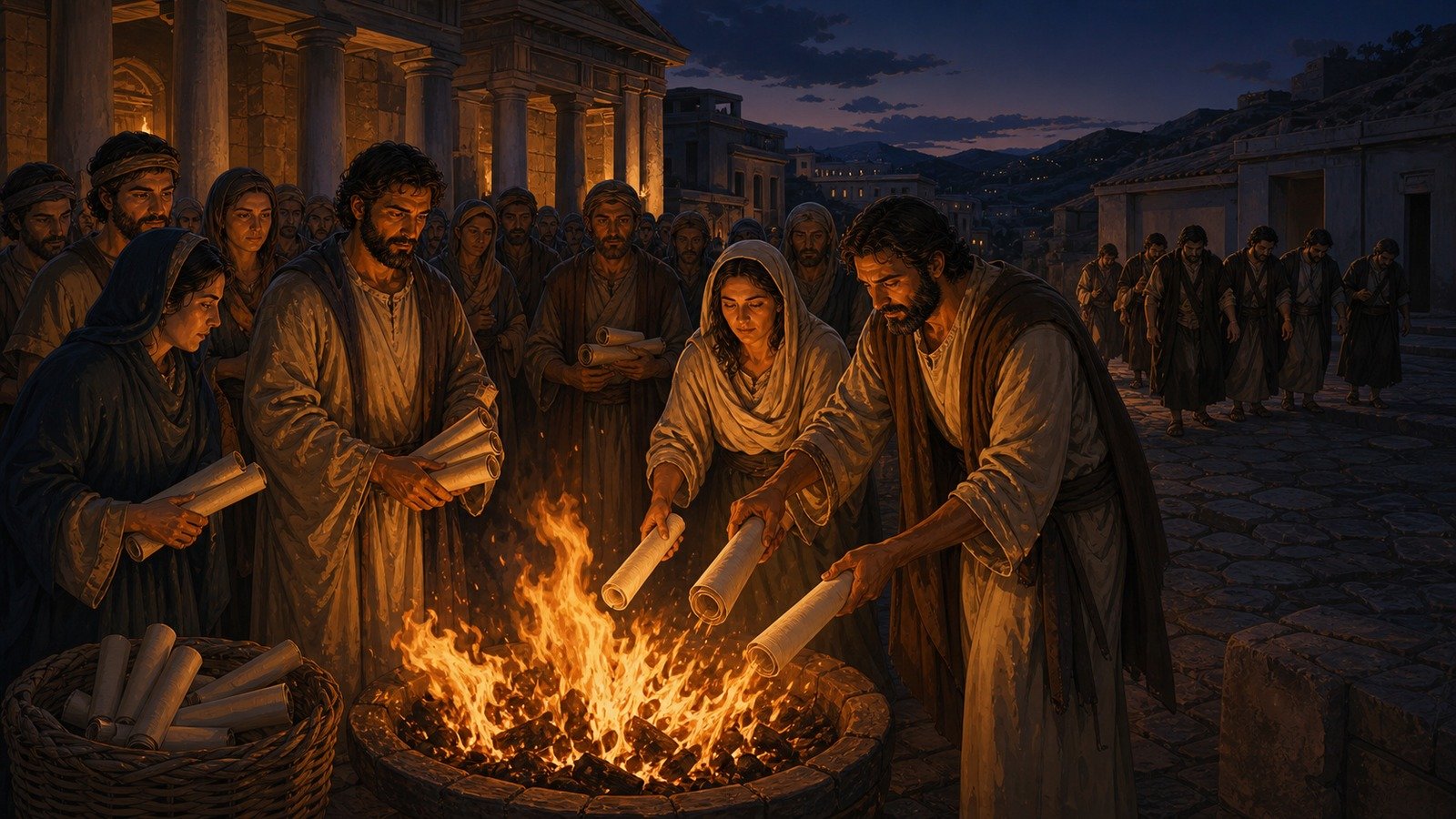
Itinerant Jewish exorcists attempt to invoke "the Jesus whom Paul preaches" over a demon-possessed man and are overpowered instead; the episode leads many practitioners of magic in Ephesus to burn their scrolls publicly, a collection Luke values at fifty thousand silver coins.
Further context
2 min readSome Jews who went around driving out evil spirits tried to invoke the name of the Lord Jesus over those who were demon-possessed. They would say, in the name of the Jesus whom Paul preaches, I command you to come out.
Jewish exorcists had a considerable reputation across the empire. Josephus describes one performing before Vespasian, and surviving magical papyri, written by pagans, invoke the God of Abraham, Isaac and Jacob among their formulas, because foreign and ancient names were held to carry power.
That is exactly what these men are doing. They have heard a name that works and they add it to the collection, with a careful attribution attached, the way a practitioner cites his source.
Seven sons of Sceva, a Jewish chief priest, were doing this. No high priest of that name is known from any list, and the title may be a professional claim rather than a fact, of the sort a travelling exorcist would find useful.
One day the evil spirit answered them: Jesus I know, and Paul I know about, but who are you?
Then the man who had the evil spirit jumped on them and overpowered them all. He gave them such a beating that they ran out of the house naked and bleeding.
The verb describing the beating means to master or subdue, and the seven of them come off worse than the one.
When this became known to the Jews and Greeks living in Ephesus, they were all seized with fear, and the name of the Lord Jesus was held in high honour.
Many of those who believed now came and openly confessed what they had done. A number who had practised sorcery brought their scrolls together and burned them publicly.
The scrolls are the point. Books of spells were expensive, they were the tools of a trade, and burning them destroyed both the capital and the possibility of going back.
When they calculated the value of the scrolls, the total came to fifty thousand drachmas. A drachma was roughly a day's wage for a labourer, so the figure represents something like a hundred and thirty years of daily earnings, going up in smoke in a city square.
In this way the word of the Lord spread widely and grew in power.
The demon's reply distinguishes between knowing and knowing about, using two different Greek verbs, and it draws a line the exorcists had not noticed: a name is not a technique.
Ephesus is also the city to which the letter warning about the powers of this dark world and instructing readers to put on the armour of God is addressed, if the traditional destination is right, and the vocabulary of that passage reads differently once the city's trade in charms is in view.
Public book-burning by owners of the books is an unusual event in any period, and the sum recorded suggests either a large number of people or a small number of very serious practitioners.
Fifty thousand drachmas is one of the few sums given in the New Testament that can be converted with any confidence, and the conversion is what makes the episode concrete rather than pious.