

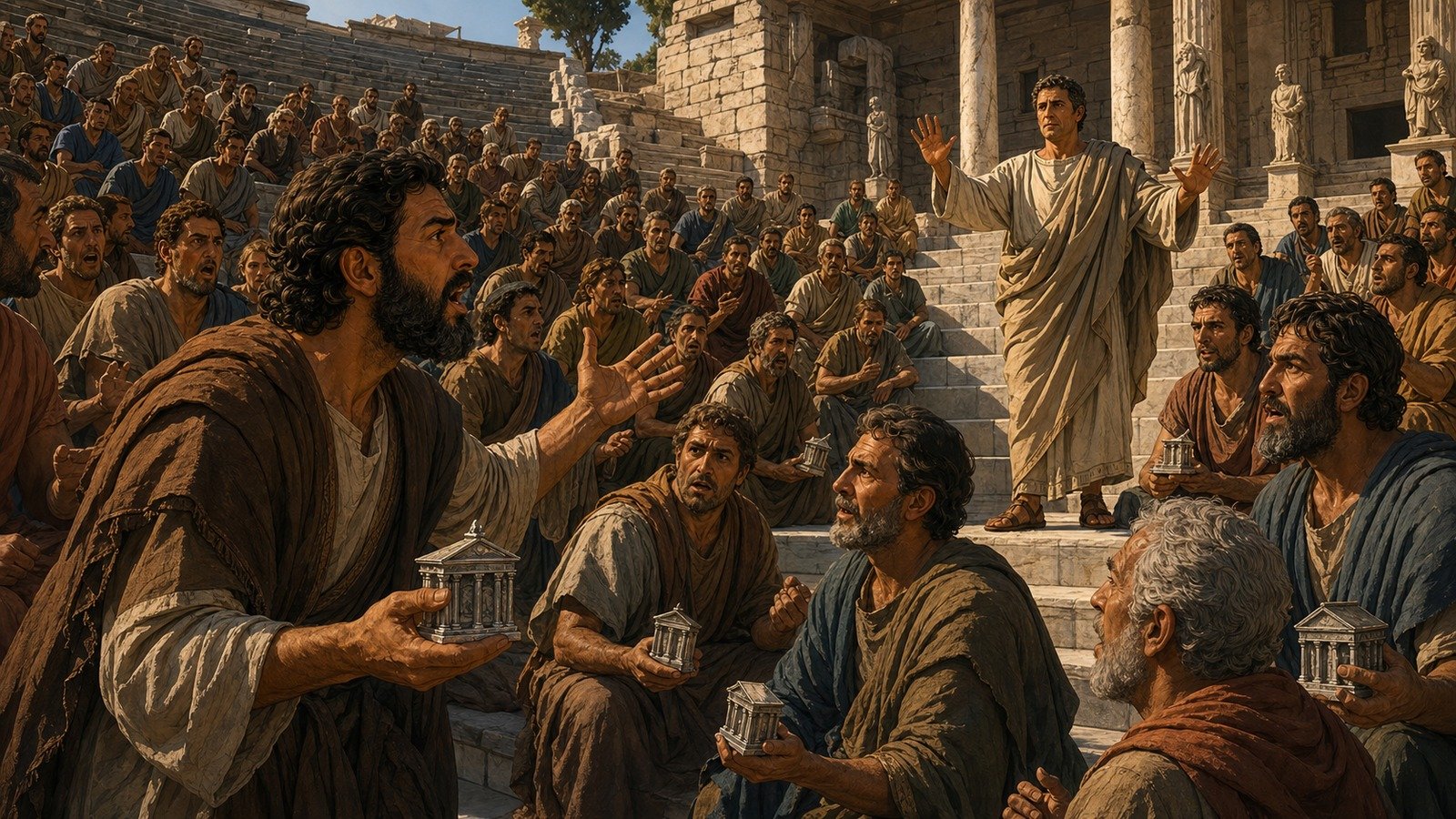
A silversmith named Demetrius, whose trade making shrines of the goddess Artemis is threatened by Paul's preaching, incites a riot that fills the city's theatre with a confused, shouting crowd for two hours before a city official manages to disperse them.
Further context
2 min readA silversmith named Demetrius, who made silver shrines of Artemis, brought in a lot of business for the craftsmen there.
Small shrines of the goddess, in silver and in terracotta, were sold to pilgrims as souvenirs and votive offerings, and terracotta examples have been excavated. An inscription from Ephesus mentions a silversmith donating an image to the temple, and the guild of silversmiths is attested.
He calls the workers together and makes a speech that is a model of its kind, because he states the economic case first and only then reaches for the religion.
You know, my friends, that we receive a good income from this business. And you see and hear how this fellow Paul has convinced and led astray large numbers of people here in Ephesus and in practically the whole province of Asia. He says that gods made by human hands are no gods at all.
Then the second argument: there is danger not only that our trade will lose its good name, but also that the temple of the great goddess Artemis will be discredited, and the goddess herself, who is worshipped throughout the province of Asia and the world, will be robbed of her divine majesty.
When they heard this, they were furious and began shouting: great is Artemis of the Ephesians!
Soon the whole city is in an uproar. The crowd seizes two of Paul's travelling companions, Gaius and Aristarchus from Macedonia, and rushes into the theatre.
Paul wants to appear before the crowd, and the disciples will not let him. Some of the officials of the province, friends of Paul, send him a message begging him not to venture into the theatre. The word used for these officials is Asiarchs, the leading men of the province responsible for the imperial cult and public games, and that Paul counted some of them as friends is a considerable detail thrown away in half a sentence.
The assembly is in confusion. Most of the people did not even know why they were there. They shout great is Artemis of the Ephesians for about two hours.
Eventually the city clerk quiets the crowd, points out that the courts are open and proconsuls are available, warns them that they are in danger of being charged with rioting, and dismisses the assembly.
The city clerk was the senior civic official at Ephesus and the link between the city and the Roman administration, and his anxiety is specific: a free city that could not control its assemblies risked losing its privileges. His speech is a piece of expert crowd management, flattering the goddess, pointing to the courts and naming the legal risk.
That the movement's most serious clash in Asia was with a trade association rather than with a synagogue is the exception in the whole account.
The theatre at Ephesus still stands, cut into the slope of Mount Pion and seating something like twenty-four thousand, and it is possible to stand in it and judge what two hours of shouting from a full house would have sounded like.