

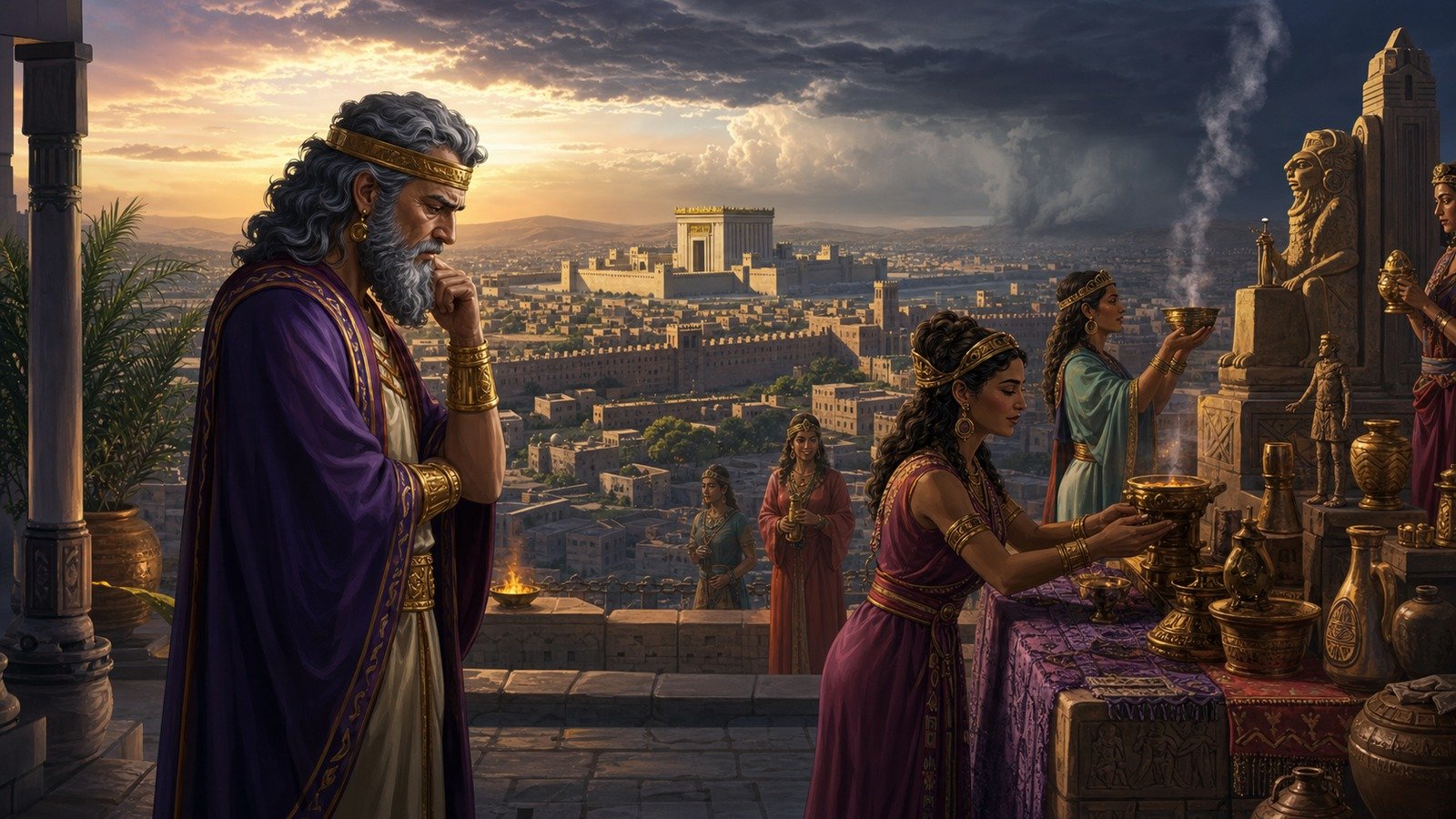
Solomon's many foreign marriages, made largely for political alliance, lead him into tolerating and even building shrines to his wives' gods; God announces the kingdom will be torn from his son, though not from Solomon himself for David's sake, and raises up adversaries against him.
Further context
3 min readSeven hundred wives of royal birth and three hundred concubines is the figure given, and the number is less important than what it represents. Marriage was the standard instrument of foreign policy in that world. Each of those marriages sealed a treaty, and the women came from Moab, Ammon, Edom, Sidon and the Hittite territories, along with a daughter of Pharaoh, which is the most prestigious of them and the one mentioned first.
Every one of those alliances brought a household, a retinue, and a god. The problem is not private morality but state religion: a foreign queen expected her own worship to continue, and a king who wanted the treaty had to provide for it. So high places are built on the hill east of Jerusalem for Chemosh of Moab and Molek of Ammon, and Ashtoreth of Sidon is followed, and the same is done for all his foreign wives.
The phrase used for what happened to him is worth having exactly: as Solomon grew old, his wives turned his heart after other gods, and his heart was not fully devoted to the LORD his God as the heart of David his father had been. Nobody claims he abandoned the temple he built. What is described is a divided allegiance, and the standard he is measured against is a man who committed adultery and arranged a murder, which indicates that wholehearted was never a synonym for blameless.
The instructions for a king given centuries earlier had named three specific dangers, and by this point he has done all three: multiplied horses and imported them from Egypt, accumulated great quantities of silver and gold, and taken many wives, with the reason attached to that last one being that they would turn his heart away.
Three adversaries are then raised up against him and each is a piece of unfinished business from his father's reign. Hadad the Edomite had escaped as a child when Joab spent six months killing every male in Edom, was raised in the Egyptian court and married into it. Rezon son of Eliada had fled from Hadadezer of Zobah and set up as a warlord in Damascus, which becomes the Aramean state that fights Israel for the next century and a half.
The third is internal. Jeroboam son of Nebat is an able young official put in charge of the forced labour of the house of Joseph, which means he administers the conscription of the northern tribes. The prophet Ahijah meets him on a road outside Jerusalem, tears his own new cloak into twelve pieces and tells him to take ten, because the kingdom is going to be torn out of Solomon's hand and ten tribes given to him, with one left for the sake of David and the city.
Solomon tries to kill him and he escapes to Egypt and waits.
The number of wives given, seven hundred of royal birth and three hundred concubines, is the kind of figure ancient historians used for magnificence rather than for a census, and it belongs with the horses and the gold.
What the marriages were is politics. A treaty between states was routinely sealed by a daughter, and a foreign princess arriving at Jerusalem came with a household, a retinue and her own gods, for whom accommodation had to be provided. The high places built for Chemosh and Molek stood on the hill east of Jerusalem for three centuries afterwards, until Josiah defiled them.
The law had warned specifically against a king acquiring many wives, many horses and great quantities of silver and gold. Solomon is recorded doing all three.