

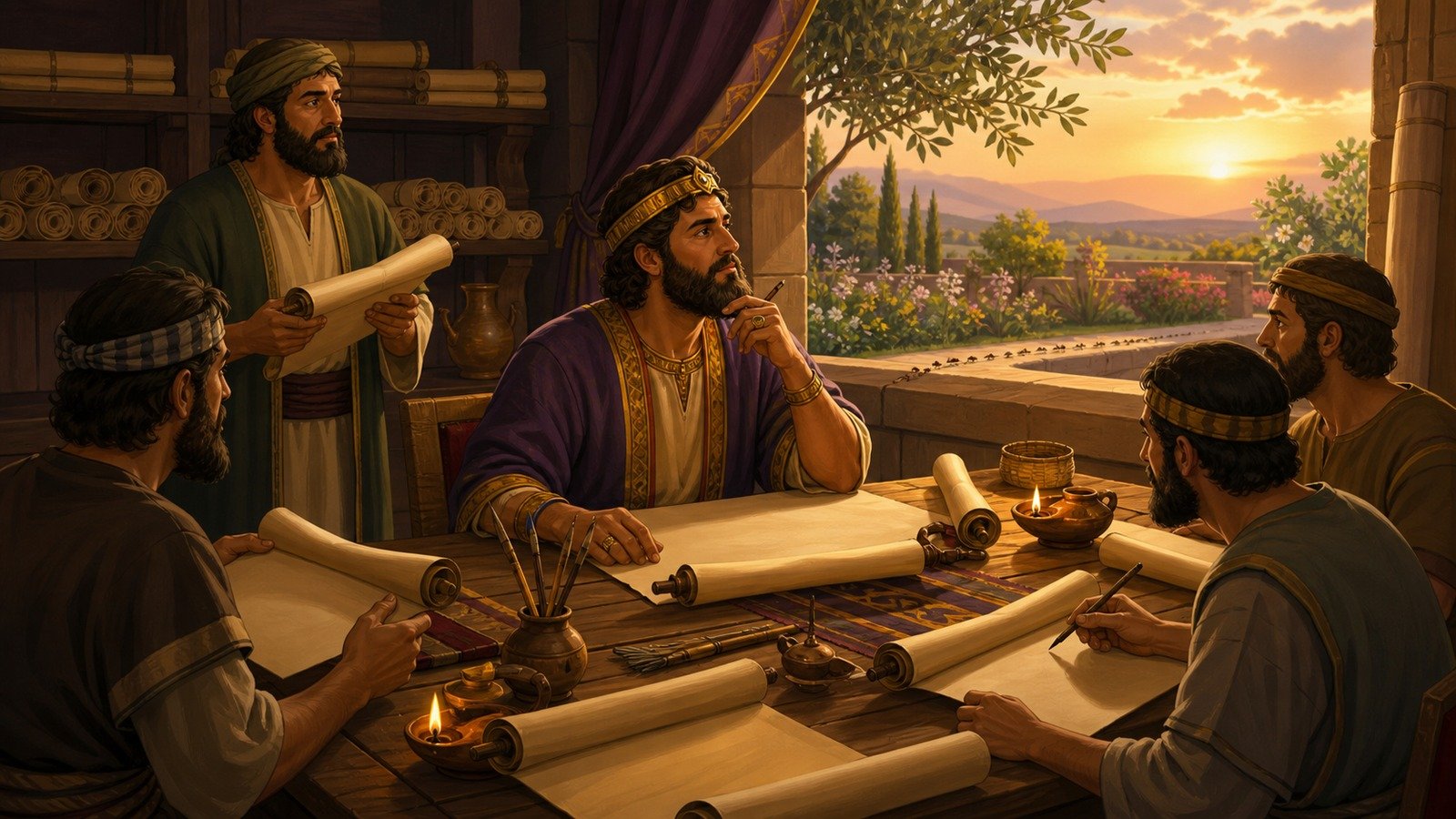
Solomon is credited with 3,000 proverbs and over a thousand songs; the books of Proverbs, Ecclesiastes and Song of Songs all carry Solomonic attribution, though scholars debate how much of Proverbs in particular reflects later editorial compilation under his name.
Further context
2 min readThree books are traditionally attributed to Solomon, and they are so unlike each other that reading them together is disorienting.
Proverbs is a manual for young men entering public life, and its claim is that the world is intelligible and that acting well generally works. Diligence produces prosperity, honesty produces trust, controlling the tongue prevents disaster. Its opening chapters are addressed by a father to a son and are largely warnings about two figures, the gang offering easy money and the woman at the door.
Its authorship is composite on its own evidence. Sections are headed as proverbs of Solomon, but two later collections are attributed to men called Agur and Lemuel, and one group is introduced as proverbs of Solomon copied by the officials of Hezekiah, a king who reigned two and a half centuries later. It also runs parallel at one point to an Egyptian wisdom text, the Instruction of Amenemope, closely enough that a relationship between them is generally accepted, though which direction it ran is argued.
Ecclesiastes contradicts most of that and does so deliberately. Its author calls himself the Teacher, son of David, king in Jerusalem, and reports having tried everything: building projects, gardens, reservoirs, slaves, herds, silver and gold, singers, and every pleasure he could think of. The verdict on all of it is a Hebrew word usually translated meaningless, which literally means vapour or breath, the same word behind Abel's name. The book observes that the wise and the fool meet the same end, that the race is not always to the swift, and that nobody knows what comes after. Its practical conclusion is modest: eat your food, enjoy your work, be content with what your hands are given. Its final section is the only place it sounds conventional, and many scholars regard those closing lines as a later editorial frame.
Song of Songs is love poetry between two people, frank about the body and containing no mention of God, law, covenant or Israel. It has been read allegorically, as God and Israel or Christ and the Church, for most of its history, and read as what it appears to be, which is a celebration of desire within marriage, for a good deal of the modern period. Both readings have long pedigrees.
What the three have in common, and it is the reason they sit together, is that none of them argues from Israel's history. There is no Exodus in them, no covenant, no law, no promised land and almost no mention of the temple. They deal with the world as anybody living in it encounters it: work, money, speech, sex, death and the question of whether any of it adds up. That is why they travel outside their own tradition more easily than anything else in the Hebrew scriptures.
How much of any of it Solomon wrote is disputed. The tradition rests on the summary that credits him with three thousand proverbs and a thousand and five songs, and on the headings the books carry, and the Hebrew phrasing of those headings is the same ambiguous construction used across the Psalms.