

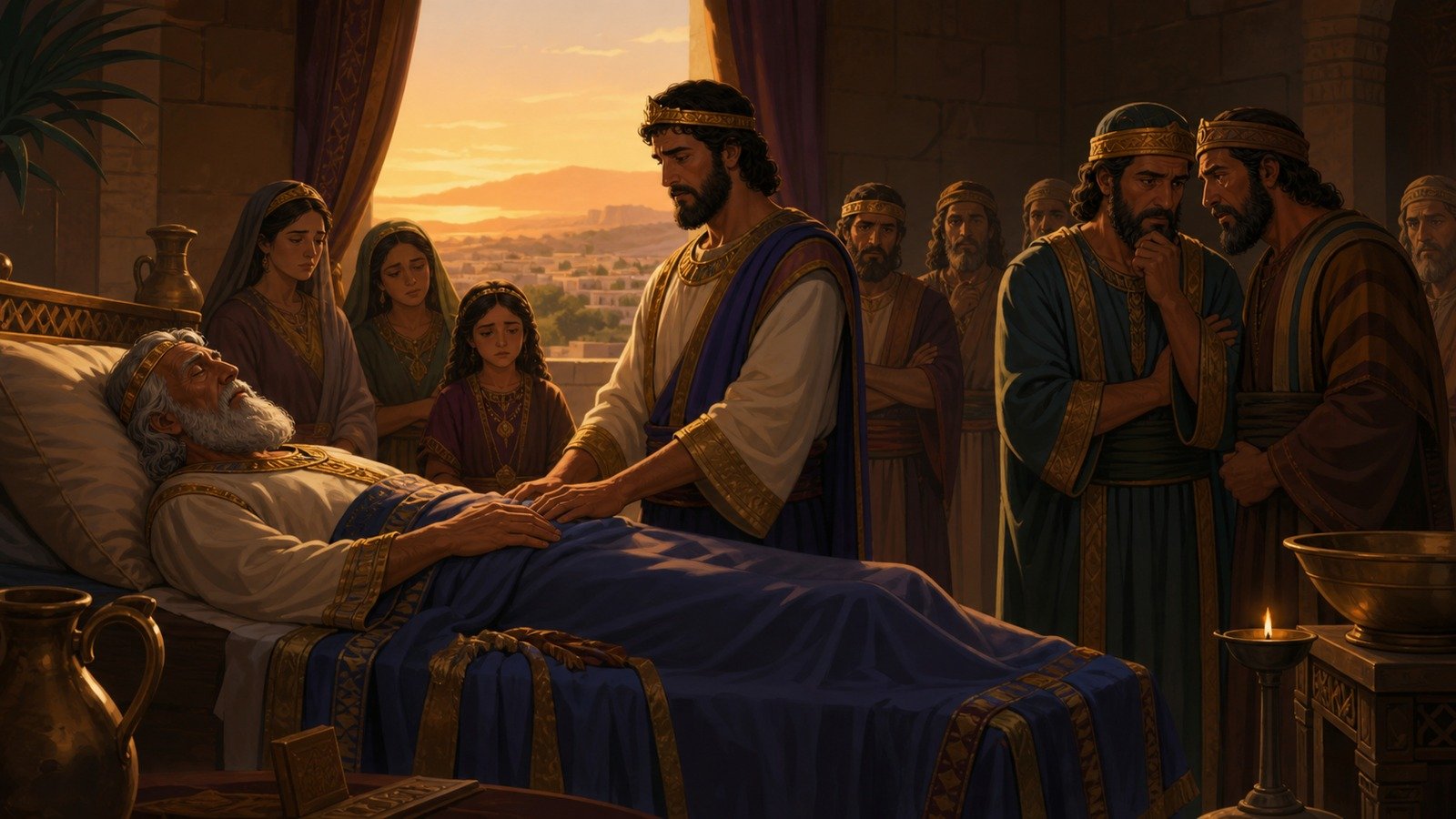
Solomon dies after 40 years on the throne, and his son Rehoboam succeeds him, inheriting a kingdom whose internal tensions are about to surface immediately.
Further context
3 min readForty years in Jerusalem over all Israel, and then he rests with his ancestors and is buried in the City of David, and his son Rehoboam succeeds him.
The date, around 931 or 930 BC, is one of the firmest fixed points in the whole of Old Testament chronology, and the reason is worth explaining because very little else in this period can be dated so closely.
Five years into Rehoboam's reign, Pharaoh Shishak attacks Jerusalem and takes the treasures of the temple and the palace, including the gold shields Solomon had made, which Rehoboam replaces with bronze ones. That pharaoh is generally identified with Shoshenq I, the founder of the Twenty-second Dynasty, whose campaign into the Levant is recorded on a relief on the exterior wall of the temple of Amun at Karnak, listing well over a hundred captured towns. Egyptian chronology places that campaign in the mid-920s BC. Counting back five years gives the division of the kingdom, and therefore the end of Solomon's reign, at 931 or 930.
Every other date in the divided monarchy hangs off that anchor and off a handful of later synchronisms with Assyrian records, which is why the reigns from here on can be given in actual years while everything before David is approximate at best.
The assessment of his reign is left implicit in the arrangement of the material. The first half is the wisdom, the temple, the international reputation and the peace. The second half is the foreign wives, the high places on the hill opposite the city, three enemies raised up and a prophet handing ten pieces of a torn cloak to a labour foreman. Both halves are the same man and the same forty years.
What he leaves his son is a functioning state with a serious structural problem. The administration runs on forced labour and a supply system that falls on the northern tribes, the army is chariot-based and expensive, and the building programme has been enormous. He has also, at some point, ceded twenty towns in Galilee to the king of Tyre in settlement of a debt, and Hiram was not impressed with them.
One further consequence of his reign is worth registering. The wisdom tradition attached to his name outlives the kingdom by centuries, and centuries after that, when a teacher in Galilee wants an image of maximum earthly splendour, he reaches for this king and says a wildflower is better dressed.
A note at the end mentions the sources the writers were using: the book of the annals of Solomon. Several such collections are cited throughout the histories of the kings, and none of them survives.
Forty years is the reign length given for David and for Solomon and for Saul, and it is the standard round figure for a full generation in these books, which makes it a useful number rather than a precise one.
What he left behind was a state with a professional army, a fleet operating out of the Gulf of Aqaba, fortified cities at Hazor, Megiddo and Gezer, and a tax system that had made the whole thing possible. Excavations at all three of those sites have uncovered monumental gates of very similar design, and whether they date to Solomon's reign or to the following century is one of the sharper archaeological disputes of the region.
Within weeks of the funeral the kingdom split, and it never reunited.