

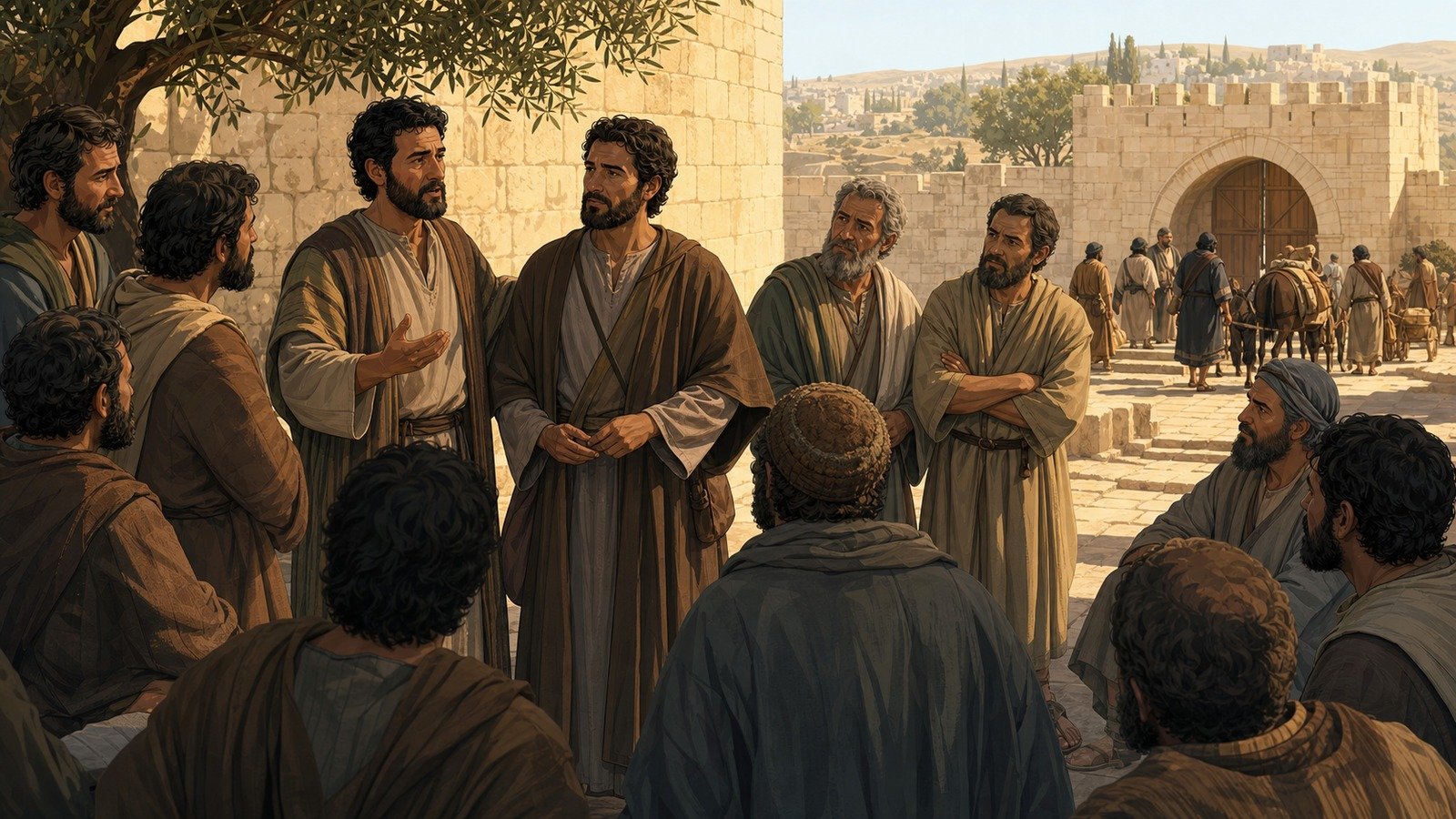
Distrusted by the Jerusalem believers who remember his persecution, Saul is introduced to the apostles by Barnabas; after a further threat on his life he is sent home to Tarsus, beginning a quiet period of several years before his missionary career proper begins.
Further context
2 min readWhen Saul comes to Jerusalem he tries to join the disciples, and they are all afraid of him, not believing that he really is a disciple.
That reaction needs no defending. The last time most of them had seen him he was dragging people out of houses, and the obvious reading of a persecutor turning up asking to be admitted to the meetings is that he is collecting names.
Barnabas took him and brought him to the apostles.
Everything downstream depends on that sentence. A Levite from Cyprus, whose nickname meant son of encouragement, decided the man was telling the truth and put his own standing behind him. He told them how Saul on his journey had seen the Lord and that the Lord had spoken to him, and how in Damascus he had preached fearlessly in the name of Jesus.
Paul's own summary of the visit is narrower. He says he went up to get acquainted with Cephas and stayed with him fifteen days, and saw none of the other apostles except James, the Lord's brother.
Fifteen days with Peter is worth pausing over. Whatever the two of them talked about, the man who had been there from the beginning and the man who had persecuted the results were in the same house for a fortnight, and a good deal of what Paul later says he received and passed on presumably comes from that.
In Jerusalem he moves about freely, speaking boldly in the name of the Lord, and talks and debates with the Hellenistic Jews, who try to kill him. That is the same Greek-speaking community Stephen had argued with, and Saul had been on their side of the argument.
When the believers learn of the plot they take him down to Caesarea and send him off to Tarsus.
Tarsus was his home city, a substantial place in Cilicia with a reputation for learning, and he disappears there for something like a decade. Nothing is recorded of those years except that he was eventually fetched.
Then the church throughout Judea, Galilee and Samaria enjoyed a time of peace and was strengthened.
The decade at Tarsus is the longest gap in Paul's recorded life, and there are hints of what filled it. He mentions preaching in Syria and Cilicia during those years, and the list of hardships he gives elsewhere contains far more beatings, imprisonments and shipwrecks than the journeys can account for, so a good deal of what he suffered belongs to a period nobody wrote down.
He was also, on any reckoning, in his thirties and unknown to almost everybody. Barnabas fetched him from that.
That Paul lists precisely whom he met and for how long, in a letter, is because his independence was under attack. Opponents were arguing that his authority was second-hand and came from Jerusalem, and his answer is that he had barely been there.
Caesarea appears here as the port they use to get him out, and it appears again at the end of his working life as the place he is held for two years. Both times he arrives there under escort of a kind.