

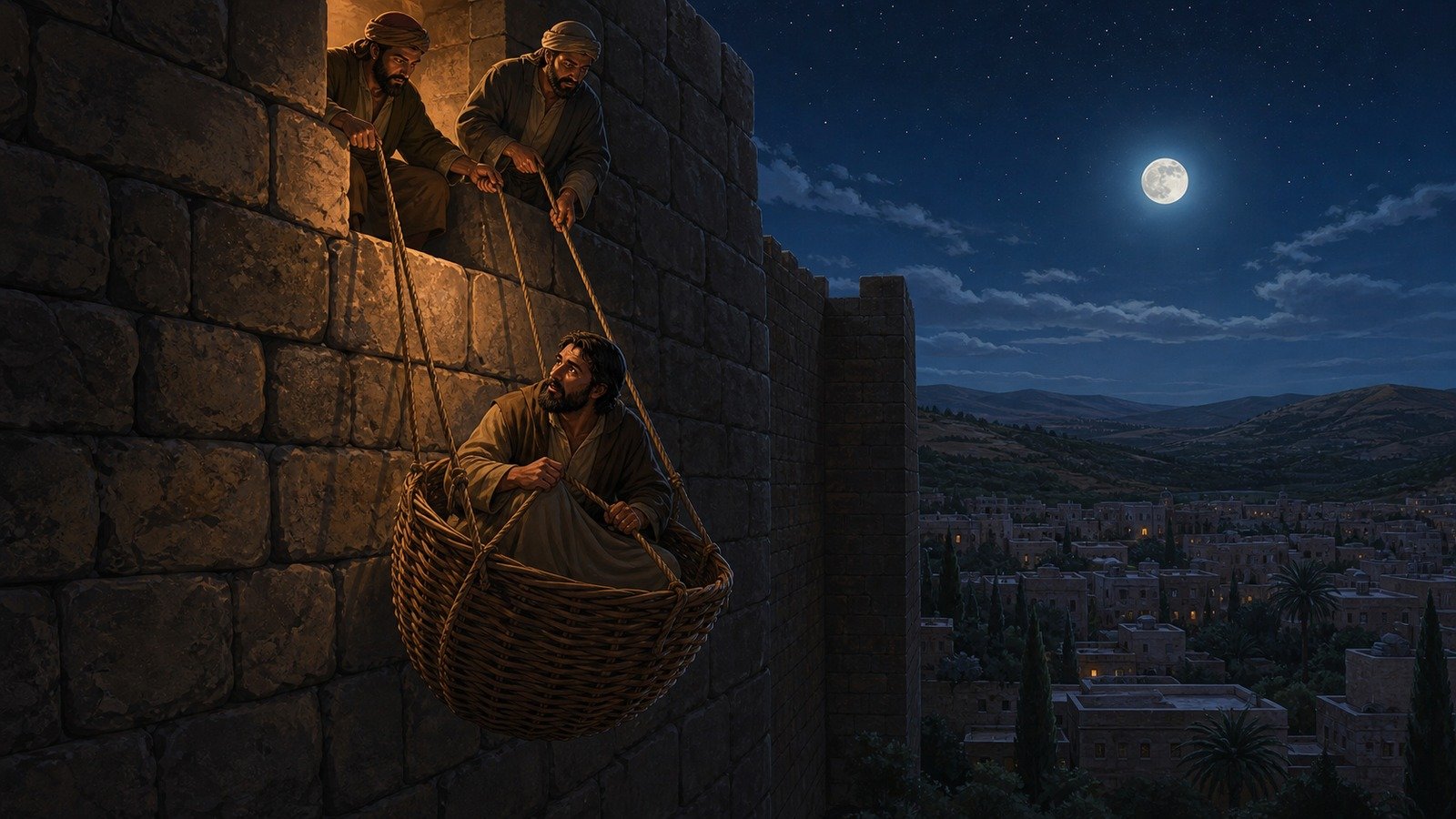
Saul begins immediately preaching in the Damascus synagogues that Jesus is the Son of God, baffling those who knew him as a persecutor; when a plot forms to kill him, believers lower him over the city wall in a basket by night.
Further context
2 min readAt once Saul begins to preach in the Damascus synagogues that Jesus is the Son of God, and the reaction is bewilderment. All those who heard him were astonished and asked, is not he the man who raised havoc in Jerusalem among those who call on this name? And has not he come here to take them as prisoners to the chief priests?
The word rendered astonished describes being knocked out of one's senses, and it is the reasonable response of a congregation whose visiting inquisitor has changed sides inside a week.
Two chronologies have to be fitted together here, and they do not quite match on the surface.
Luke compresses this period into a few sentences. Paul himself, writing to the Galatians, says that after his call he did not consult any human being, nor did he go up to Jerusalem to those who were apostles before him, but went into Arabia and later returned to Damascus, and that three years passed before he went to Jerusalem.
Arabia means the Nabatean kingdom to the south and east, whose capital was Petra. What he did there is unknown, and both preaching and a period of reflection have been proposed with equal confidence and equal evidence.
The escape from the city is described twice and the two descriptions differ in an instructive way. One says the Jews there conspired to kill him and watched the city gates day and night. Paul's own version says the governor under King Aretas had the city guarded in order to arrest him.
Aretas IV was the Nabatean king whose daughter Antipas had discarded in favour of Herodias. Whatever Paul had been doing in Arabia had evidently made him worth arresting.
Both accounts agree on the method. His followers took him by night and lowered him in a basket through an opening in the wall.
Houses built into city walls with windows overlooking the outside are attested archaeologically, and the same manoeuvre appears in the story of Rahab at Jericho.
Paul mentions the basket himself, at the end of a passage listing the things he might boast about if he were inclined to boast. Having gone through beatings, shipwrecks and stonings, the item he chooses to end on is being let down a wall in a laundry basket.
Damascus is one of the oldest continuously inhabited cities on earth and it was already ancient then, a caravan centre at the edge of the desert with a substantial Jewish population. Straight Street, which Ananias was told to look for, is the Roman colonnaded thoroughfare running east to west through the old city, and it is still there.
Nothing in the record says what Ananias did afterwards, and later tradition made him the first bishop of the city and a martyr.
Nabatean control of Damascus at this period is disputed among historians, since the city was in the Roman province of Syria and no Nabatean coinage from it survives. The likeliest reading is that Aretas had an ethnarch representing his subjects' interests in the city rather than governing it.