

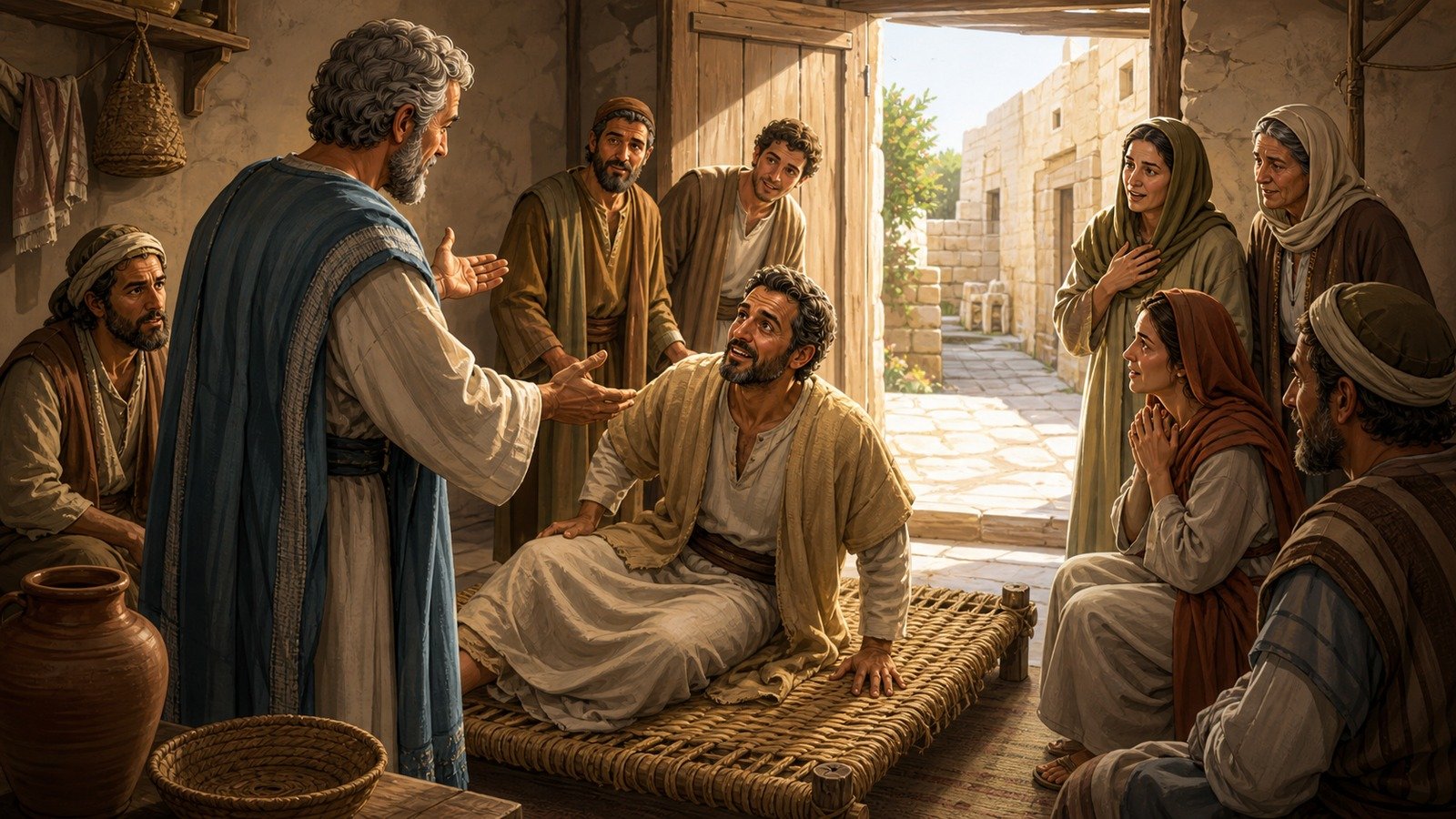
Travelling among the scattered believers, Peter heals a paralysed man named Aeneas at Lydda; the healing leads, Luke says, to many in the surrounding region turning to the Lord.
Further context
2 min readPeter travels about the country and visits the Lord's people who live in Lydda, and the sentence describing that journey is easy to read past. The apostles had stayed in Jerusalem when everyone else was scattered; now the leading one is on the coastal plain, checking on communities he did not found.
Lydda, called Lod in Hebrew and still bearing that name, sits about forty kilometres north-west of Jerusalem on the plain of Sharon, at the junction of the road from Egypt and the road up to Jerusalem. It was a market town of some size with a substantial Jewish population, and it became an important centre of rabbinic learning after the destruction of the temple.
There Peter finds a man named Aeneas, bedridden for eight years and paralysed.
The name is Greek and it is the name of the hero of Virgil's epic, which suggests either a Hellenised Jew or a Gentile, and nothing is said about which. Nothing is said about his faith either, before or after.
Aeneas, Peter said to him, Jesus Christ heals you. Get up and roll up your mat.
Two features of that sentence are worth noticing. The healing is attributed explicitly to someone else, which is the pattern in every one of these episodes and is stated even more plainly a little later, when Peter tells Cornelius he is only a man. And the instruction to roll up his mat is the same one given to a paralysed man in Capernaum years earlier, which for anyone who had been there would have been a deliberate echo.
Immediately Aeneas got up.
All those who lived in Lydda and Sharon saw him and turned to the Lord. Sharon is the coastal plain running north towards Caesarea, so what is being described is not one town but a district, and the mechanism is stated plainly: they saw him.
These short episodes on the coast are usually read as filler between the conversion of Saul and the opening of the mission to the Gentiles, and they are doing something more specific than that. They move Peter, step by step, from Jerusalem to Lydda to Joppa on the coast, and Joppa is where the messengers from a Roman officer in Caesarea find him.
Peter is described travelling about the country visiting the Lord's people, which is a supervisory role rather than a pioneering one, and it is the only glimpse of what the Jerusalem apostles did after the dispersal.
Sharon's fertility was proverbial in the prophets, and the plain supported towns and orchards between the hills and the sea. A district turning to the Lord because of one man walking is the summary the writer chose, and he gives no numbers.
Lydda was burned by Roman troops during the revolt about twenty-five years later, and it appears in the rabbinic sources afterwards as a centre where the law was studied and where several of the great teachers of the second century worked.
The formula Peter uses, Jesus Christ heals you, keeps the healing in the present tense and attributes it to someone who was not in the room, which is the consistent pattern in every one of these episodes.