

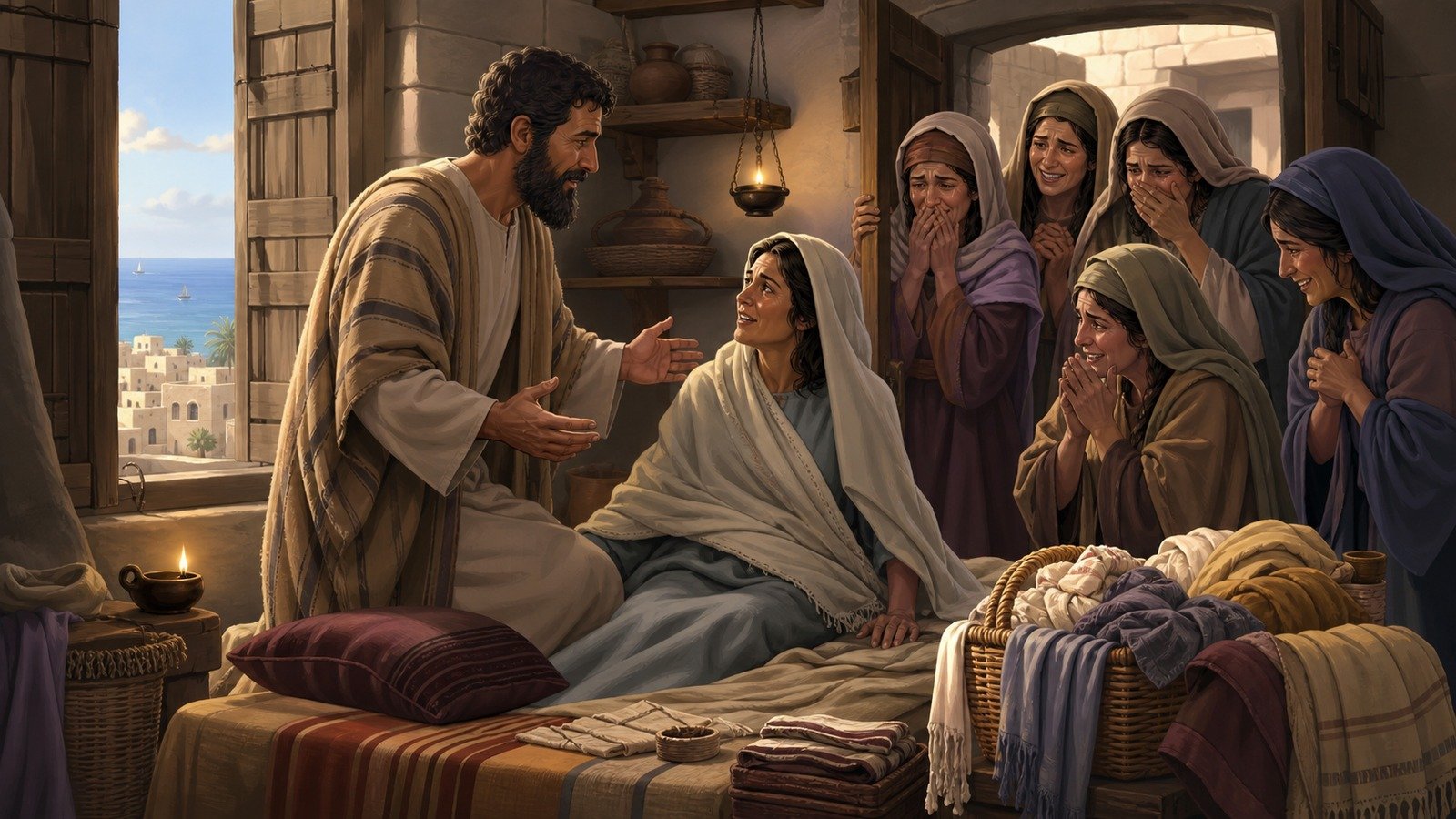
At Joppa, Peter is called to the body of Tabitha, a disciple known for her charity, and raises her back to life, a miracle Luke says becomes known throughout the town.
Further context
2 min readIn Joppa there was a disciple named Tabitha, which in Greek is Dorcas, and both words mean gazelle.
She is described in a way nobody else in the record of the early church is described: she was always doing good and helping the poor. The Greek word applied to her is the feminine form of disciple, and it appears nowhere else in the New Testament.
She becomes ill and dies, and her body is washed and placed in an upstairs room. Joppa is about eighteen kilometres from Lydda, so the disciples there send two men to Peter urging him to come at once.
When he arrives he is taken upstairs, and what he finds is a room full of widows standing around crying and showing him the robes and other clothing that Dorcas had made while she was still with them.
That is the most eloquent detail in the episode. The evidence of what she was is being held up in the hands of the women who would have had nothing without her, and the word used for showing describes displaying something one is wearing.
Peter sends them all out of the room, kneels down and prays, then turns towards the dead woman and says, Tabitha, get up.
The Aramaic behind that would be Tabitha koum, and a very similar sentence had been spoken in a room in Capernaum with the crowd sent outside, over a girl who was also dead: talitha koum. One word different. Peter had been in that room.
She opens her eyes, sees Peter and sits up. He takes her by the hand and helps her to her feet, then calls the believers and the widows and presents her to them alive.
This became known all over Joppa, and many people believed in the Lord.
Then a sentence that exists only to set up what happens next: Peter stayed in Joppa for some time with a tanner named Simon.
Tanning involved handling the skins of dead animals and made a man perpetually unclean under the law, and the trade stank badly enough that tanneries were required to be sited outside towns. A leading Jewish believer lodging with a tanner is already living at the edge of the purity system, which is where the vision on the roof finds him.
Joppa is the modern Jaffa, the natural harbour south of Tel Aviv, and it is the port Jonah sailed from when he went in the opposite direction to the one he had been given. That a Jewish believer is about to be sent from the same town to a Gentile city, with considerable reluctance, is a coincidence the writer may or may not have intended.
Tabitha is one of very few individuals raised from the dead in the New Testament, and the only woman among them apart from the girl at Capernaum. What she is remembered for is not the miracle but the clothing.
Widows appear repeatedly as a group with a claim on the early church, from the dispute over the daily distribution in Jerusalem to detailed instructions in a later letter about which of them should be supported. Tabitha had been doing that work herself, with a needle.