

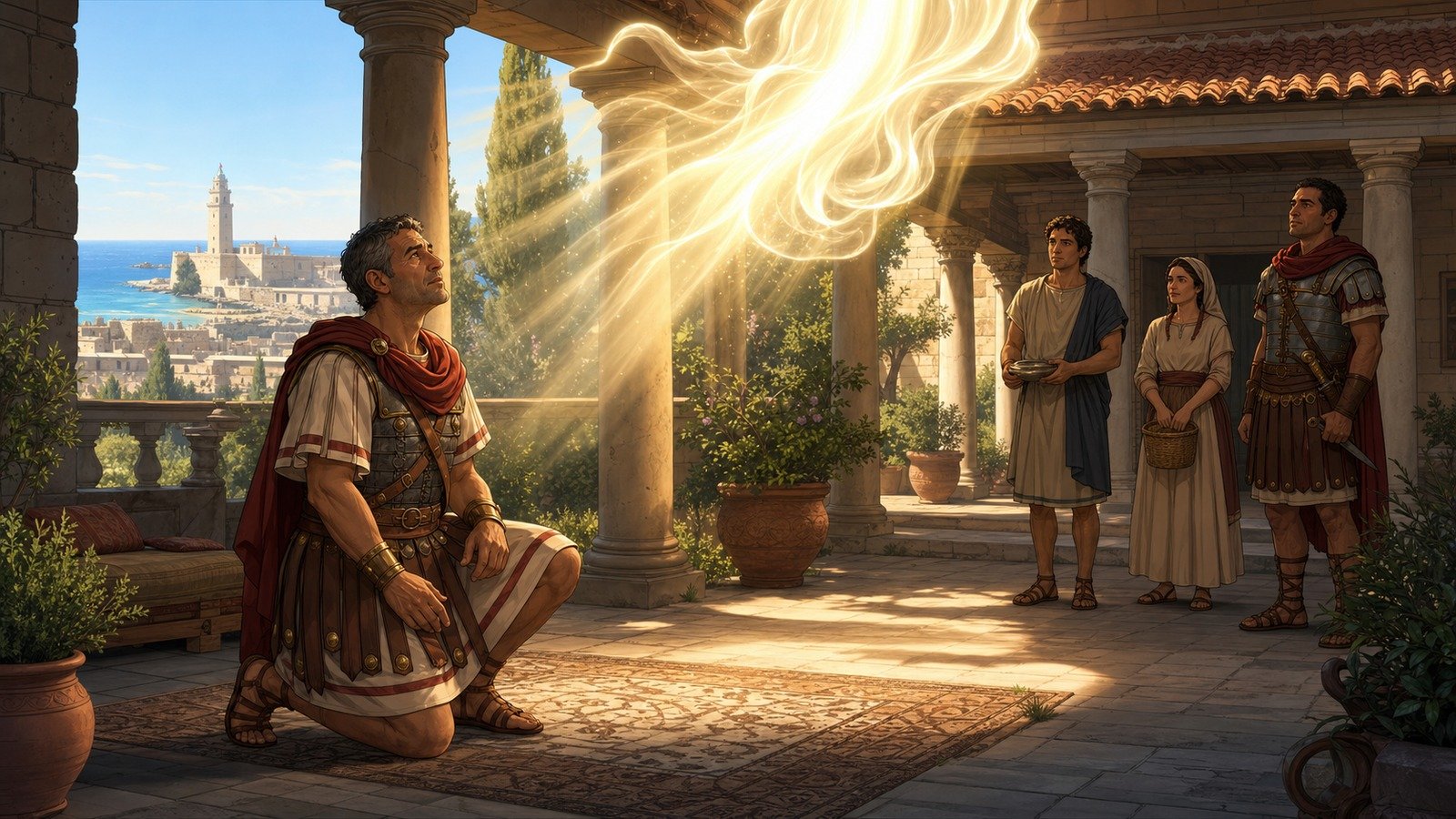
A Roman centurion at Caesarea named Cornelius, described as devout and generous though not a convert to Judaism, is told in a vision to send for Peter, setting up one of the New Testament's turning points for Gentile inclusion.
Further context
2 min readAt Caesarea there is a centurion named Cornelius, of what was known as the Italian Regiment.
Caesarea Maritima was Herod the Great's port city, built from nothing over twelve years with an artificial harbour of hydraulic concrete, a theatre, an aqueduct and a temple to Augustus. It was the seat of the Roman administration of Judea, and the prefect lived there rather than in Jerusalem. The inscription bearing Pilate's name was found in its theatre.
A centurion commanded roughly eighty men and was the backbone of the Roman army, promoted from the ranks, long-serving and comparatively well paid. Every centurion who appears in the New Testament is described favourably, which is itself worth noticing in literature produced under occupation.
Cornelius is described as devout and God-fearing, giving generously to those in need and praying to God regularly. That combination of terms describes a recognised category: a Gentile who attached himself to the synagogue, accepted the God of Israel and kept much of the moral law, without becoming a proselyte through circumcision. Inscriptions from synagogues around the empire list such people as donors, and there were many of them.
He was therefore as close to Israel as a man could get without crossing the line, and he was still on the wrong side of it. Jews did not enter Gentile houses or eat at Gentile tables.
At about three in the afternoon, the hour of prayer, he has a vision. An angel comes to him and says, Cornelius. He stares at him in fear and asks what it is.
Your prayers and gifts to the poor have come up as a memorial offering before God. Now send men to Joppa to bring back a man named Simon who is called Peter. He is staying with Simon the tanner, whose house is by the sea.
The vocabulary is priestly. A memorial offering was the portion of a grain offering burned on the altar so that its smoke went up, and it is being applied to a Roman officer's charity and prayers.
He calls two servants and a devout soldier who was one of his attendants, tells them everything, and sends them to Joppa, about fifty kilometres down the coast.
Nothing is explained to him about why. He is given an address and the name of a tanner.
The Italian Regiment, or cohort, is attested in an inscription from Syria, and auxiliary units of that name were raised in Italy and posted to the eastern provinces.
Roman religion had no difficulty with a soldier honouring a local god; what was unusual about Cornelius is the seriousness of it, described in terms normally used of a devout Jew. The prayers at the ninth hour are the Jewish hours of prayer, kept by a man who could not enter the temple.
Caesarea remained the administrative capital until the Muslim conquest, and its harbour, built with concrete that set underwater, was one of the engineering achievements of the age. Much of it now lies submerged and has been surveyed by divers.