

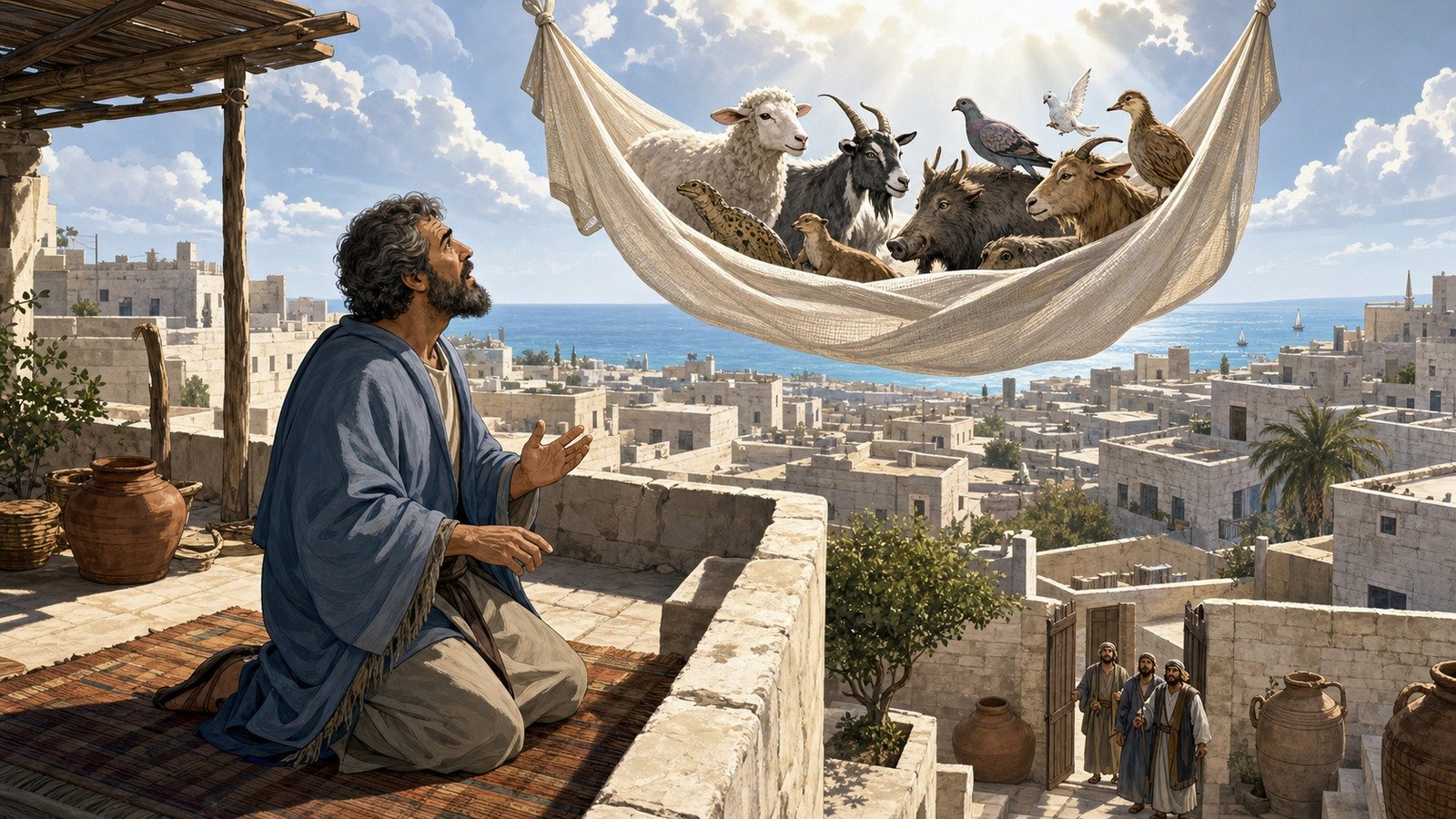
While Cornelius' messengers are travelling, Peter sees a vision of a sheet lowered from heaven filled with animals he considers unclean and is told, "do not call anything impure that God has made clean"; he understands only afterward that the vision concerns people, not food.
Further context
2 min readAbout noon the following day, as the messengers approach the town, Peter goes up on the roof to pray.
Flat roofs reached by an outside stair were the ordinary architecture, and they were used for sleeping, drying produce and being alone. This one belonged to a tanner and stood by the sea.
He becomes hungry and wants something to eat, and while the meal is being prepared he falls into a trance.
He sees heaven opened and something like a large sheet being let down to earth by its four corners. It contains all kinds of four-footed animals, as well as reptiles and birds.
Then a voice: get up, Peter. Kill and eat.
Surely not, Lord! I have never eaten anything impure or unclean.
That answer is the answer of a lifetime. The food laws were among the most visible markers of Jewish identity, they had been enforced at the cost of lives under Antiochus IV, and a man raised in Galilee had never in his life put certain things in his mouth.
The voice speaks a second time. Do not call anything impure that God has made clean.
This happens three times, and then the sheet is taken back to heaven.
While Peter is wondering about the meaning of it, the men sent by Cornelius arrive at the gate and call out, asking whether Simon who is called Peter is staying there.
The timing is the interpretation. He is puzzling over a vision about clean and unclean when three Gentiles knock on the door, and the Spirit tells him to go with them without hesitation.
He invites them in as his guests, which for a Jewish host was already a step, and the next day sets out with them for Caesarea.
When he arrives, Cornelius falls at his feet in reverence and is pulled up: stand up, I am only a man myself.
Then Peter states what he has worked out, and states the difficulty at the same time. You are well aware that it is against our law for a Jew to associate with or visit a Gentile. But God has shown me that I should not call anyone impure or unclean.
The vision was about animals. He applies it to people.
The three repetitions matter. Peter had denied three times, had been asked three times whether he loved him, and now refuses three times before the point lands. The writer keeps the pattern without commenting on it.
Nothing in the vision mentions people. It concerns animals, a food law and a voice, and the whole of the following twenty years of argument about Gentile inclusion rests on Peter's decision to extend it, which he does in the presence of six witnesses and later has to justify in Jerusalem.
Roof prayers at noon are worth noting for their own sake, since the fixed Jewish hours were morning, mid-afternoon and evening. A man praying at midday on a tanner's roof by the sea is a man with time on his hands and something on his mind.