

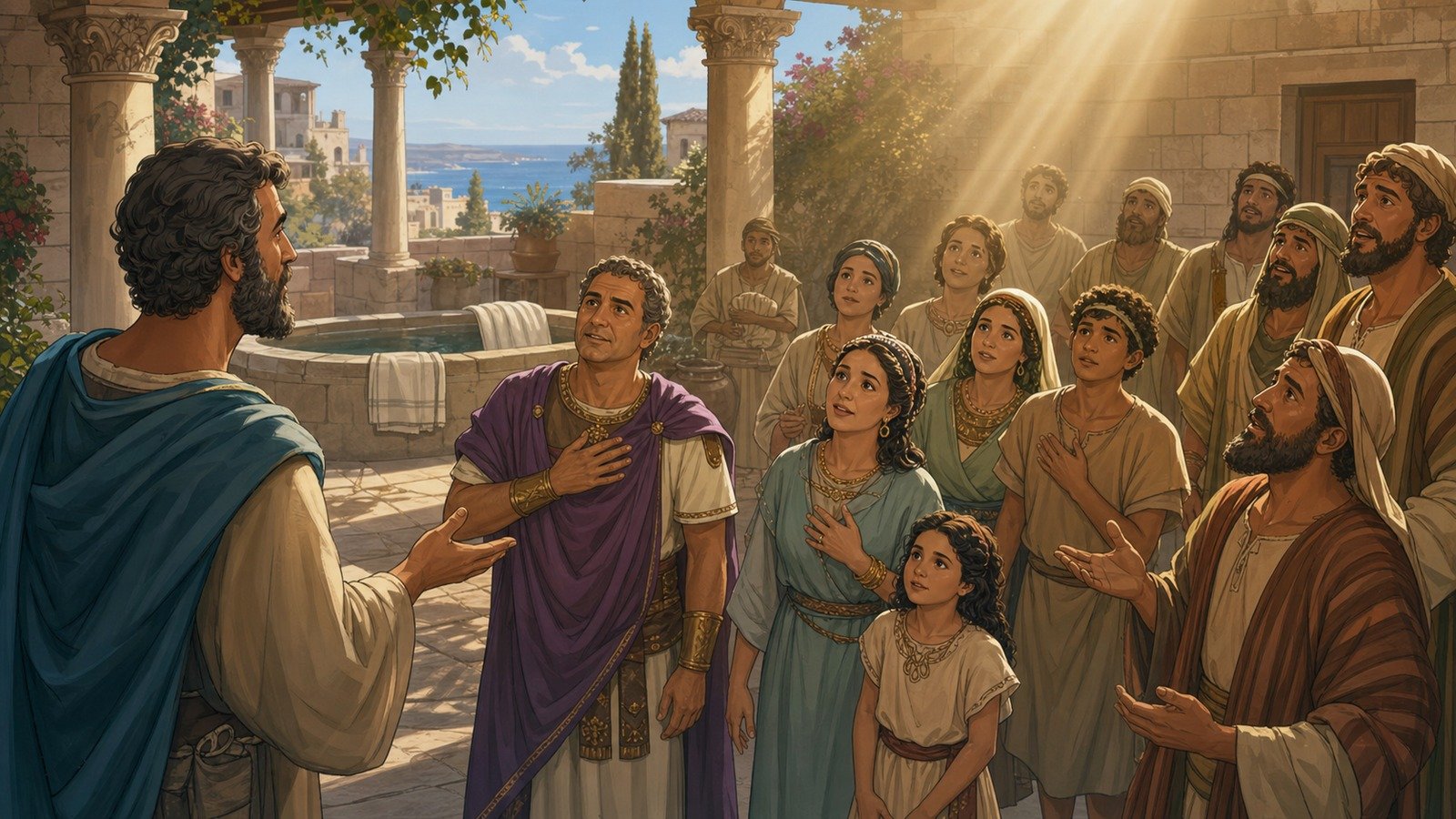
Peter preaches to Cornelius' household, and the Holy Spirit falls on them while he is still speaking, before baptism and without the Jewish believers present laying hands on them; the astonished Jewish believers with Peter conclude that God has extended the gift of the Spirit to Gentiles directly.
Further context
2 min readCornelius has gathered his relatives and close friends, so Peter walks into a room full of Gentiles in a Roman officer's house in the administrative capital of the province.
He begins with a sentence that reads like a man working something out while saying it: I now realise how true it is that God does not show favouritism, but accepts from every nation the one who fears him and does what is right.
The sermon that follows is short and it is the same message given at Pentecost, adjusted at the edges for an audience that had not been in Jerusalem. Jesus of Nazareth, anointed with the Holy Spirit and power, going around doing good and healing. They killed him by hanging him on a cross, but God raised him from the dead on the third day and caused him to be seen, not by all the people, but by witnesses whom God had already chosen, by us who ate and drank with him after he rose from the dead.
While Peter is still speaking, the Holy Spirit comes on all who hear the message.
The circumcised believers who had come with Peter were astonished that the gift of the Holy Spirit had been poured out even on Gentiles, for they heard them speaking in tongues and praising God.
That the interruption comes before the sermon ends is the point of the episode. Nobody laid hands on them. Nobody baptised them first. Nobody asked whether they intended to be circumcised. The decision was taken out of the church's hands in front of six witnesses who had come from Joppa precisely because Peter thought he might need them.
Can anyone keep these people from being baptised with water? They have received the Holy Spirit just as we have.
So he orders that they be baptised in the name of Jesus Christ. Then they ask him to stay with them for a few days, which means eating at their table, which is the thing he had said was against the law a few hours earlier.
This episode is the hinge of the whole record of the early church. Everything before it happens within Judaism; everything after it is a movement working out what to do with Gentiles who are plainly already in.
It also did not settle the argument. Nine chapters later a council meets in Jerusalem to decide the same question, and Peter stands up and cites this day.
What Cornelius did afterwards is unknown, and no church at Caesarea is credited to him. His significance is entirely in the precedent.
Peter's opening sentence about God not showing favouritism uses a compound word meaning to receive the face, an idiom from the law courts for judging by appearances or accepting a bribe. What he is denying is that God has a preferred category of applicant.
The sermon here is the shortest of the ones recorded, and it is the only one interrupted before its conclusion. Whatever Peter intended to say next, nobody found out.