

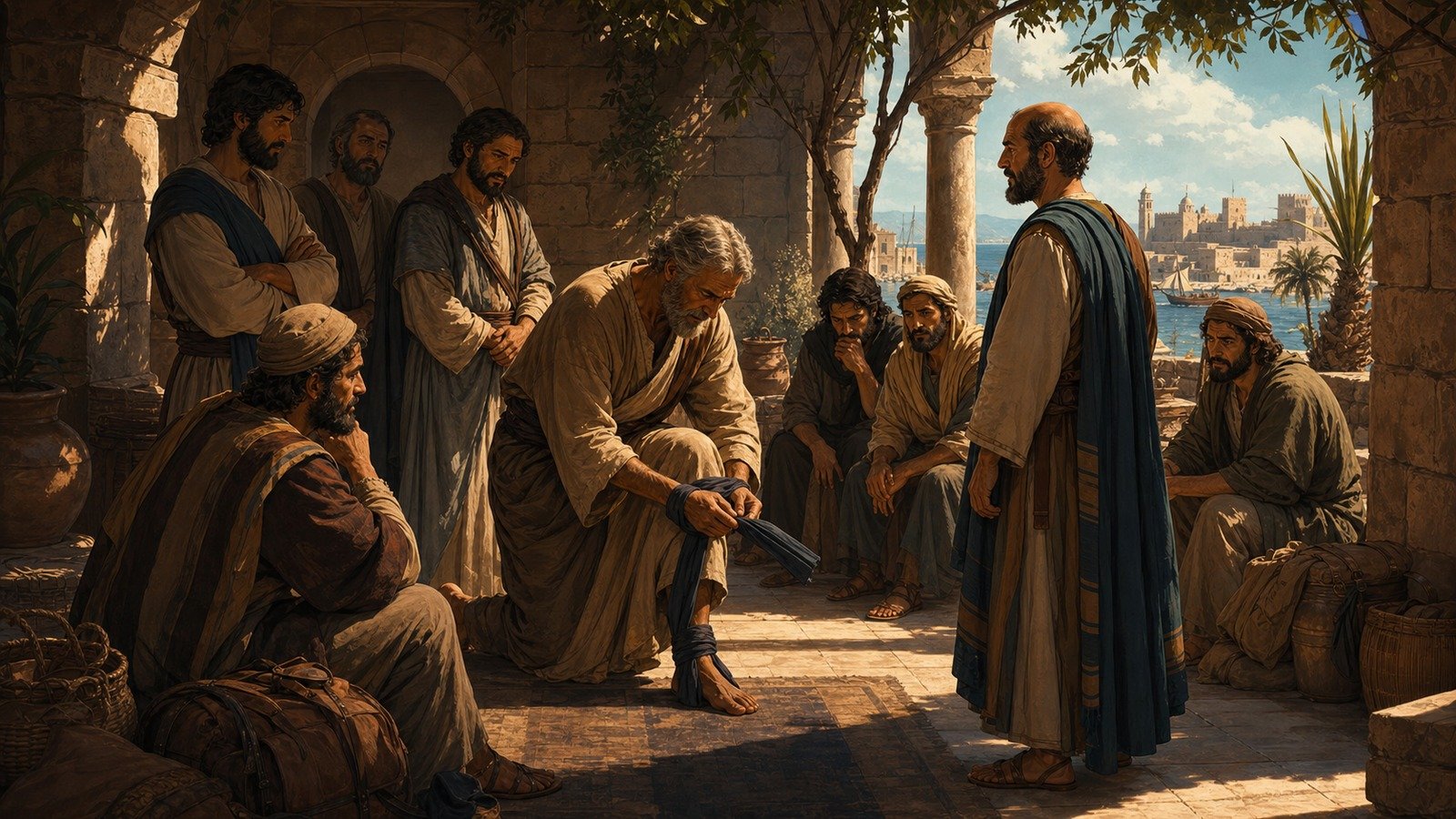
Sailing toward Jerusalem despite repeated warnings along the way, Paul is told by the prophet Agabus, through a dramatic sign of binding his own hands and feet, that Paul will be bound and handed over to Gentiles in Jerusalem; Paul insists on going anyway, "ready to die for the name of the Lord Jesus."
Further context
2 min readThe voyage south is described port by port, with the ship's cargo and crew changes noted, which is the kind of detail a passenger keeps.
At Tyre they find disciples and stay seven days, and through the Spirit these urge Paul not to go on to Jerusalem. When the time comes to leave, all of them, with wives and children, accompany him out of the city, and they kneel to pray on the beach.
At Caesarea they stay with Philip the evangelist, one of the seven appointed years earlier, who had baptised the Ethiopian on the desert road and had settled on the coast. He has four unmarried daughters who prophesy, mentioned in passing and never mentioned again.
After several days a prophet named Agabus comes down from Judea. He is the man who had predicted the famine years before, and what he does now is act rather than speak. Coming over to us, he took Paul's belt, tied his own hands and feet with it and said: in this way the Jewish leaders in Jerusalem will bind the owner of this belt and will hand him over to the Gentiles.
That is the method of the older prophets, who lay on their sides, walked barefoot and smashed pots to make a point that words alone would not carry.
When we heard this, we and the people there pleaded with Paul not to go up to Jerusalem.
His answer is the hardest sentence in the chapter. Why are you weeping and breaking my heart? I am ready not only to be bound, but also to die in Jerusalem for the name of the Lord Jesus.
When he would not be dissuaded, they gave up and said, the Lord's will be done.
The whole sequence raises a question that is never resolved. The warnings are described as coming through the Spirit, and Paul says he is going because he is compelled by the Spirit. The usual reading is that the warnings were accurate about what awaited him and that the conclusion drawn from them, that he should not go, was the disciples' own.
Some of the disciples from Caesarea accompany them and bring them to the house of a man named Mnason, an early disciple from Cyprus, with whom they are to stay.
Philip's four daughters are the only unmarried women in the New Testament described as prophesying, and nothing further is said about them. A second-century writer reports that they later lived at Hierapolis in Asia and were regarded as authorities on the earliest events, which if true makes them sources rather than a footnote.
The house of Mnason is mentioned because a Jerusalem household willing to lodge a party of Gentile delegates was not a small thing to find that week.
The belt Agabus used was the sash worn round the waist, in which money and small items were carried, and taking a man's belt to bind yourself is a piece of stagecraft with a very old pedigree.
Prophecy in these chapters consistently supplies information rather than instructions, and the decisions are left to the people who receive it.