

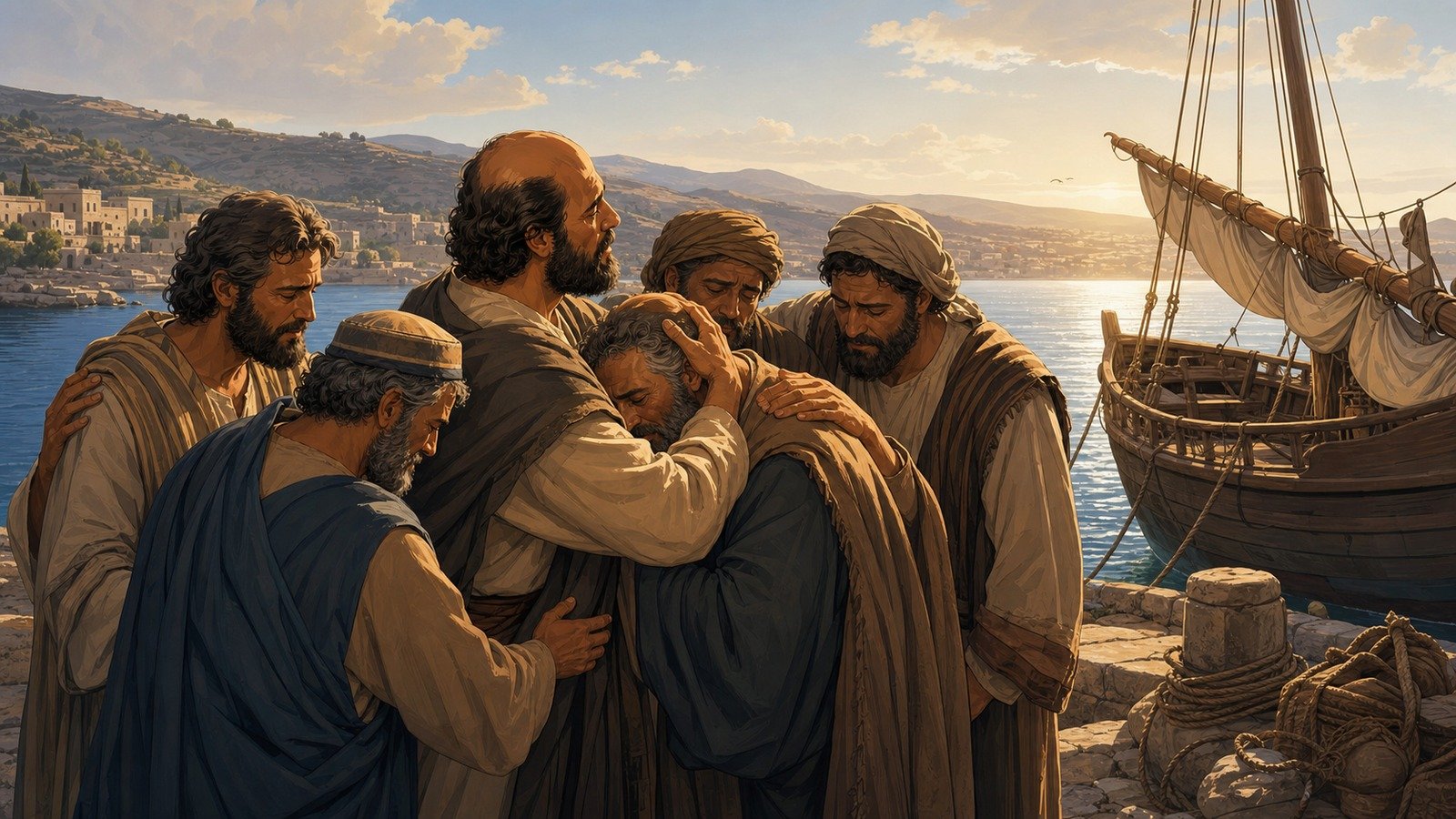
Avoiding a stop at Ephesus itself to save time, Paul summons the city's elders to Miletus instead, reviews his ministry among them, warns of coming false teachers, and tells them plainly they will not see his face again; the elders weep as they see him off.
Further context
2 min readPaul sails past Ephesus to avoid spending time in the province of Asia, because he is in a hurry to reach Jerusalem, if possible, by the day of Pentecost. From Miletus he sends to Ephesus for the elders of the church.
Miletus is about fifty kilometres from Ephesus, so the messenger's journey and the elders' journey together take several days, which suggests the ship was unloading.
The speech he gives them is the only one addressed to Christians rather than to outsiders, and it reads differently from all the others.
He begins with his record among them, and it is unusually personal. You know how I lived the whole time I was with you, serving the Lord with great humility and with tears and in the midst of severe testing. You know that I have not hesitated to preach anything that would be helpful to you.
Then the future, stated without softening. Compelled by the Spirit, I am going to Jerusalem, not knowing what will happen to me there. I only know that in every city the Holy Spirit warns me that prison and hardships are facing me. However, I consider my life worth nothing to me; my only aim is to finish the race.
Now I know that none of you among whom I have gone about preaching the kingdom will ever see me again.
Then a warning about what will happen to the church itself: savage wolves will come in among you and will not spare the flock. Even from your own number men will arise and distort the truth in order to draw away disciples after them.
He reminds them that he worked with his own hands to supply his needs and those of his companions, and closes with a saying of Jesus that appears nowhere in the Gospels: it is more blessed to give than to receive.
When he had said this, he knelt down with all of them and prayed. They all wept as they embraced him and kissed him. What grieved them most was his statement that they would never see his face again. Then they accompanied him to the ship.
The saying about giving and receiving appears nowhere in the Gospels, which makes it one of a small number of sentences attributed to Jesus that survived outside them.
Whether Paul ever saw the Ephesians again is uncertain. The pastoral letters imply a later visit to the region, which would require a release from the imprisonment in Rome and a further period of travel, and that reconstruction is disputed.
He kneels on a beach with a group of men he will not see again, and the last thing recorded is that they went with him to the ship. The scene is the closest thing in the letters or the history to a retirement, and he was heading for an arrest.
Elders and overseers are used interchangeably in this speech, one word describing the men and the other their function, and it is one of the passages every discussion of church order returns to.