

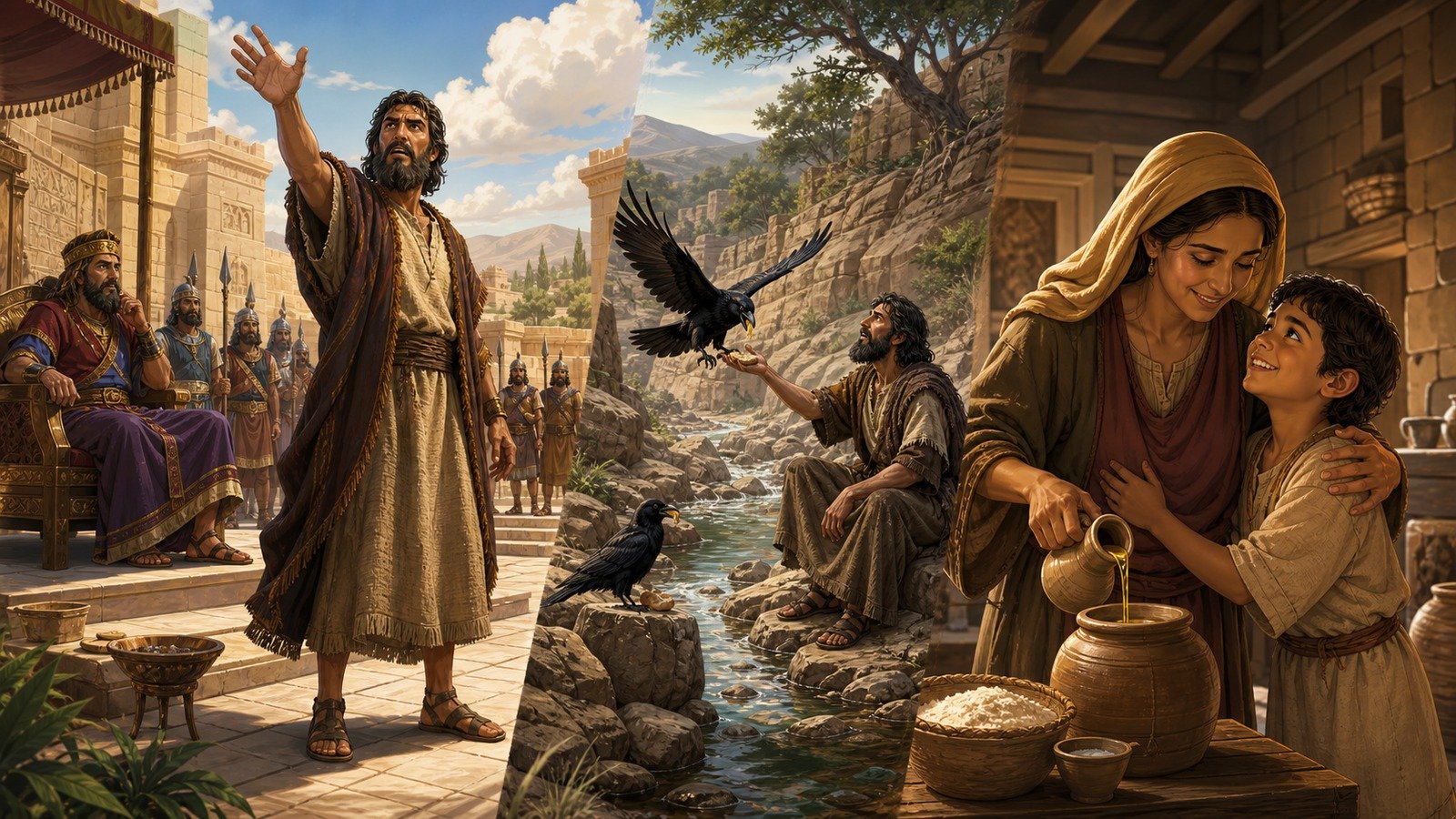
Elijah announces a drought as judgement on Ahab's Baal worship, is fed by ravens at the Kerith Ravine, and then sustains a widow at Zarephath through a jar of flour and jug of oil that do not run out, later raising her son from death.
Further context
3 min readElijah arrives without introduction, genealogy or call narrative. Elijah the Tishbite, from Tishbe in Gilead, says to Ahab: as the LORD, the God of Israel, lives, whom I serve, there will be neither dew nor rain in the next few years except at my word. Then he leaves.
The announcement is a direct challenge to the state religion. Baal is the storm god, responsible for rain, and the queen maintains four hundred and fifty of his prophets at royal expense. Withholding rain attacks the one function the god exists to perform, on his own ground.
He is sent to the Kerith ravine east of the Jordan, where ravens bring him bread and meat morning and evening and he drinks from the brook. When the brook dries up, because there is no rain, he is sent to Zarephath, and the destination is the sharpest thing in the episode. Zarephath is in Sidonian territory, on the Phoenician coast, which is Jezebel's own country. The prophet of a drought sent to challenge Baal spends the drought being fed inside Baal's heartland.
He finds a widow gathering sticks at the town gate and asks her for water and a piece of bread. Her answer is that she has only a handful of flour in a jar and a little olive oil in a jug, and is gathering sticks to make a last meal for herself and her son so that they may eat it and die.
He tells her to make him a small loaf first, and then some for herself and her son, and promises that the jar and the jug will not run out until the day rain falls. She does it, and there is food every day for her family and for him.
Then her son falls ill and stops breathing, and she turns on him: what do you have against me, man of God? Did you come to remind me of my sin and kill my son? He takes the boy upstairs, lays him on his own bed, and complains upward in almost the same terms: have you brought tragedy even on this widow I am staying with? Then he stretches himself out on the boy three times and asks for his life to return.
The child revives and is carried down, and the woman's response is the point of the whole episode: now I know that you are a man of God and that the word of the LORD from your mouth is the truth.
Jesus refers to that stay, in his own home town, and the observation is what starts a riot: there were many widows in Israel in Elijah's time, yet he was not sent to any of them, but to a widow in Zarephath in Sidon.
Zarephath lay on the Phoenician coast between Tyre and Sidon, which is Jezebel's own country. A prophet driven out of Israel by a Phoenician queen is fed for two years by a Phoenician widow, and the arrangement is stated without any comment on the irony.
The drought is not invented for the story. Josephus quotes a Phoenician historian, Menander of Ephesus, who recorded a year without rain in the reign of Ethbaal, Jezebel's father, ended by prayer, and the two accounts appear to be describing the same event from opposite sides.
The widow's own position is set out in one sentence when Elijah asks for bread: I have only a handful of flour in a jar and a little olive oil in a jug. I am gathering a few sticks to take home and make a meal for myself and my son, that we may eat it, and die.
Her son later falls ill and stops breathing, and Elijah stretches himself over the boy three times.