

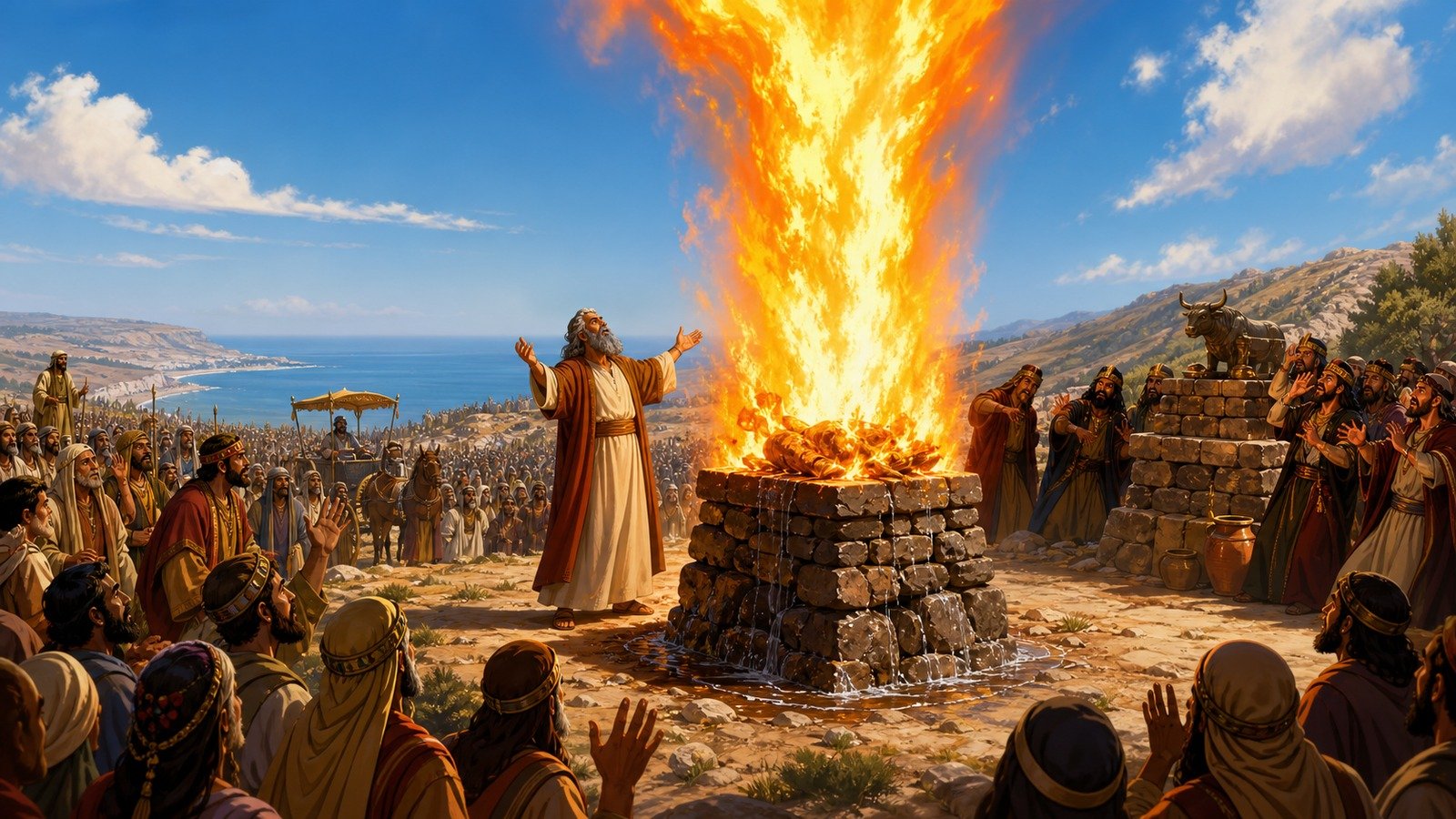
Elijah challenges 450 prophets of Baal to a public contest to see whose god will send fire to consume a sacrifice; after their frantic, failed appeals, Elijah's simple prayer is answered instantly, and the assembled prophets of Baal are executed, ending the contest decisively.
Further context
3 min readThree years into the drought he comes back, and the first exchange sets the terms. Ahab greets him with, is that you, you troubler of Israel? The reply refuses the framing: I have not made trouble for Israel, but you and your father's family have, by abandoning the LORD's commands and following the Baals.
Carmel is a ridge running to the Mediterranean at the northern edge of the country, close to Phoenician territory and a plausible site for a shrine of a storm god. All Israel is summoned there, along with the four hundred and fifty prophets of Baal.
His opening question to the crowd is the one the whole episode exists for: how long will you waver between two opinions? If the LORD is God, follow him; but if Baal is God, follow him. The Hebrew image is of hobbling on two unequal legs. The people said nothing, which is the honest answer of a country that had been doing both for a generation and had not thought of it as a choice.
The test is designed so that the deity in question performs his own speciality. Two bulls, two altars, no fire lit by anyone, and the god who answers by fire is God. The people agree that this is fair.
The prophets of Baal go first and take all morning, calling on his name and dancing round the altar. Elijah's mockery at noon is the only recorded sarcasm of its kind: shout louder, surely he is a god. Perhaps he is deep in thought, or busy, or travelling. Maybe he is sleeping and must be awakened. The Hebrew of one of those suggestions is a euphemism for relieving himself.
They shout louder and slash themselves with swords and spears until their blood flows, and prophesy frantically until evening. There was no response, no one answered, no one paid attention.
He then repairs the altar of the LORD with twelve stones for the twelve tribes, digs a trench around it, and has four large jars of water poured over the offering and the wood three times until the trench is full. His prayer takes about thirty seconds and asks for one thing: that these people will know that you, LORD, are God, and that you are turning their hearts back again.
Fire falls and consumes the offering, the wood, the stones, the soil and the water in the trench, and the people fall prostrate and cry, the LORD, he is God.
The prophets of Baal are taken down to the Kishon valley and slaughtered. Then Elijah tells the king to eat and drink because there is the sound of a heavy rain, climbs to the top of the mountain, bends down with his face between his knees and sends his servant to look seven times. On the seventh a cloud the size of a man's hand comes up from the sea.
The mountain matters. Carmel is a ridge running north-west to the sea, forming the border between Israelite territory and Phoenician, and it had a sanctuary of Baal on it. Choosing it means the contest is held on ground where Baal had a home advantage.
Baal was a storm god whose particular business was rain and lightning, which is what makes the terms of the test as pointed as they are: the god who answers by fire.
The description of the prophets' efforts is unsparing and slightly comic. They dance around the altar they have made, shout from morning till noon, slash themselves with swords and spears as was their custom until their blood flows, and rave on till the time of the evening sacrifice.
Elijah's taunts are worse. Shout louder! Perhaps he is deep in thought, or busy, or travelling. Maybe he is sleeping and must be awakened.