

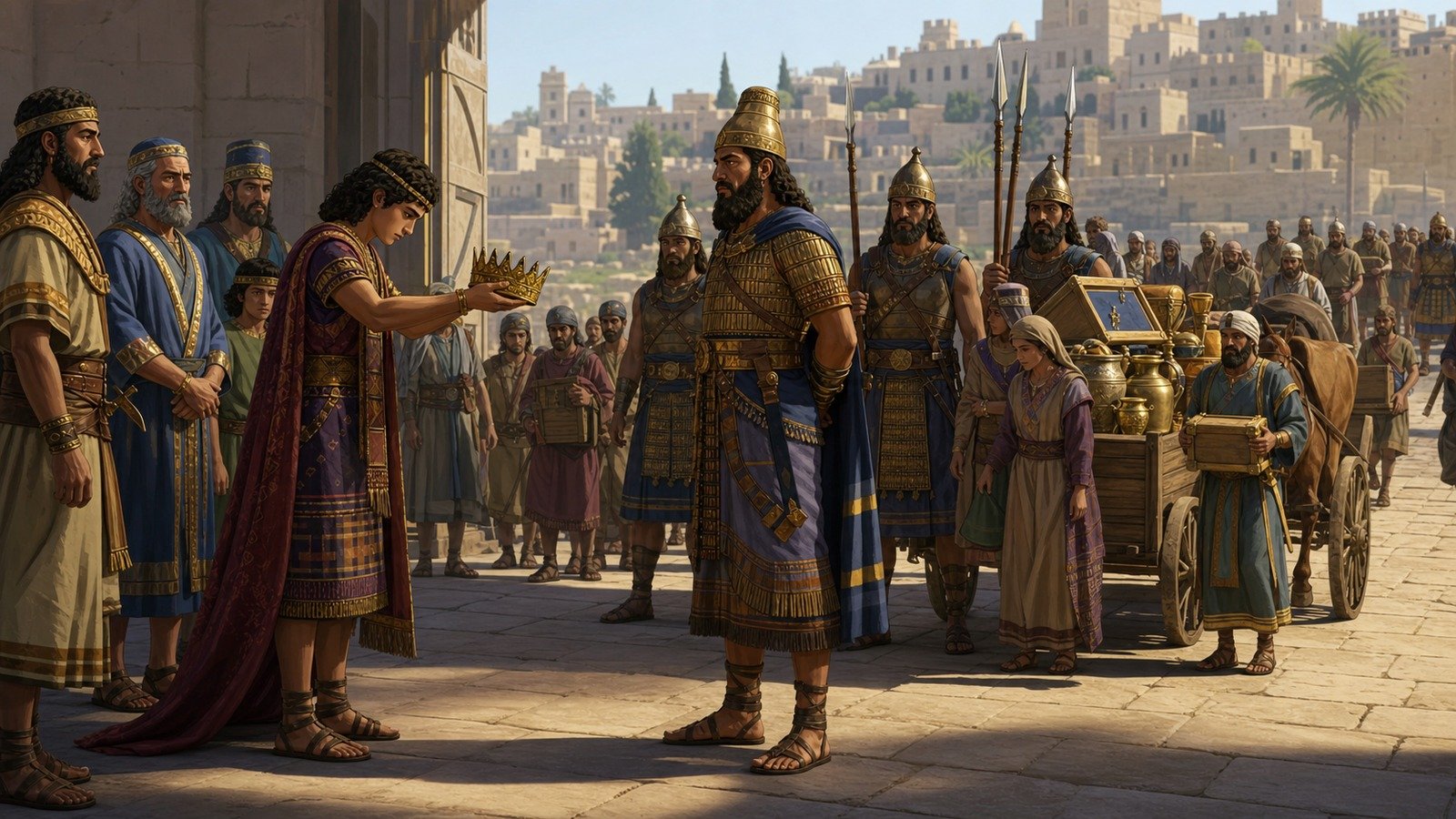
Jehoiakim's son Jehoiachin reigns only three months before Nebuchadnezzar besieges Jerusalem and deports him to Babylon along with the Temple's treasures and much of the elite.
Further context
3 min readEighteen years old, three months and ten days on the throne, and then a siege.
Nebuchadnezzar's officers advance on Jerusalem and lay siege to it, and the king himself arrives while it is in progress. Jehoiachin surrenders, going out to the Babylonian king with his mother, his attendants, his nobles and his officials, and they are all taken prisoner.
What is removed is the entire functioning class of the country. Ten thousand are deported: all the officers and fighting men, all the skilled workers and artisans, the king, his mother, his wives, his officials and the leading men of the land. Only the poorest people are left. The treasures of the temple and the palace are carried off and the gold articles Solomon had made are cut up.
Nebuchadnezzar then installs the young king's uncle and renames him Zedekiah, which is the same assertion of authority Necho had made a decade earlier with a different name.
One detail of the surrender is worth noticing. He goes out to the Babylonian king rather than defending the walls, and the consequence is that Jerusalem is not sacked on this occasion and the temple, though stripped, is left standing. Eleven years later his uncle takes the opposite course and the city is burned.
Among the ten thousand is a young priest called Ezekiel, who begins to prophesy in a refugee settlement by the Kebar canal in Babylonia five years later, and who dates everything in his book from the year of this deportation.
This event is dated more precisely than almost anything else in the Hebrew scriptures, because the Babylonian Chronicle records it: in the seventh year of Nebuchadnezzar, in the month of Kislev, he encamped against the city of Judah and on the second day of Adar he captured the city and seized its king, appointing a king of his own choosing. That converts to 16 March 597 BC.
There is a further and stranger piece of corroboration. Excavations in Babylon in the early twentieth century recovered administrative tablets from a storeroom near the Ishtar Gate, listing rations of oil and barley issued to prisoners and dependants of the state. Among the recipients are Yaukin king of the land of Yahudu and his five sons, with the amounts specified. A king of Judah appears in the pantry accounts of Babylon, receiving provisions, thirty years after his deportation.
The other history closes his story with a note: in the thirty-seventh year of the exile, a new Babylonian king releases him from prison, speaks kindly to him, gives him a seat of honour higher than those of the other kings with him, and provides him with a regular allowance for the rest of his life. He eats at the king's table.
That is the last event recorded in the histories of Israel and Judah, and it is a small, ambiguous piece of mercy shown to a man who had reigned for three months at eighteen.
Three months, and everything about his life afterwards is documented outside the Bible.
Babylonian ration tablets excavated from a storeroom near the Ishtar Gate list oil and barley issued to Yaukin, king of the land of Yahud, and to his five sons, which confirms both his captivity and the household maintained with him.
The Babylonian Chronicle records the capture of Jerusalem, dating it to the second day of the month Adar in the seventh year of Nebuchadnezzar, which is 16 March 597 BC, and says the king appointed a king of his own choice, received heavy tribute and sent it to Babylon. It is the most precisely dated event in the entire Old Testament.
Ezekiel, deported in the same wave, dates every one of his visions by the years of Jehoiachin's exile rather than by the reign of the king sitting in Jerusalem, which is a quiet statement about who he thought was the legitimate ruler.