

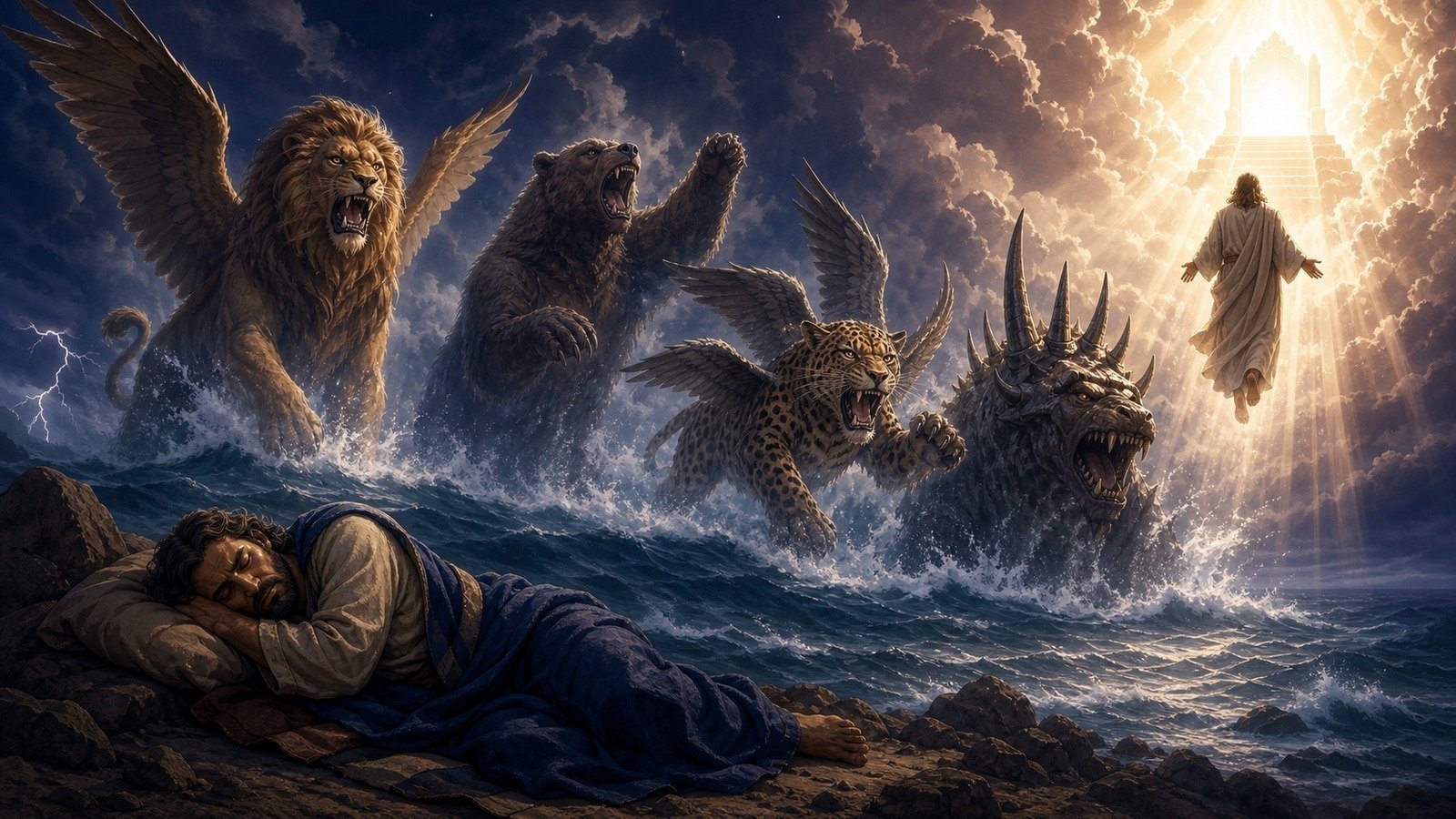
Daniel sees four beasts representing successive empires and a "son of man" given everlasting dominion, then a further vision of a ram and goat that most interpreters read as depicting the Medo-Persian and Greek empires.
Further context
3 min readThe first half of the book of Daniel is stories told about him in the third person. From this point it is visions recorded in the first person, and they are dated earlier than the events of some of the stories, so the arrangement is thematic rather than chronological.
He sees the four winds churning up a great sea and four beasts coming out of it, each different.
The first is like a lion with the wings of an eagle, whose wings are torn off and which is made to stand on two feet like a human with a human mind given to it. The second is like a bear, raised up on one side, with three ribs in its mouth. The third is like a leopard with four wings and four heads. The fourth is not compared to any animal: terrifying, frightening and very powerful, with large iron teeth, crushing and devouring its victims and trampling underfoot whatever was left, and it has ten horns. A little horn comes up among them, uproots three of the others, and has eyes like a human and a mouth that speaks boastfully.
Then the scene changes to a throne room. The Ancient of Days takes his seat, his clothing white as snow, the hair of his head white like wool, his throne flaming with fire and its wheels all ablaze, with thousands upon thousands attending him. The court is seated and the books are opened.
And then the figure that carries more weight in later use than anything else in the book: one like a son of man, coming with the clouds of heaven, approaching the Ancient of Days and led into his presence, and given authority, glory and sovereign power, so that all nations and peoples of every language worshipped him, an everlasting dominion that will not pass away.
Son of man in Hebrew and Aramaic simply means a human being, and the phrase here means one who looked human, in contrast to four beasts. It is the title Jesus uses of himself more than any other, about eighty times in the Gospels, and when he is asked directly at his trial whether he is the Messiah, his answer quotes this scene.
The four beasts are interpreted as four kingdoms, and identifying them is the same argument as with the statue, running either Babylon, Medo-Persia, Greece and Rome, or Babylon, Media, Persia and Greece.
The following vision of a ram and a goat comes with its own interpretation attached, and there is no ambiguity: the ram is Media and Persia, the goat is Greece, and the large horn between its eyes is its first king.
The book divides at this point. The first half is a set of stories about Daniel told in the third person; from here on it is visions recorded in the first person, and they are dated by regnal year.
The four beasts are a lion with eagle's wings, a bear raised up on one side with three ribs in its mouth, a leopard with four wings and four heads, and a fourth beast with iron teeth and ten horns which the vision does not compare to any animal at all.
Then the throne scene: the Ancient of Days taking his seat, clothing white as snow, hair white like wool, a throne flaming with fire, and thousands upon thousands attending him.
And one like a son of man coming with the clouds of heaven, given authority, glory and sovereign power, whose dominion will not pass away. That figure and that phrase run through the whole New Testament, and it is the title Jesus used of himself more than any other.