

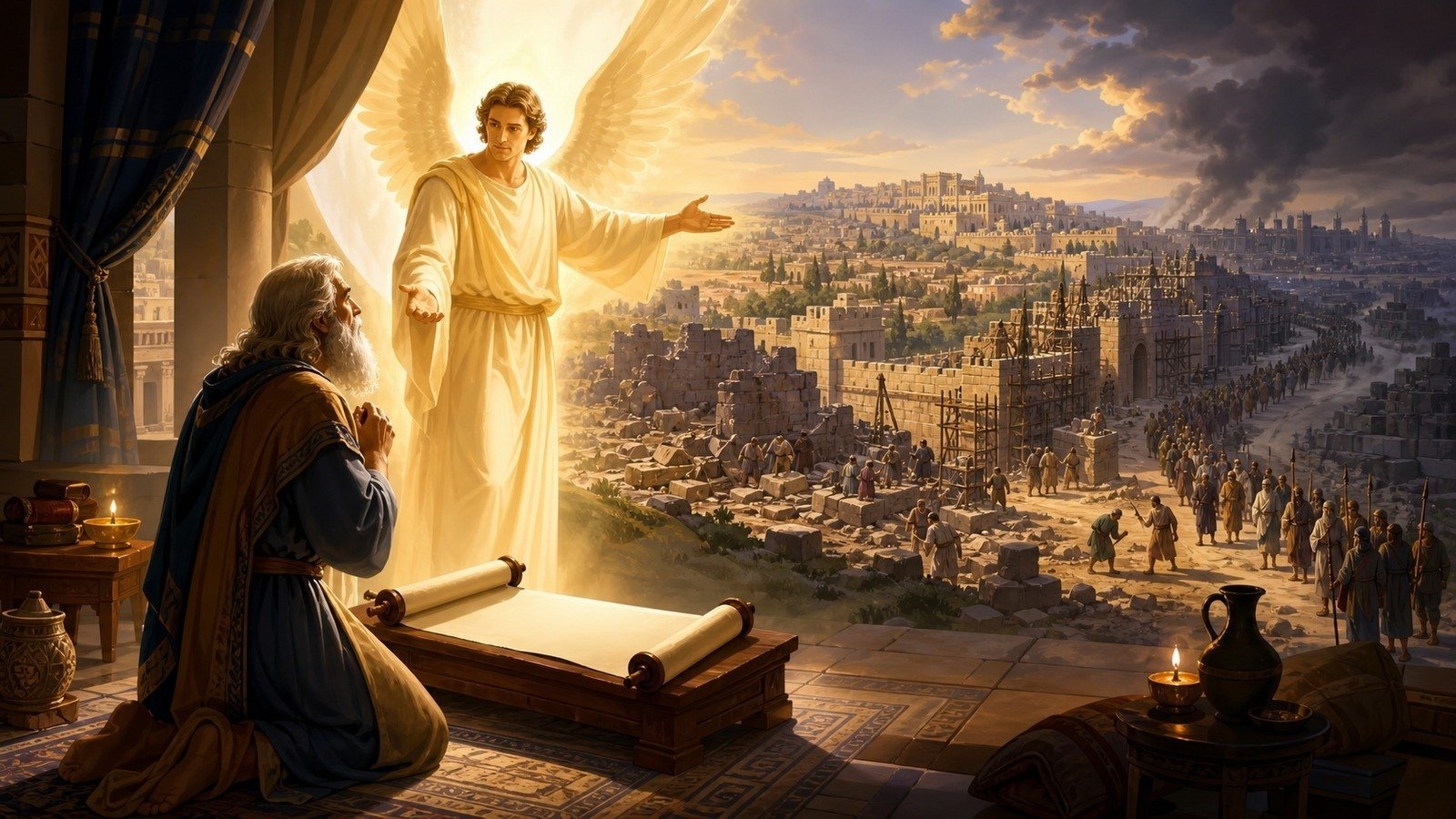
After praying over Jeremiah's prophecy of seventy years' exile, Daniel receives a further prophecy of "seventy weeks" concerning Jerusalem's future, one of the most debated passages in the book.
Further context
3 min readIt begins with Daniel reading. In the first year of Darius, Daniel understands from the Scriptures, according to the word of the LORD given to Jeremiah, that the desolation of Jerusalem would last seventy years. He works out that the period is nearly up, and his response is not to wait for it but to pray.
The prayer is one of the great confessions in the Hebrew scriptures and its most striking feature is the pronoun. A man of impeccable record, who has refused a king's food, kept praying with the windows open under a death sentence and served three empires without a stain on him, says: we have sinned and done wrong. We have been wicked and have rebelled. We have turned away from your commands and laws. He does not once separate himself from the people he is confessing for.
While he is still praying, Gabriel arrives and tells him he is highly esteemed, and gives him a timetable.
Seventy sevens are decreed for your people and your holy city to finish transgression, to put an end to sin, to atone for wickedness, to bring in everlasting righteousness, to seal up vision and prophecy and to anoint the Most Holy Place. The period is divided: seven sevens and sixty-two sevens from the issuing of the decree to restore and rebuild Jerusalem until the Anointed One comes, and then, after the sixty-two sevens, the Anointed One will be put to death and will have nothing, and the people of the ruler who will come will destroy the city and the sanctuary. The last seven involves a covenant confirmed with many, an end put to sacrifice and offering, and an abomination that causes desolation.
If a seven is a week of years, seventy sevens is four hundred and ninety.
Interpretations divide sharply and each has a starting point and an arithmetic. One family of readings runs the count from a Persian decree and arrives in the first century AD, at the death of Jesus and the destruction of the temple by Titus in AD 70. Another places the whole thing in the second century BC, ending with the desecration of the temple by Antiochus IV in 167 BC, when a pagan altar was erected over the altar of burnt offering and the phrase about abomination is used of it in the books describing that crisis. A third separates the final seven from the rest and places it at the end of history.
Nothing settles it. What is not disputed is that the phrase about the abomination that causes desolation is quoted by Jesus in his last week, applied to something his hearers would see, and that both the second-century crisis and the first-century destruction are things that actually happened.
The seventy weeks are seventy sevens in the Hebrew, and the ambiguity is deliberate enough that every reading has to make a decision about it before it can start.
The main lines are these. Some take the sevens as years, producing four hundred and ninety, and count from a decree to rebuild Jerusalem to arrive at the first century. Which decree is the first question, since there are at least three candidates in the Persian period, and whether the years are solar or of three hundred and sixty days is the second.
Others take the numbers symbolically, as seventy times the sabbatical seven, meaning a complete period rather than a countable one.
Others place the whole thing in the second century BC and read the cut-off anointed one as the murdered high priest Onias III and the desolation as Antiochus IV's altar.
These verses have generated more calculation than anything else in the Old Testament, and the calculations have a poor record.