

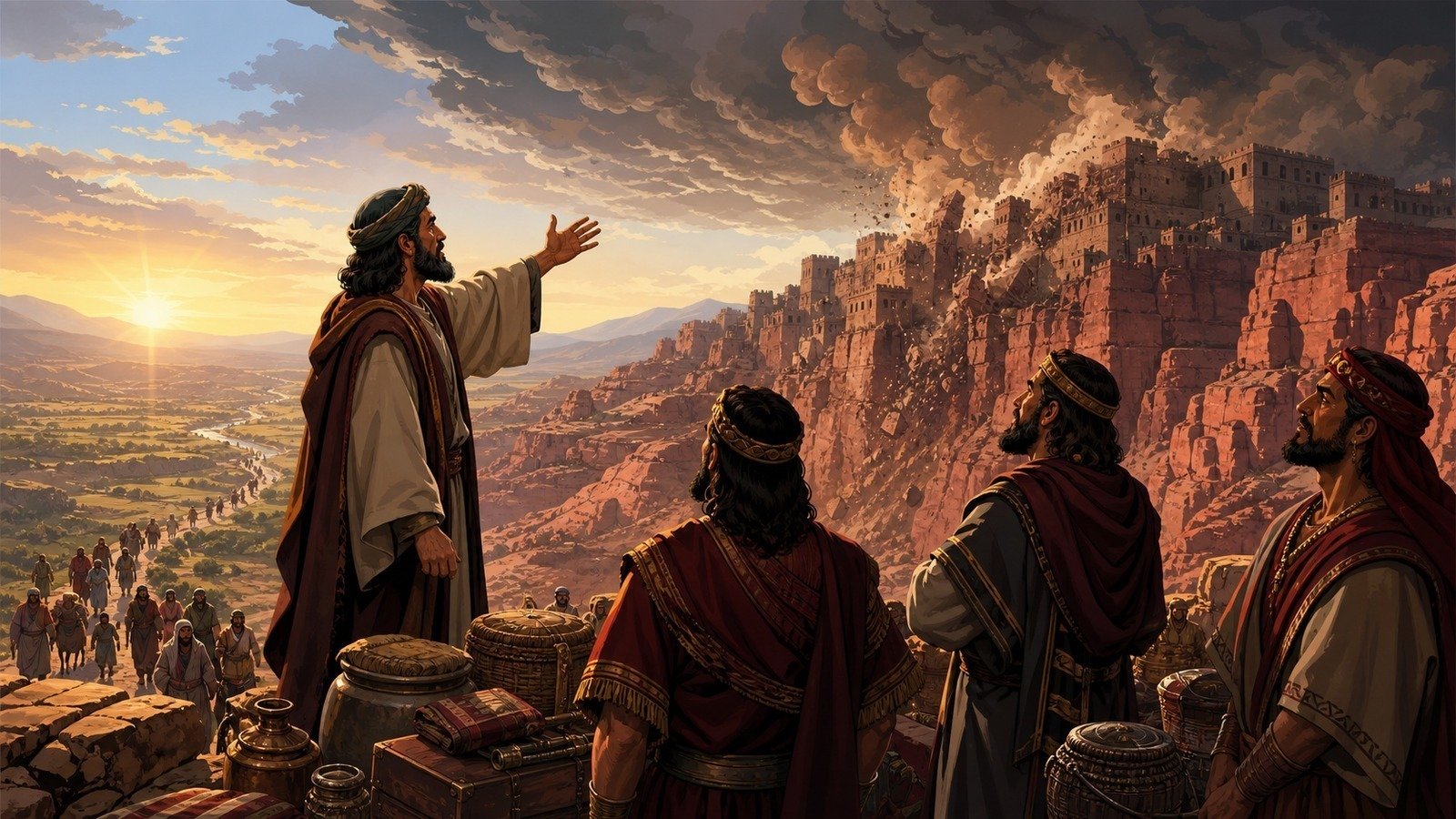
The shortest Old Testament book condemns Edom for standing by, or actively assisting, while Jerusalem fell, and promises Edom's own eventual downfall alongside Israel's ultimate restoration.
Further context
3 min readTwenty-one verses, the shortest book in the Hebrew scriptures, and every one of them is about one neighbour.
Edom occupied the mountainous country south-east of the Dead Sea, and its people descended from Esau, Jacob's twin. The relationship is stated in family terms throughout: because of the violence against your brother Jacob.
What Edom did is set out in a list of participles that reads like a charge sheet, and it all concerns the day Jerusalem fell. You stood aloof while strangers carried off his wealth. You should not gloat over your brother in the day of his misfortune, nor rejoice over the people of Judah in the day of their destruction. You should not march through the gates of my people in the day of their disaster, nor seize their wealth. You should not wait at the crossroads to cut down their fugitives, nor hand over their survivors in the day of their trouble.
Cutting down fugitives at a crossroads is the specific accusation, and it is the one that recurs in several other books. A psalm written in exile asks God to remember what the Edomites said on the day Jerusalem fell: tear it down to its foundations.
The taunt aimed at their confidence is geographical and exact. You who live in the clefts of the rocks and make your home on the heights, you who say to yourself, who can bring me down to the ground? Though you soar like the eagle and make your nest among the stars, from there I will bring you down. Edomite settlements sat on sandstone ridges reached by narrow defiles, and the region later produced Petra, which is approached through a gorge and carved into cliff faces.
Dating it depends on which fall of Jerusalem is meant, and most place it shortly after 586 BC, though an earlier setting has been argued.
What happened to Edom afterwards is that it disappeared as a nation. Pressure from Arab groups pushed the population west into southern Judah during the Persian period, where they became the Idumeans. Under Roman rule the most famous Idumean was Herod the Great, which means the last ruler produced by Esau's line sat on Jacob's throne and tried to kill a child in Bethlehem.
One line in it is quoted almost verbatim in a longer oracle against Edom preserved elsewhere, and which of the two came first is unresolved. Shared material between prophetic books is common enough that it is generally taken as evidence of a body of oracles circulating in more than one collection.
The book closes on a wider scene than its subject: the day of the LORD is near for all nations, and deliverers will go up on Mount Zion to govern the mountains of Esau, and the kingdom will be the LORD's.
Obadiah is twenty-one verses, the shortest book in the Old Testament, and it is entirely about one small neighbouring nation.
Edom descended from Esau and Israel from Jacob, which makes the quarrel a family one going back to the twins, and the book says so directly: because of the violence against your brother Jacob.
What Edom had done is specified. On the day Jerusalem fell they stood aloof while strangers carried off its wealth, they looked down on their brother in his misfortune, they boasted, they marched through the gates, they seized his wealth, they waited at the crossroads to cut down the fugitives, and they handed over the survivors.
Edom's own security is described geographically, and anyone who has seen Petra recognises it: you who live in the clefts of the rocks and make your home on the heights, who say to yourself, who can bring me down to the ground?