

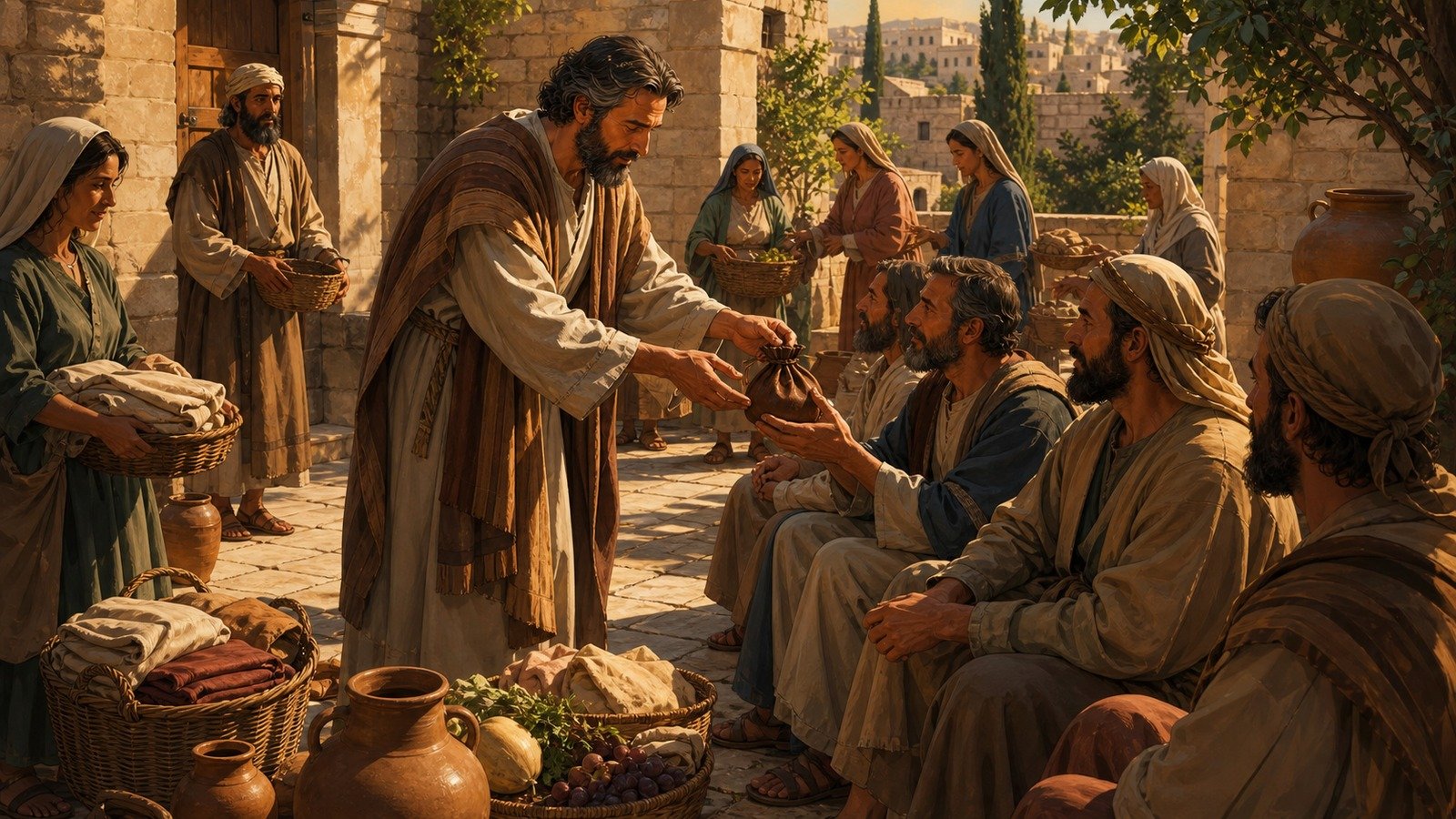
Luke describes a community holding property loosely, selling land and goods to support those in need; Barnabas, later Paul's companion, is singled out for selling a field and giving the proceeds to the apostles.
Further context
2 min readAll the believers were one in heart and mind. No one claimed that any of their possessions was their own, but they shared everything they had.
The mechanism is then described, and it is not what people usually assume. From time to time those who owned land or houses sold them, brought the money from the sales and put it at the apostles' feet, and it was distributed to anyone who had need.
Three things follow from that wording. Sales happened from time to time rather than all at once, so this was not a single act of collectivisation. Property was liquidated as need arose, which means people continued to own things until they sold them. And distribution was according to need rather than in equal shares.
Putting money at someone's feet was a recognised gesture of handing over authority along with the goods, and it also, incidentally, made the transfer public.
There were no needy persons among them. That claim echoes a sentence in the law about the sabbatical year, where Israel is told there should be no poor among you, and the correspondence is unlikely to be accidental.
Then one man is named as an example, and the reason he is named becomes clear a few sentences later, when a couple do the opposite.
Joseph, a Levite from Cyprus, whom the apostles called Barnabas, which means son of encouragement, sold a field he owned and brought the money and put it at the apostles' feet.
Two details about him are worth holding on to, because he becomes one of the more important figures in the next thirty years. Levites were not supposed to own land in Israel under the law, since the tribe was given cities rather than territory, and the field may well have been on Cyprus, where the rule would not apply. And Cyprus makes him a Jew of the diaspora, Greek-speaking, from outside Judea.
He is the man who later vouches for Saul of Tarsus when the Jerusalem church was afraid of him and did not believe he was a disciple, which is the reason Paul got a hearing at all. He is sent to Antioch to assess what was happening there, goes to Tarsus to fetch Paul, and travels with him on the first journey. They later separate after a sharp disagreement about whether to take John Mark with them.
The nickname the apostles gave him is the sort of thing a community only invents when it is deserved.
Cyprus becomes important later. It is where Barnabas takes John Mark after the quarrel with Paul, and it is the first place the two of them go on the earliest journey, which is the ordinary pattern of the whole movement: people go where they have family and connections.
The description of the community's unity uses a phrase that means one heart and one soul, an expression found in Greek writing about ideal friendship, and it is applied here to several thousand people who had mostly met within the last year.