

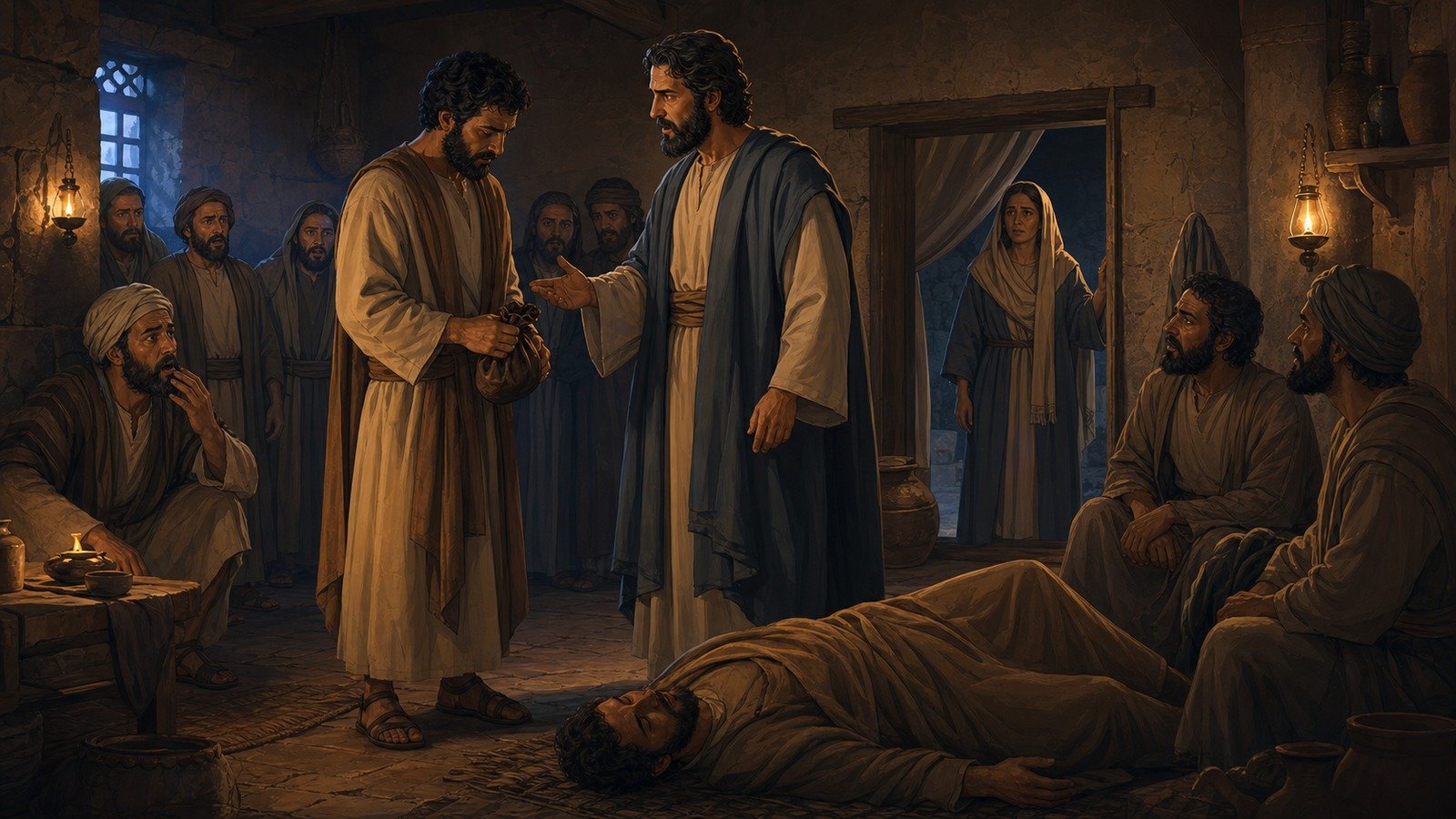
A married couple sell a property but secretly keep back part of the proceeds while claiming to have given it all; when Peter confronts each of them in turn, both fall dead, and "great fear seized the whole church."
Further context
2 min readA man named Ananias, together with his wife Sapphira, sells a piece of property. With his wife's full knowledge he keeps back part of the money for himself, but brings the rest and puts it at the apostles' feet.
The offence is stated precisely and it is not the withholding. Ananias, why has Satan so filled your heart that you have lied to the Holy Spirit and have kept for yourself some of the money you received for the land? Did it not belong to you before it was sold? And after it was sold, was not the money at your disposal? What made you think of doing such a thing? You have not lied just to human beings but to God.
Nobody was required to sell anything, and nobody who sold was required to hand over the whole price. What is condemned is a piece of theatre: bringing part and letting everyone believe it was all, in a community where such gifts were made publicly and reputation followed them.
When Ananias heard this, he fell down and died. Great fear seized all who heard what had happened. The young men came forward, wrapped up his body, and carried him out and buried him.
About three hours later his wife comes in, not knowing what has happened. Peter puts a question to her that gives her an opening: is this the price you and Ananias got for the land? Yes, she says, that is the price.
How could you conspire to test the Spirit of the Lord? Listen! The feet of the men who buried your husband are at the door, and they will carry you out also.
At that moment she falls down at his feet and dies.
The verb translated kept back is the same one used in the Greek Old Testament of Achan, who took plunder from Jericho that had been devoted to God and hid it under his tent, and whose theft brought defeat on the whole army. The parallel is deliberate: a community at its beginning, an act of private appropriation, and a penalty that looks disproportionate until the timing is considered.
Great fear seized the whole church and all who heard about these events.
It remains one of the hardest episodes in the New Testament, and nothing in the telling apologises for it.
Whether the deaths are described as a judgement or simply as what happened is a fine distinction and probably a real one. Peter announces neither death in advance; he tells Ananias what he has done, and the man collapses. To Sapphira he says the men are at the door and will carry her out, which is a prediction, and three hours after her husband's burial it is not a difficult one.
The effect on the community is stated twice in four sentences, and the word both times is fear.
The property was almost certainly land, and the sums involved in the surrounding accounts were large enough to support a community for some time, which is why a false declaration mattered to more than the couple's reputation.