

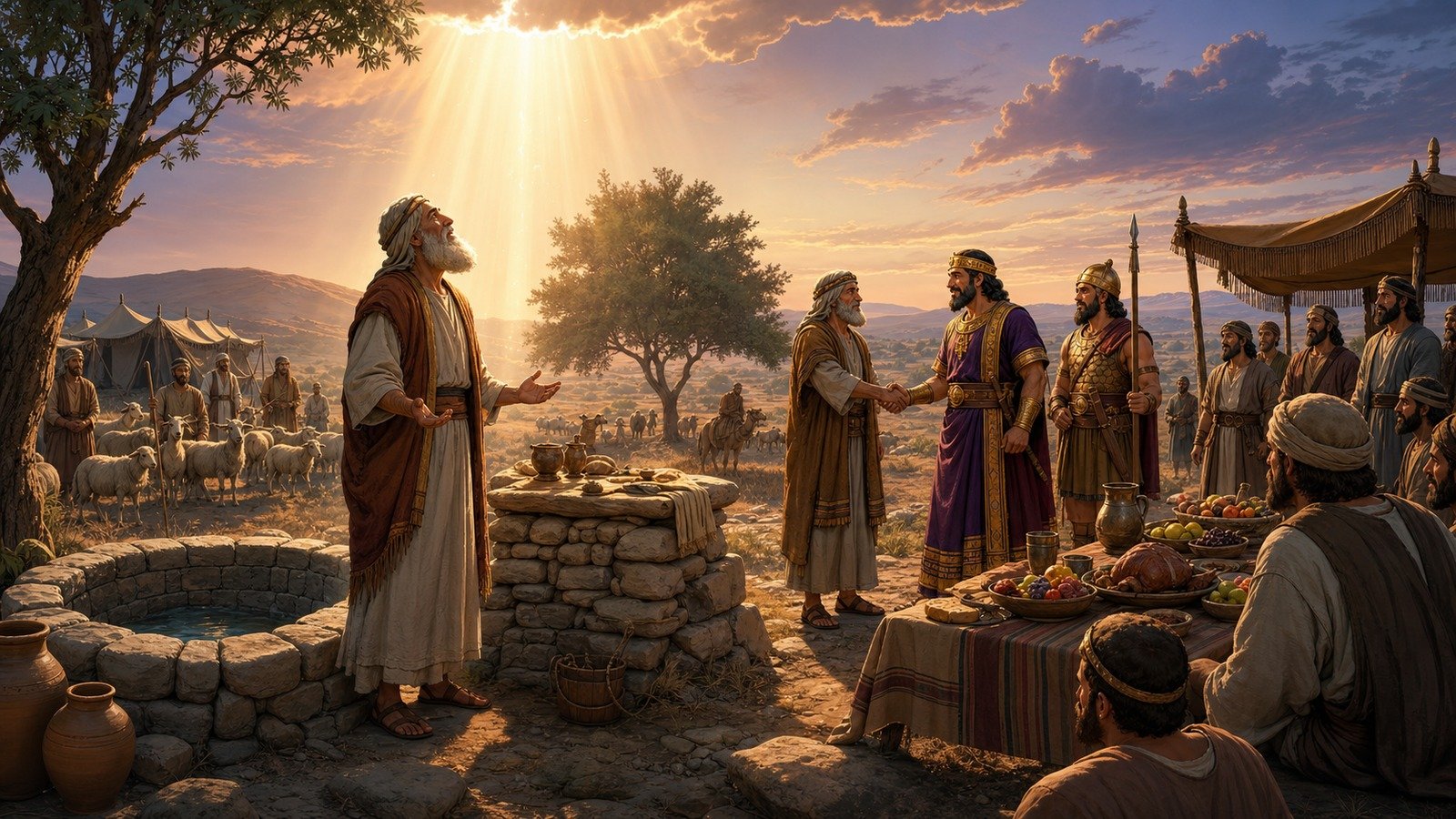
God appears to Isaac at Beersheba to renew the promise first given to Abraham, and Isaac makes a covenant of peace with Abimelech at the same site his father had, echoing Abraham's earlier treaty there.
Further context
3 min readIsaac moves up from the Gerar valley to Beersheba, back to the place where his father Abraham planted a tamarisk and swore a treaty a generation earlier.
God appears to him that night with a short address containing three things: an identification, a reassurance and a promise. I am the God of your father Abraham. Do not be afraid, for I am with you. I will bless you and increase the number of your descendants for the sake of my servant Abraham. The reason given is Abraham's standing rather than Isaac's, which is consistent with everything else about him.
His response follows a sequence used repeatedly in these chapters. He builds an altar, calls on the name of the LORD, pitches his tent, and his servants dig a well. Worship, settlement and water in that order, and the well is the practical test of whether the settlement will hold.
Abimelech then arrives from Gerar with two officials, Ahuzzath his personal adviser and Phicol the commander of his forces. Isaac's question is direct: why have you come to me, since you were hostile to me and sent me away? The answer concedes the situation. We saw clearly that the LORD was with you, so we said there ought to be a sworn agreement between us. They ask for a treaty, and their case is that they did him no harm and sent him away peacefully, which is a generous description of filling in his wells.
A feast is held, they swear oaths in the morning and he sends them on their way. The same day his servants report that they have found water in the well they were digging. He names it Shibah, and the town has been called Beersheba ever since.
The parallels with his father's dealings in the same place are extensive: the same city, a king called Abimelech, a commander called Phicol, a dispute over wells, a treaty, an oath and the name Beersheba explained. Two explanations compete. The first treats them as separate incidents a generation apart, and notes that Abimelech means "my father is king" and may well be a dynastic title in the manner of Pharaoh, with Phicol likewise an office rather than a personal name. The second treats them as variant tellings of one tradition preserved in different sources. The recurrence of the names is the strongest argument for the second and the weakest point of the first, and neither can be settled.
Isaac's part of the story is the shortest of the three patriarchal cycles and its shape is consistent throughout. He is the son almost sacrificed rather than the man who acts, the husband found for him rather than the suitor, the father deceived rather than the one who arranges. He digs his father's wells again and keeps his father's names for them, receives his father's covenant in his father's words, and settles his father's disputes with what may well be his father's counterpart.
He is also the only one of the three who never leaves the country, and the only one who is never recorded travelling outside it. Abraham came from Mesopotamia and went down to Egypt; Jacob spends twenty years in Harran and dies in the Delta. Isaac is born in Canaan, marries a woman brought to him there, is forbidden to go to Egypt when famine comes, and dies at Hebron. Whatever else the promise of a land meant to the other two, he is the only one who lived his whole life inside it.