

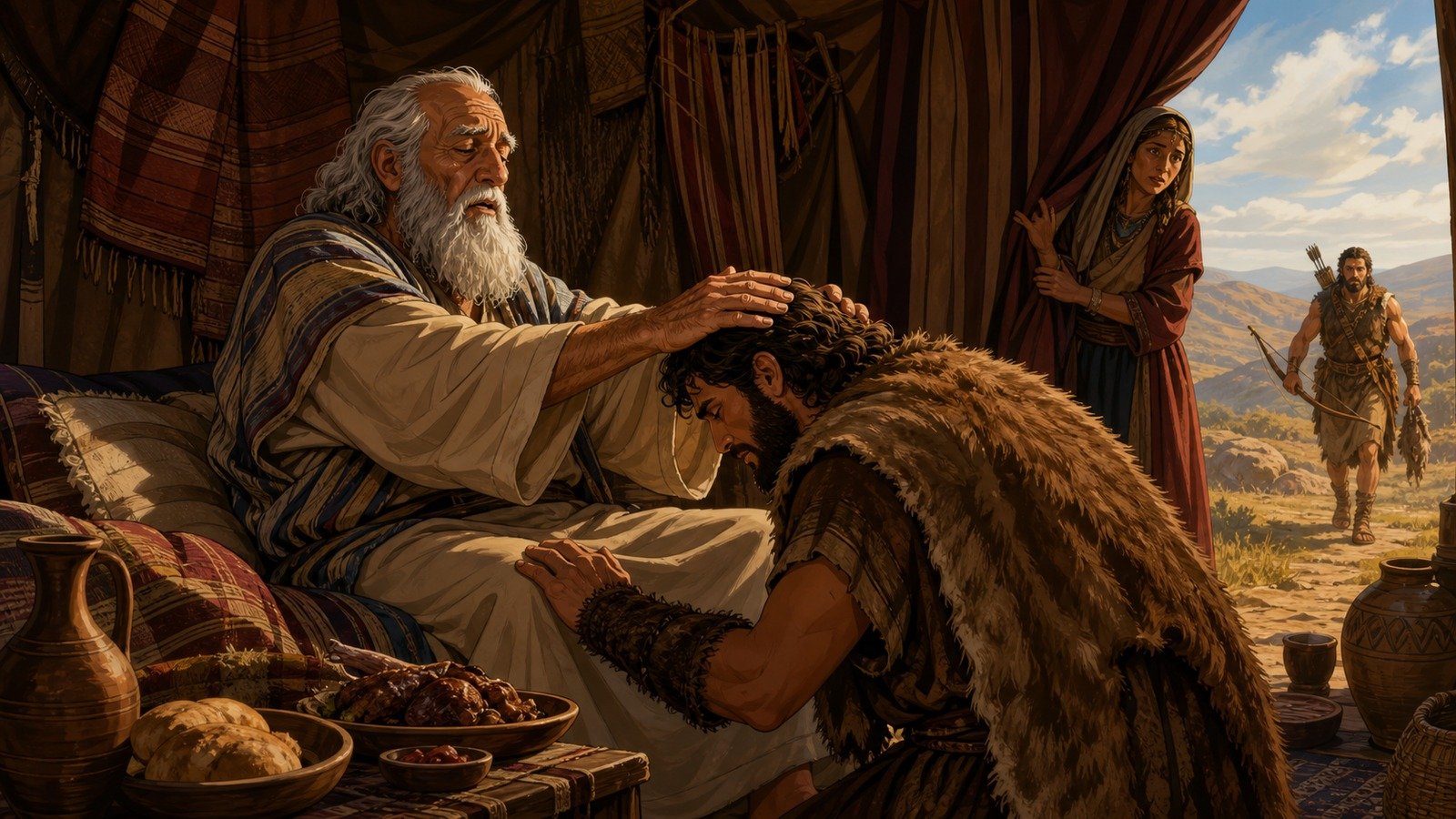
With Rebekah's help, Jacob disguises himself as Esau to secure the blind and dying Isaac's blessing, the formal transfer of covenant leadership. Esau's fury forces Jacob to flee, fulfilling the birthright sale while deepening the brothers' estrangement.
Further context
2 min readIsaac is old and his eyes are so weak that he can no longer see. He calls Esau, tells him he does not know the day of his death, and asks him to hunt some wild game and prepare the food he likes so that he may give him his blessing.
Two things are wrong with that before anyone deceives anyone. He is proposing to bless the son who sold his birthright, in defiance of the oracle given to Rebekah before the twins were born. And he attaches the blessing to a meal he particularly enjoys. Every person in this episode behaves badly, and each of them is implicated in turn.
Rebekah overhears and acts at once. She has Jacob fetch two young goats, cooks them the way Isaac likes, dresses him in Esau's best clothes and covers his hands and the smooth part of his neck with goatskins. When he objects, his concern is not that the plan is dishonest but that he might be caught and cursed.
The scene at the bedside is uncomfortable in its detail. He says, I am Esau your firstborn. Asked how he found the game so quickly, he answers that the LORD his father's God gave him success, which puts God's name inside the lie. Isaac, suspicious, asks him to come near, touches him, and says the sentence that has outlived the whole story: the voice is the voice of Jacob, but the hands are the hands of Esau. He asks a second time whether this is really Esau, gets a flat yes, eats, drinks and blesses him.
The blessing asks for dew from heaven and the richness of the earth, an abundance of grain and new wine, the service of nations and lordship over his brothers, and closes with the formula given to Abraham: may those who curse you be cursed and those who bless you be blessed.
Esau comes back with his own dish and everything collapses. Isaac trembles violently, in Hebrew something closer to convulsion than surprise, and asks who it was that has already been blessed. Esau bursts out with a loud and bitter cry and asks for a blessing too, and is told that his brother came deceitfully and took it.
Nobody proposes taking it back. A spoken blessing was treated as an act with legal force, irreversible once uttered, and Isaac says plainly that he has blessed Jacob and indeed he will be blessed. Esau's remark, asking whether his brother is not rightly named Jacob since he has now supplanted him twice, turns the name into an accusation.
What Esau receives is a description rather than a blessing: a dwelling away from the earth's richness, a life by the sword, service to his brother, and a closing line saying that when he grows restless he will throw off the yoke. The Edomites did break away from Judah in the ninth century BC, and that is recorded.
He holds a grudge and tells himself he will kill Jacob once the days of mourning for his father are over. Isaac in fact lives roughly another forty years.