

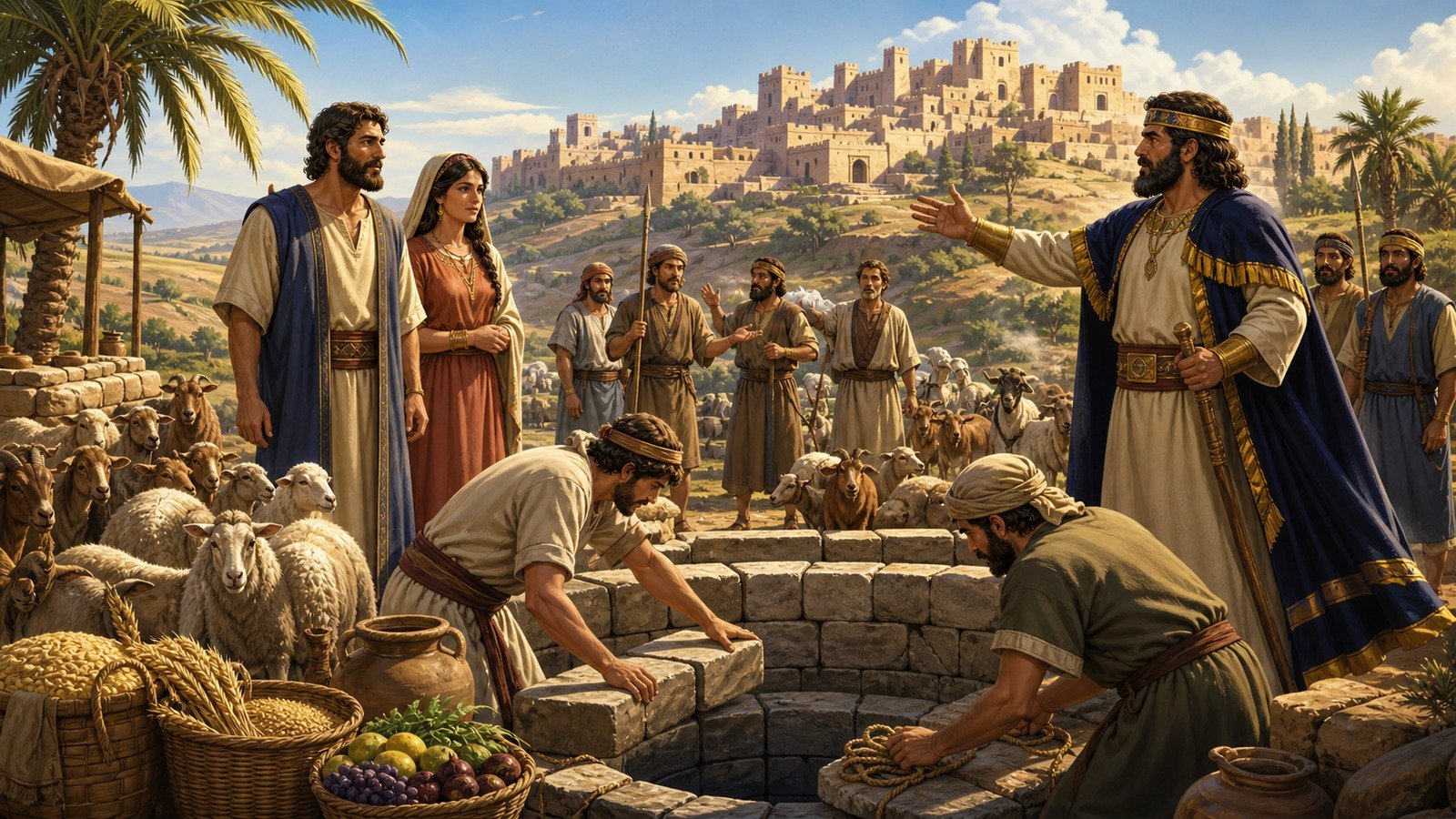
Isaac repeats his father's deception about his wife during a famine, then prospers in Gerar to the point that the Philistines envy him, and redigs the wells his father had dug, which the Philistines had filled in after Abraham's death.
Further context
3 min readA second famine drives the family to Gerar, and this one is carefully distinguished from the famine of Abraham's time, which is unusually helpful to a reader who might otherwise assume a duplicate.
This is the only stretch where God speaks to Isaac at length, and the first instruction is a prohibition: do not go down to Egypt. His father went to Egypt in a famine and it went badly. Isaac is told to stay in the land he is shown, and is given the promise made to Abraham, with the reason attached that Abraham obeyed and kept what was required of him. Isaac receives the covenant as an inheritance rather than as a fresh call, which suits the way he functions throughout: the man who holds a promise between two more dramatic figures.
He then repeats his father's manoeuvre. Asked about Rebekah, he says she is his sister, because he is afraid the men of the place will kill him on her account. The deception unravels in an unexpected way. Abimelech looks down from a window and sees Isaac metsacheq with Rebekah, a verb from the same root as Isaac's own name, so that the Hebrew reads roughly as Isaac Isaac-ing with his wife. Here it means caressing, and the wordplay is deliberate.
The rebuke follows the pattern of the earlier episodes. What is this you have done to us? One of the men might well have slept with your wife, and you would have brought guilt upon us. Abimelech then issues a decree threatening death to anyone who molests either of them, which gives the couple more protection than the lie did.
The rest is about farming and water. Isaac plants crops and reaps a hundredfold in the same year, and becomes so wealthy in flocks, herds and servants that the Philistines envy him. Their response is to fill in the wells his father's servants had dug, which in that region is economic warfare, and Abimelech asks him to move away because he has become too powerful.
The hundredfold harvest is worth a note, because this is the only occasion when a patriarch is described as farming rather than herding. Abraham and Jacob move with flocks; Isaac sows a crop and reaps it in the year he planted it, during a famine. Yields of that order are exceptional but not impossible in the loess soils of the northern Negev in a year of good rain. Settling to plant also represents a commitment to stay, which is what makes the Philistine reaction political rather than merely envious.
He reopens his father's wells and keeps the old names. His herdsmen then dig fresh ones and quarrel with the herdsmen of Gerar over the first two. He names them Esek, meaning dispute, and Sitnah, meaning opposition, and moves on each time without fighting. The third is not contested, and he calls it Rehoboth, meaning room, saying that now the LORD has given them room and they will flourish in the land.
Naming three wells after the arguments that surrounded them records a policy. He withdraws rather than defends, twice, and the eventual outcome is treated as vindication rather than the retreats as failure. He is the least assertive of the three patriarchs and the only one who never leaves the country.