

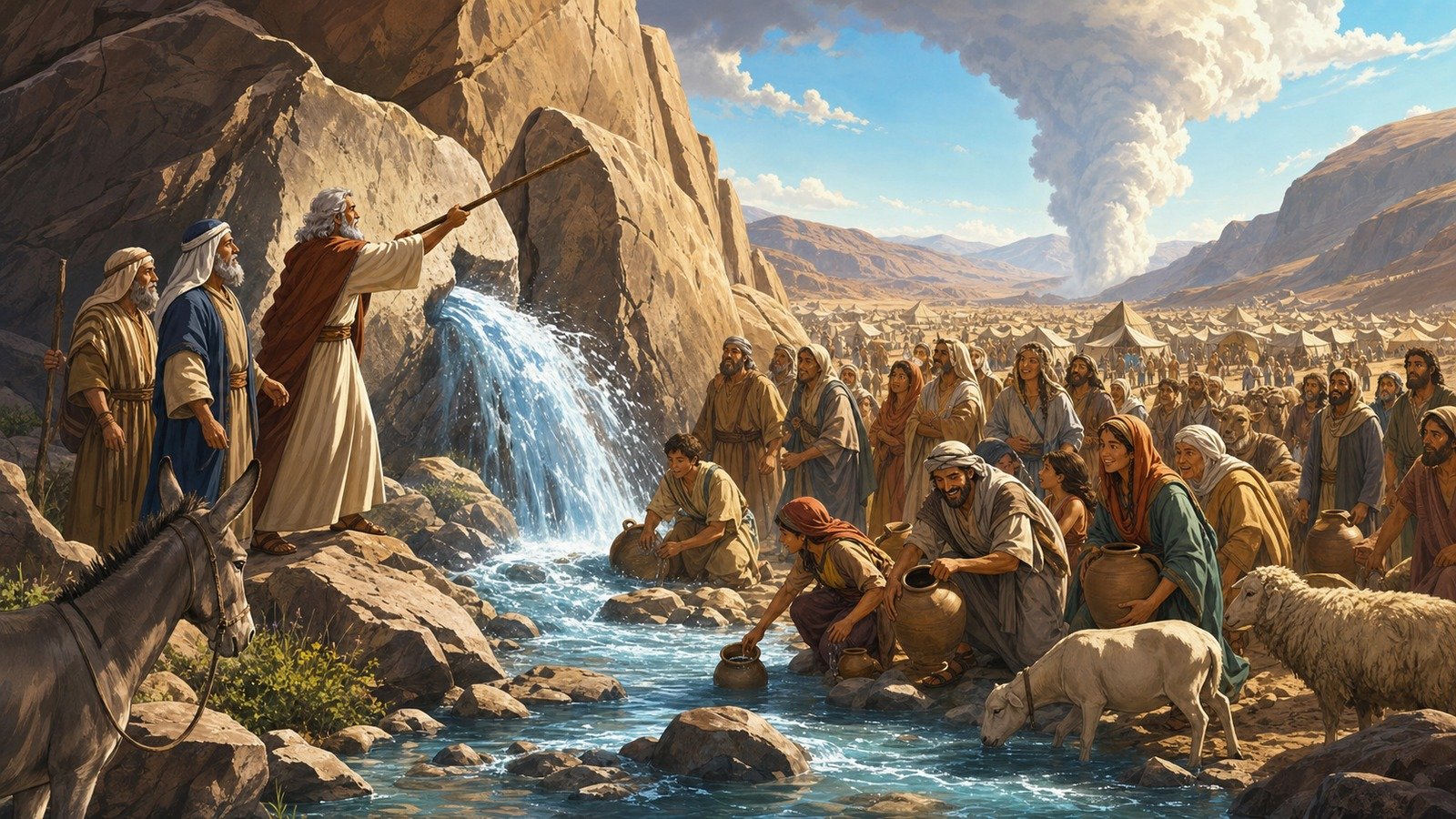
Israel again complains of thirst at Rephidim; God instructs Moses to strike a rock at Horeb, and water flows out for the whole community.
Further context
2 min readIsrael camps at Rephidim and there is no water, and this time it escalates faster than the earlier complaints. They quarrel with Moses and demand water, and his reply is a question about where the dispute is actually aimed: why do you quarrel with me? Why do you put the LORD to the test?
Their answer sharpens it. Why did you bring us up out of Egypt to make us and our children and livestock die of thirst? He takes it upward in terms that show how far things have gone: what am I to do with these people? They are almost ready to stone me.
The instruction he receives is oddly specific. Take some of the elders with him, so there are witnesses. Take the staff with which he struck the Nile, the instrument associated with judgement on Egypt. And strike the rock at Horeb, where God says he will stand in front of him on the rock. Water comes out and the people drink.
The place gets two names and both are accusations rather than commemorations. Massah means testing and Meribah means quarrelling, and the reason given is the question the people asked: is the LORD among us or not? They asked it a month after the sea, with a pillar of cloud standing over the camp.
The physical setting makes the episode less improbable than it sounds. Much of the Sinai is limestone, water moves through it and collects behind porous rock faces, and it is sometimes held in by a thin crust of harder deposit. Travellers and administrators in the region have reported water released by breaking such a face, and Bedouin practice included digging at the base of rock walls where seepage was visible. None of that is what is being argued about, and no view is taken on the hydrology; the interest is in the timing, the instruction and the witnesses.
Those two names become shorthand in later Scripture for a particular kind of failure. A psalm uses them to warn a much later generation not to harden their hearts as their ancestors did, and the letter to the Hebrews quotes that psalm at length to make the same point to its own readers.
This should be distinguished from a similar episode about forty years later, which also involves a rock, a water shortage and a place called Meribah. The two are separated by the whole wilderness period and by their outcomes. In the later one Moses is told to speak to the rock and strikes it twice while shouting at the people, and the consequence is that he is told he will not bring the community into the land. The two are frequently merged in retellings, and the difference between them is the whole of his fate.
Paul makes an unexpected use of the tradition, saying the Israelites drank from a spiritual rock that accompanied them and that the rock was Christ. He is drawing on a Jewish tradition of a well that travelled with the people, and applying it to a claim about who had been providing for them.