

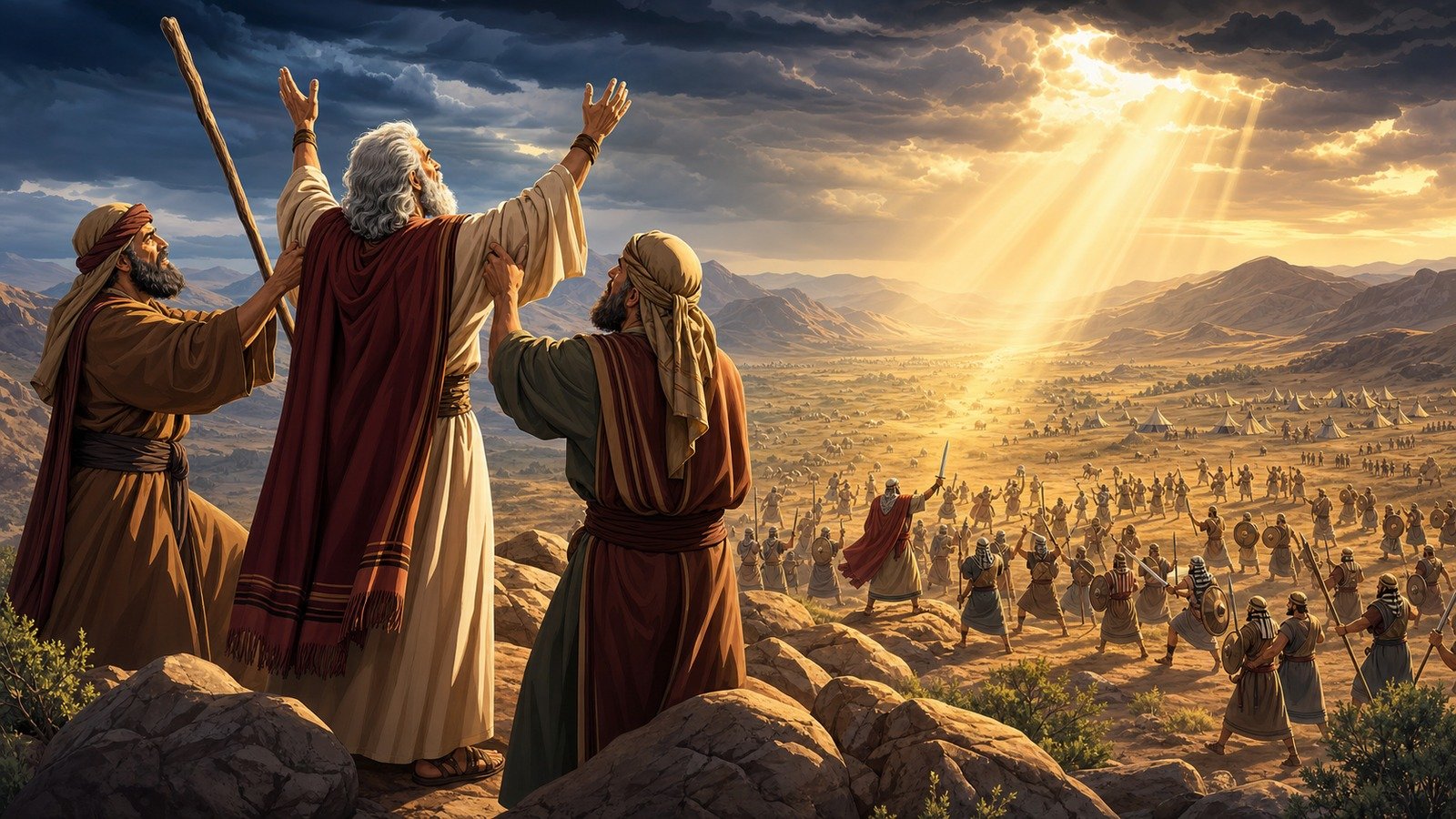
Israel defeats Amalek at Rephidim while Moses holds up his hands in intercession on a hilltop, supported by Aaron and Hur when his arms tire.
Further context
2 min readThe Amalekites attack at Rephidim, and no motive is supplied at the time. Moses fills it in decades later: they met the Israelites on the way and attacked the stragglers at the rear, all who were lagging behind, when the people were weary and worn out. The attack fell on the slowest part of a column of refugees.
The Amalekites were a nomadic people of the Negev and northern Sinai, described as descendants of Esau, and they operate as raiders throughout the later histories.
Moses gives the command to a man who has not appeared before and who will be central to everything after: Joshua. He is told to choose some men and go out and fight, while Moses stands on the top of the hill with the staff of God in his hands.
The mechanism described is odd and precise. As long as Moses held up his hands the Israelites were winning, and whenever he lowered them the Amalekites were winning. When his hands grew tired, Aaron and Hur put a stone under him to sit on and stood one on each side, holding his hands up until sunset.
Care is taken not to make the raised hands magical. The staff is the one associated with the Nile, the sea and the rock, and the posture is the ordinary posture of prayer. What is unusual is that the intercession has to be physically propped up by two other men, and that the outcome on the field tracks it visibly. Joshua fights and wins; Moses does not fight and cannot hold his own arms up.
The aftermath contains the first instruction anywhere to write something down. Write this on a scroll as something to be remembered, and make sure that Joshua hears it. Whatever else that establishes, the tradition being preserved includes an instruction to preserve it.
Moses builds an altar and calls it The LORD is my Banner, another of the compound names attached to particular moments in the wilderness.
The closing line is a declaration of permanent hostility, and its consequences run a very long way. Saul is commissioned centuries later to act against the Amalekites for what they did on this day, and his failure to carry out the instruction is the reason his kingship is taken from him. The book of Esther then introduces its antagonist as an Agagite, echoing the name of the Amalekite king Saul spared, and sets him against a man descended from Saul's own tribe. A thread runs from a raid on stragglers in the Sinai to a plot in the Persian court.
Joshua's introduction here is done without ceremony. He is named as though the reader already knows him, given command of a fighting force and left to get on with it. He appears next as the aide who does not leave the tent of meeting, then as one of twelve men sent to scout Canaan and one of only two who come back recommending entry, and finally as Moses' successor. He is built up gradually and always in Moses' shadow, and this is the one occasion where he acts on his own while Moses watches from a distance.