

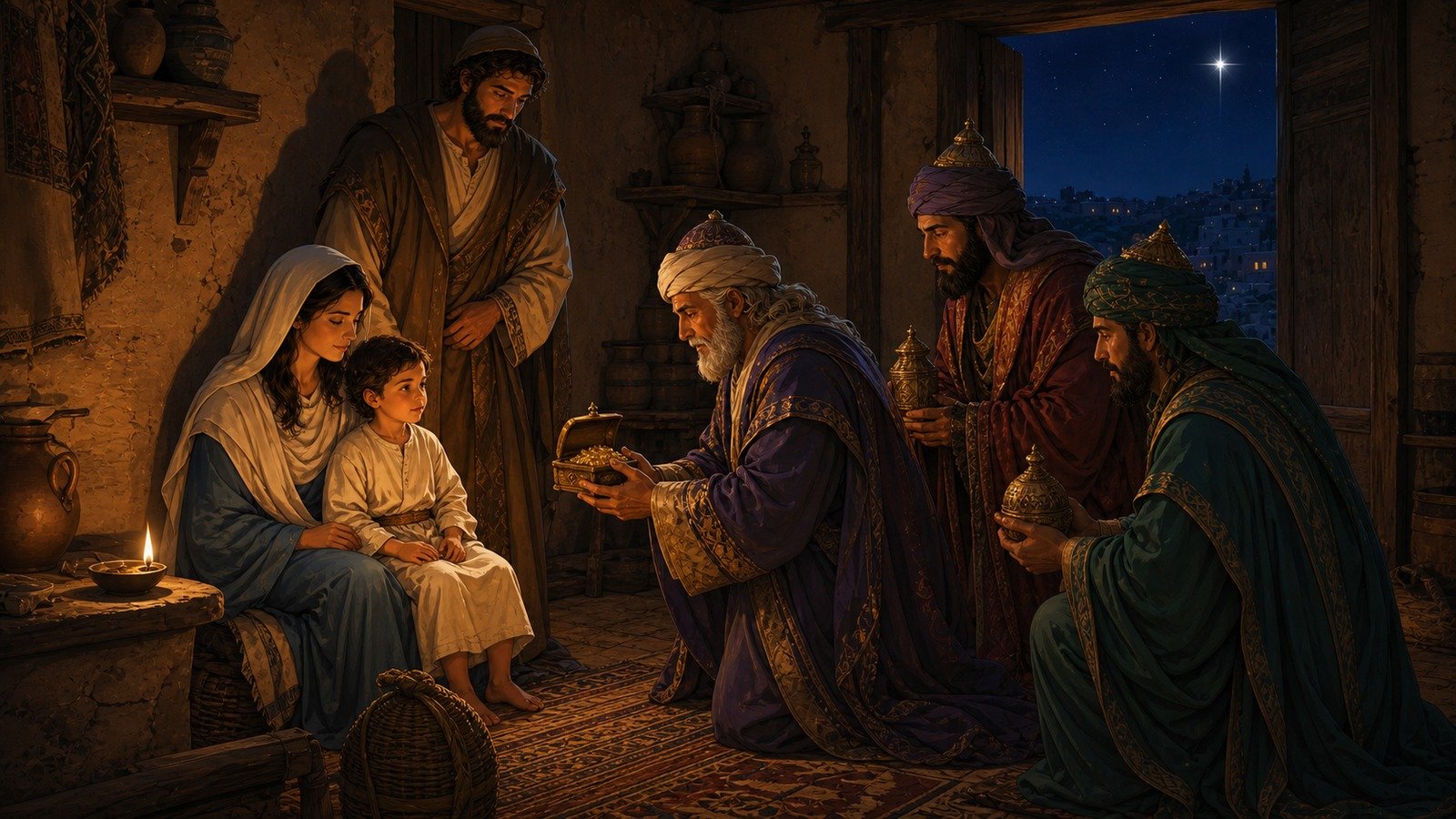
Magi from the East, having followed a star, arrive in Jerusalem asking for "the one who has been born king of the Jews," alarming Herod; guided further to Bethlehem, they present the child with gold, frankincense and myrrh before returning home by a different route, warned in a dream to avoid Herod.
Further context
3 min readAlmost everything popularly attached to this episode is added later. No number is mentioned, and neither are camels, kings or names. Three gifts are listed, which is where the number three comes from, and the medieval names Caspar, Melchior and Balthazar appear centuries afterwards.
The word used for them refers to a class of Persian and Babylonian priestly scholars associated with astronomy, astrology and dream interpretation, and the same term is used in Daniel of the wise men of Babylon. They come from the east, which in that vocabulary means Mesopotamia or Arabia, and they are Gentiles reading the sky.
Their question in Jerusalem causes a political incident: where is the one who has been born king of the Jews? We saw his star when it rose and have come to worship him. Asking that in the capital of a paranoid client king who had executed his own sons on suspicion is the most dangerous thing anyone in these chapters does, and Herod and all Jerusalem with him are disturbed.
He convenes the chief priests and teachers of the law and asks where the Messiah was to be born, and they answer from Micah without hesitation: in Bethlehem in Judea. The religious establishment knows the address and does not travel the ten kilometres to look.
He then meets the visitors secretly, finds out the exact time the star appeared, and sends them on with an instruction to report back so that he too may go and worship.
What the star was has generated a very large literature. Proposals include a conjunction of Jupiter and Saturn in 7 BC, a comet recorded in Chinese sources in 5 BC, a nova, and a phenomenon that was not astronomical at all. The difficulty for every natural explanation is the behaviour described, since it goes ahead of them and stops over a particular place.
They find the child with his mother in a house, not a stable, and the wording matters. Herod's later order covers boys two years old and under, in accordance with the time he had learned from them, which suggests a gap of up to two years between the birth and this visit. The nativity scene that puts shepherds and magi at the manger together compresses two episodes separated by many months.
The gifts are gold, frankincense and myrrh, all of them valuable trade goods of the Arabian caravan routes. Christian tradition has read them as royalty, divinity and burial, and their more immediate function is that they are portable wealth given to a poor family days before it has to leave the country.
They are warned in a dream not to go back to Herod, and return by another route.
Magi were a Persian priestly caste with a reputation for astronomy and dream interpretation, and the word gives English magic. How many there were is unknown; the traditional three comes from counting the gifts.
What they saw has produced centuries of astronomical work. The candidates include a triple conjunction of Jupiter and Saturn in 7 BC, a conjunction of Jupiter and Venus in 2 BC, a comet recorded by Chinese astronomers in 5 BC, and a nova. None accounts for a star that appears to move and then stop over a house.
They go to Jerusalem first, which is the natural place to look for a newborn king and which is what alerts Herod.
The gifts are usually read symbolically, and gold, frankincense and myrrh were all high-value trade goods from Arabia and the east. Myrrh was used in burial preparation, which is the detail that makes the list uncomfortable.