

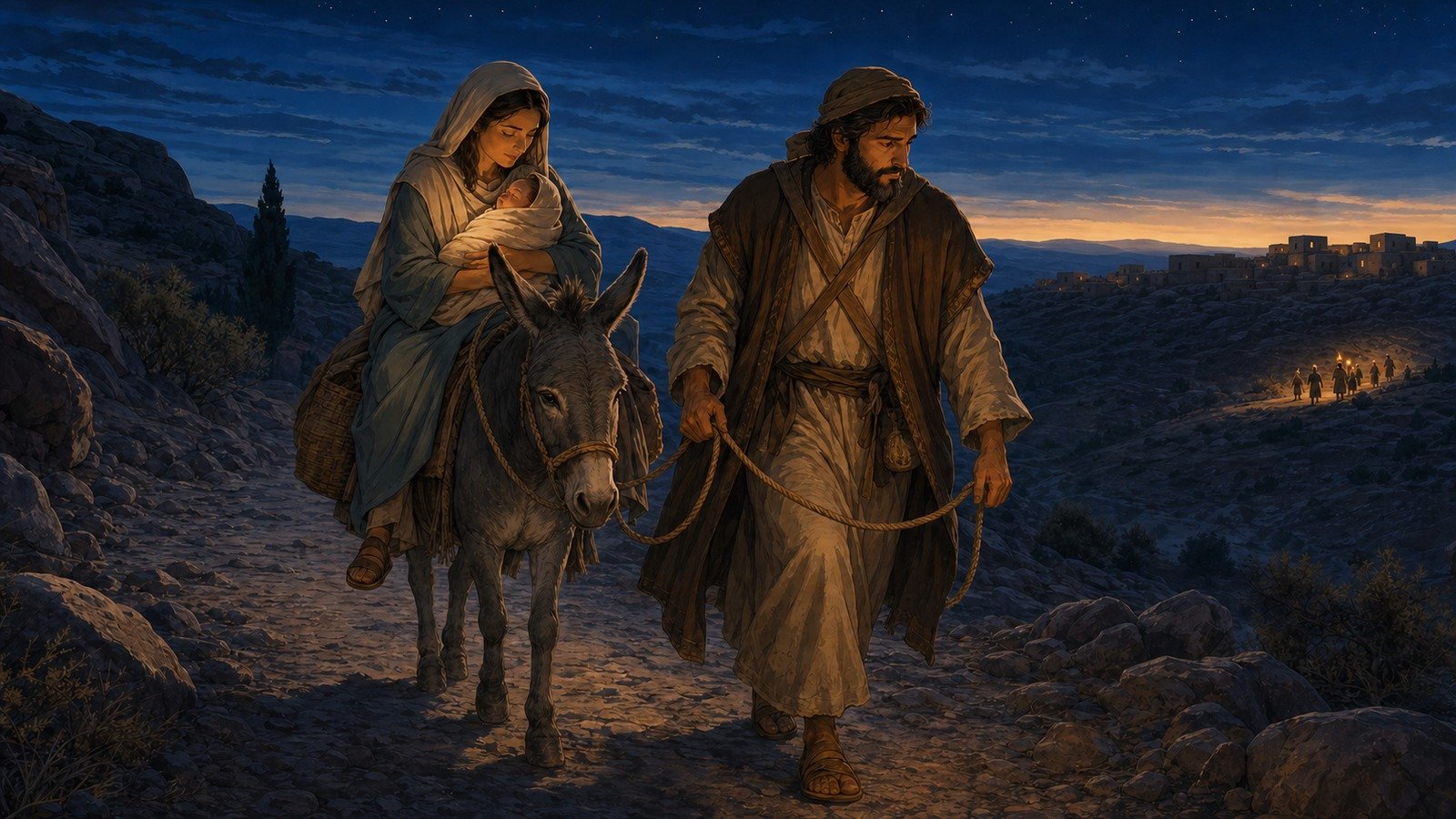
Warned in a dream, Joseph flees with Mary and Jesus to Egypt; Herod, enraged at being outwitted by the Magi, orders the killing of all boys two and under in Bethlehem's vicinity, an atrocity consistent with Herod's well-documented historical brutality even if not separately attested outside Matthew.
Further context
3 min readAn angel appears to Joseph in a dream and tells him to get up, take the child and his mother and escape to Egypt, and to stay there until told otherwise. He gets up during the night and leaves.
Egypt is the obvious destination and it is not exile into the unknown. It was outside Herod's jurisdiction, about a week's journey, and Alexandria held one of the largest Jewish communities in the world. Refugees from Judean politics had gone there before, and the gifts just delivered would have funded the journey and a period of support.
Herod's response when he realises the visitors have not come back is described in a single sentence: he was furious, and he gave orders to kill all the boys in Bethlehem and its vicinity who were two years old and under, in accordance with the time he had learned from the Magi.
The number of children involved is smaller than the phrase suggests. Bethlehem was a village, and estimates based on plausible population figures put the number of boys under two at somewhere between six and twenty. That is not a mass atrocity by the standards of the period, which is very probably why no other source mentions it.
The absence of independent corroboration is often raised as an objection and it needs stating fairly in both directions. Josephus, who is the main source for the reign, records a great deal about Herod's killings, including three of his own sons, his wife, her brother and grandfather, and hundreds of others, and he does not mention this. Against that, the killing of a handful of infants in a small village would not have registered against that record, and the action is entirely consistent with everything else known about the man in his final years.
The quotation attached to it is from Jeremiah and describes Rachel weeping for her children and refusing to be comforted, because they are no more. Rachel's tomb was traditionally located near Bethlehem, and Jeremiah had used her as an image of a mother mourning descendants being deported.
One line of the quotation attached to the flight is worth a note. Out of Egypt I called my son, in its original setting in Hosea, is about the nation being brought out of slavery, not about an individual at all. Matthew is doing something he does repeatedly: reading the life of one person as a compressed re-run of the history of a whole people, and the descent into Egypt and return is the clearest instance of it.
The family returns after Herod's death, and the reason given for settling in Galilee rather than Judea is that Archelaus was reigning in his father's place there, and Joseph was afraid. That fear was justified: Archelaus began his reign by killing three thousand people in the temple courts at Passover and was removed by Rome within a decade for misgovernment.
No source outside the Gospels mentions the massacre at Bethlehem, and that silence is sometimes cited as evidence against it. The counter-observation is one of scale: Bethlehem was a village of perhaps a few hundred people, and the number of boys under two would have been somewhere between six and twenty. Against Herod's record of executing his own wife, three of his sons, his mother-in-law and his brother-in-law, an incident of that size in a hill village would not have registered with Josephus at all.
Egypt was the obvious refuge. It was outside Herod's jurisdiction, it was three or four days' travel from Bethlehem, and it had a very large Jewish population, with a temple of its own at Leontopolis.
How long they stayed is unknown. Herod died in 4 BC, which places the return within a year or two at most, and later Egyptian Christian tradition developed an elaborate itinerary for the family that has no early support.