

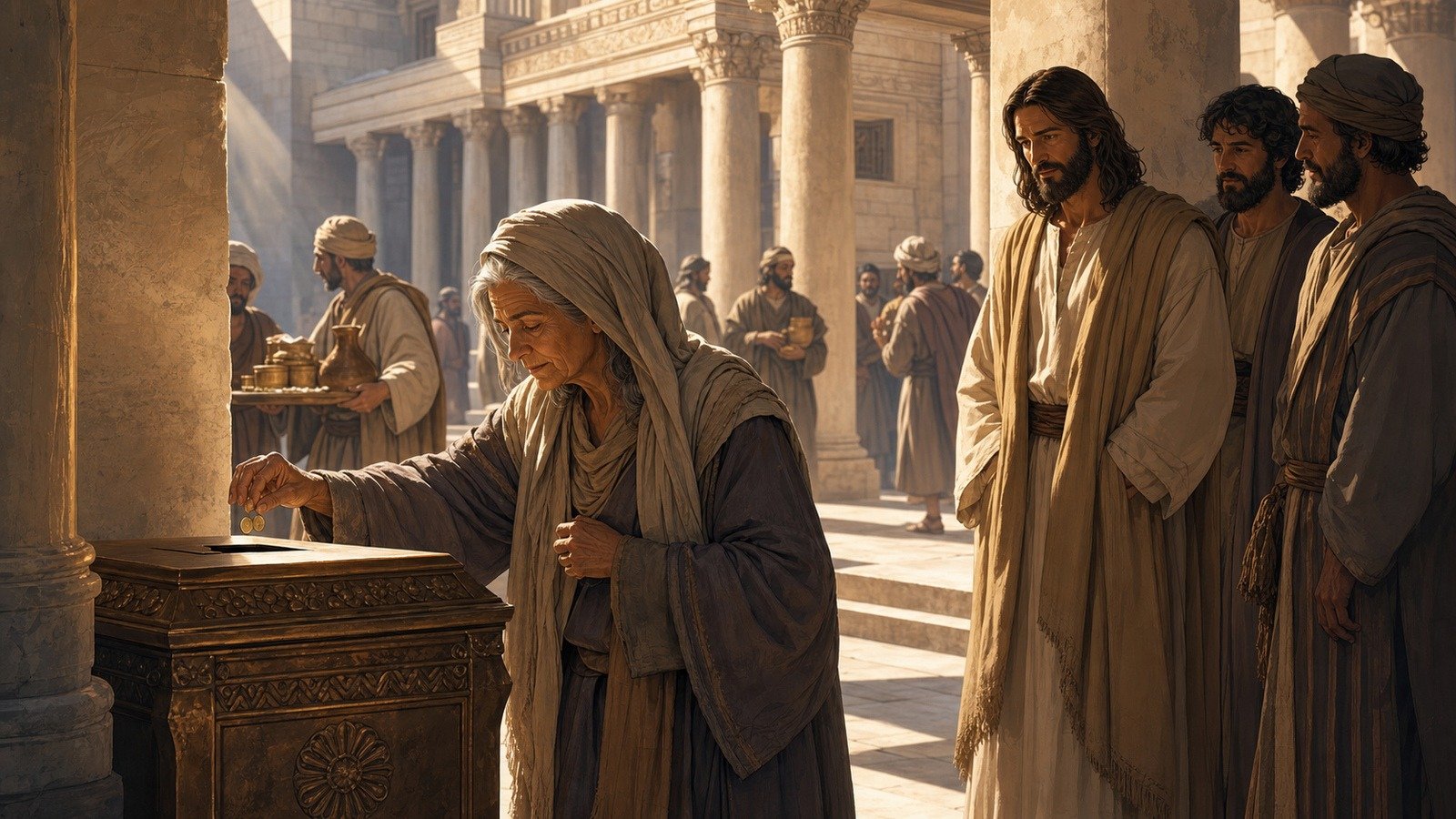
Watching people give at the Temple treasury, Jesus points out a poor widow's two small coins as a greater gift than the large sums given by the wealthy, since she gave "all she had to live on."
Further context
2 min readJesus sits down opposite the place where the offerings were put and watches the crowd putting money into the temple treasury.
The arrangement is worth picturing, because the physical setting explains the scene. Thirteen chests stood in the court of the women, each with a trumpet-shaped brass mouth and each labelled for a particular purpose: the annual half-shekel, the cost of doves, wood for the altar, incense, and freewill gifts. Coins dropped into a metal funnel made a noise, and the volume of it told everyone within hearing what had been given.
Many rich people threw in large amounts.
Then a poor widow comes and puts in two very small copper coins, worth only a few pence. The coin named is the lepton, the smallest in circulation in Judea, a thin bronze piece about a centimetre across; two of them made a quadrans, the smallest Roman coin, and something like a sixty-fourth of a day's wage for a labourer. She could have kept one and given the other, and did not.
He calls the disciples over to tell them what they have just watched, and the assessment reverses the arithmetic. Truly I tell you, this poor widow has put more into the treasury than all the others. They all gave out of their wealth; but she, out of her poverty, put in everything, all she had to live on.
The last phrase is stronger in Greek than in English. What she put in was her whole life, meaning her whole living, everything she had to keep herself with that day.
Widows in that society had almost no independent means. A woman without a husband depended on grown sons, on her father's household, or on charity, and the law's repeated instructions to protect widows exist because they were the easiest people in the country to ruin.
That context makes the placement of this episode uncomfortable in a way that is probably deliberate. A few sentences earlier, the teachers of the law have been denounced for devouring widows' houses while making lengthy prayers. A few sentences later, the disciples are admiring the stonework, and are told that not one stone will be left on another.
Between the criticism of a system and the announcement of its end stands a woman giving it everything she has.
Two small coins, and the sum is so trivial that a temple official emptying the chest would not have noticed it among the day's takings.
The episode has been used for two thousand years to encourage giving, and it is worth noticing that the man telling it does not encourage anything. He makes an observation about proportion to a group of disciples, in a building he has just said is finished, about a woman he never speaks to and who never knows he was watching.
The temple treasury was substantial. It held the annual half-shekel from every adult Jewish male in the empire, along with deposits placed there for safekeeping, and both Roman governors and earlier rulers had raided it when short of money.
Against that, two lepta. The comparison being made is not between her gift and the building's needs; it is between what was left in her hand and what was left in everybody else's.