

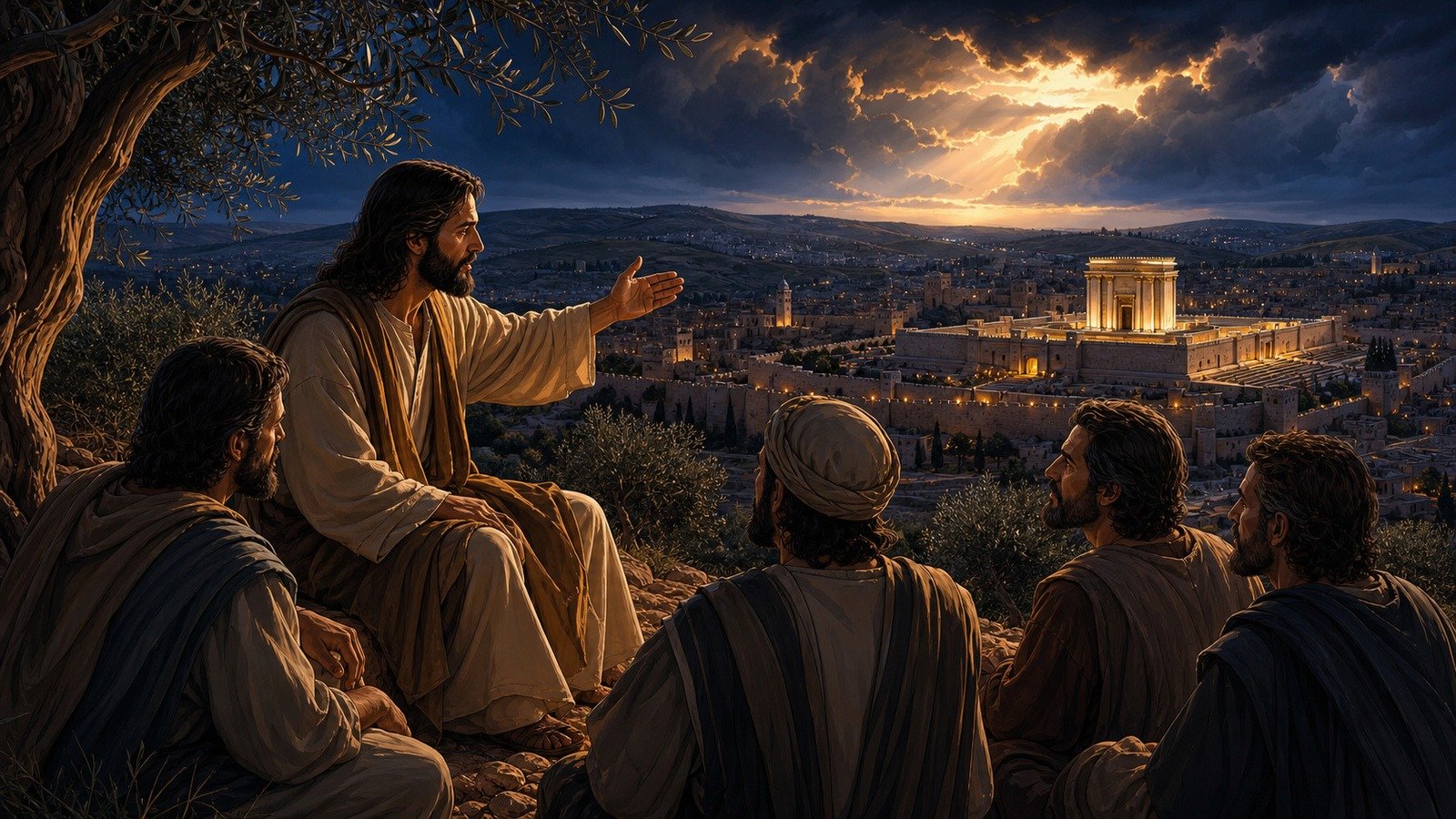
On the Mount of Olives, Jesus gives an extended private prophecy of the Temple's destruction, wars, persecution and false messiahs, and his own future return, illustrated with the parables of the ten virgins, the talents and the sheep and the goats.
Further context
2 min readLeaving the temple, one of the disciples says what any visitor said: look, teacher! What massive stones! What magnificent buildings!
That reaction was universal. Herod's platform was the largest sacred enclosure in the ancient world, and some of the foundation blocks in the western wall weigh several hundred tonnes and can still be touched. Josephus, who saw it standing, compares the whole structure to a snow-covered mountain.
Do you see all these great buildings? Not one stone here will be left on another; every one will be thrown down.
They cross the Kidron valley and sit on the Mount of Olives, opposite the temple, from where the whole complex lies spread out below, and four of them ask privately when this will happen and what the sign will be.
What follows is the longest continuous block of prediction he gives, and the most argued over, because two subjects are interwoven and separating them is genuinely difficult. One is the destruction of Jerusalem, which happened in AD 70 when Titus took the city, burned the temple and left the platform bare. The other is a final return and judgement.
Some readings assign nearly everything to the first century. Some assign nearly everything to the future. Most take him to move between the two, on the pattern of prophetic speech, where a near event and a distant one are described in the same breath because one prefigures the other. The disagreement is old, and the honest position is that the material resists a clean division.
The warnings are specific enough to be useful. Watch out that no one deceives you; many will come in my name claiming to be the Messiah. Wars and rumours of wars, but the end is still to come. Famines and earthquakes. Persecution, betrayal by family members, and hatred because of his name. False prophets producing signs.
Then a marker that reads as immediate: when you see the abomination that causes desolation standing where it does not belong, then let those who are in Judea flee to the mountains. The phrase comes from Daniel and had already been used of Antiochus IV's pagan altar in the temple two centuries earlier.
The instructions that follow are for people running for their lives. Do not go down into the house to take anything out. Pray it does not happen in winter, when the wadis flood.
Two things are stated about the timing. This generation will certainly not pass away until all these things have happened. And, about that day or hour no one knows, not even the angels in heaven, nor the Son, but only the Father.
Then the parables of the ten virgins, the talents, and the sheep and the goats.
The temple was destroyed in August of AD 70 after a siege of about five months, and Josephus, who was present in the Roman camp, describes the fire spreading through the buildings and the platform being cleared. What stands today is the retaining wall of the platform, not the temple.
Christians in Jerusalem are reported by a fourth-century historian to have left the city before the siege closed and settled at Pella across the Jordan, which if true would make the instruction to flee to the mountains something somebody acted on.