

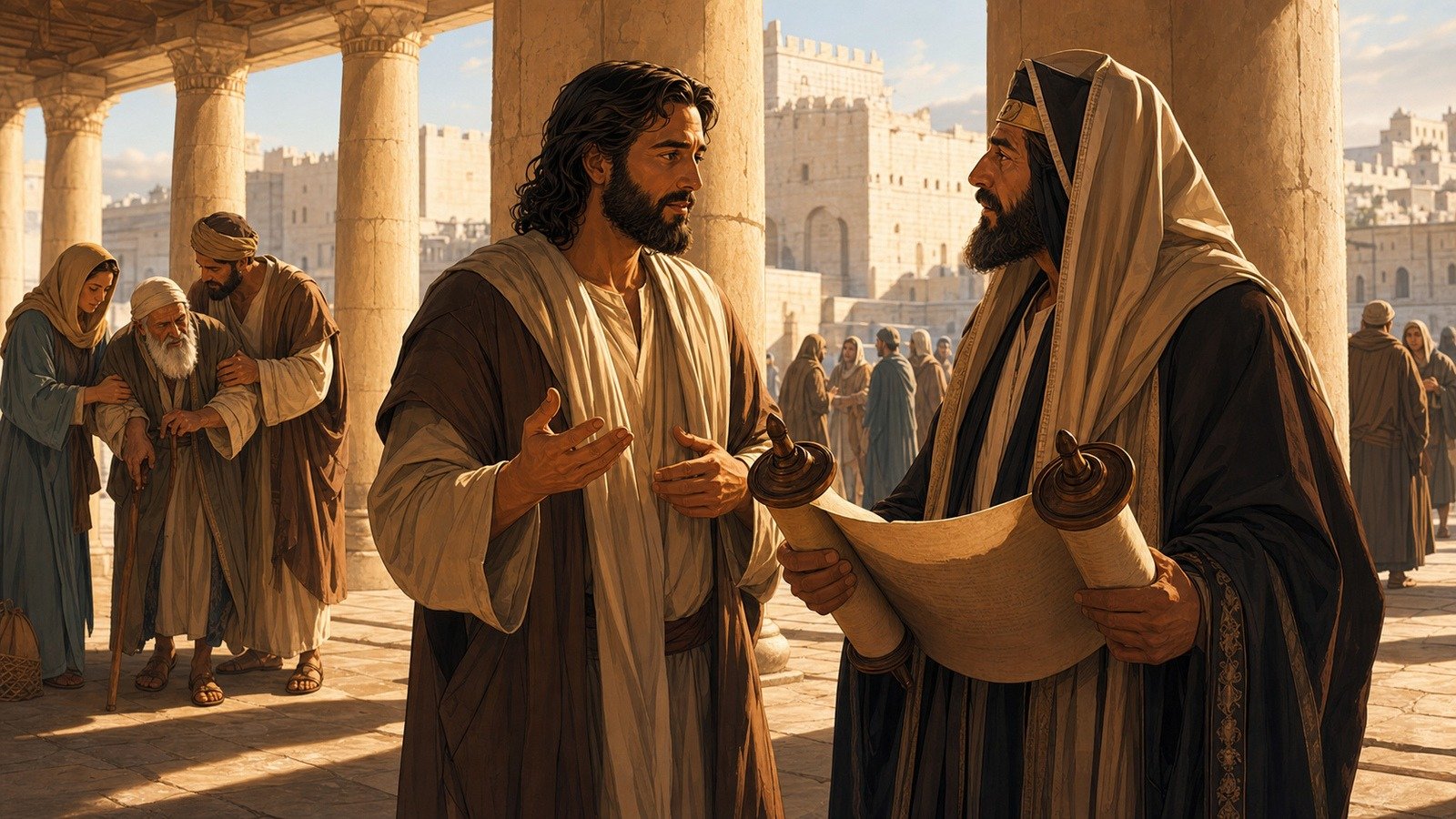
Asked which commandment is greatest, Jesus summarises the entire Law and Prophets as love of God and love of neighbour, and the questioning expert in the law is told he is "not far from the kingdom of God."
Further context
2 min readOne of the teachers of the law has been listening to the debates and notices that the answers have been good, so he asks his own question: of all the commandments, which is the most important?
The question was a standing one in Jewish discussion and it was not frivolous. Rabbinic tradition counted six hundred and thirteen commands in the law, two hundred and forty-eight positive and three hundred and sixty-five negative, and the question of which were weighty and which light was debated constantly, along with the related question of whether the whole law could be summarised without distorting it. A story preserved in the rabbinic material has a Gentile asking Hillel to teach him the entire law while standing on one leg, and getting an answer about not doing to others what you would hate done to you.
Jesus answers with two passages joined together, and joining them is the innovation.
The first is the sentence every observant Jew recited twice a day and still does, known from its opening word as the Shema: hear, O Israel, the Lord our God, the Lord is one. Love the Lord your God with all your heart and with all your soul and with all your mind and with all your strength. It was written on small scrolls placed in the boxes bound to the arm and forehead for prayer, and in the case fixed to the doorpost of a house.
The second comes from the middle of the levitical laws, in a passage about not bearing a grudge and not taking revenge: love your neighbour as yourself.
There is no commandment greater than these.
The teacher's response is worth quoting because it is one of the few times an opponent in that week agrees out loud. Well said, teacher. You are right in saying that God is one and there is no other but him. To love him with all your heart, with all your understanding and with all your strength, and to love your neighbour as yourself, is more important than all burnt offerings and sacrifices.
That last clause, from a man standing inside the temple where burnt offerings were being made all day, is not a small statement. He is repeating something the prophets had said, and the priests would not have thanked him for it.
Seeing that he had answered wisely, Jesus said to him: you are not far from the kingdom of God.
Not far is not the same as inside, and the sentence is left where it lands.
Neither passage was obscure and neither choice was surprising on its own. What had not been done before, so far as anything surviving shows, was to fasten them together and make everything else hang from the pair, which is what the closing sentence in Matthew's version does: all the Law and the Prophets hang on these two commandments.
The verb there is the one used of a door hanging on its hinges. Remove them and the rest does not stand.