

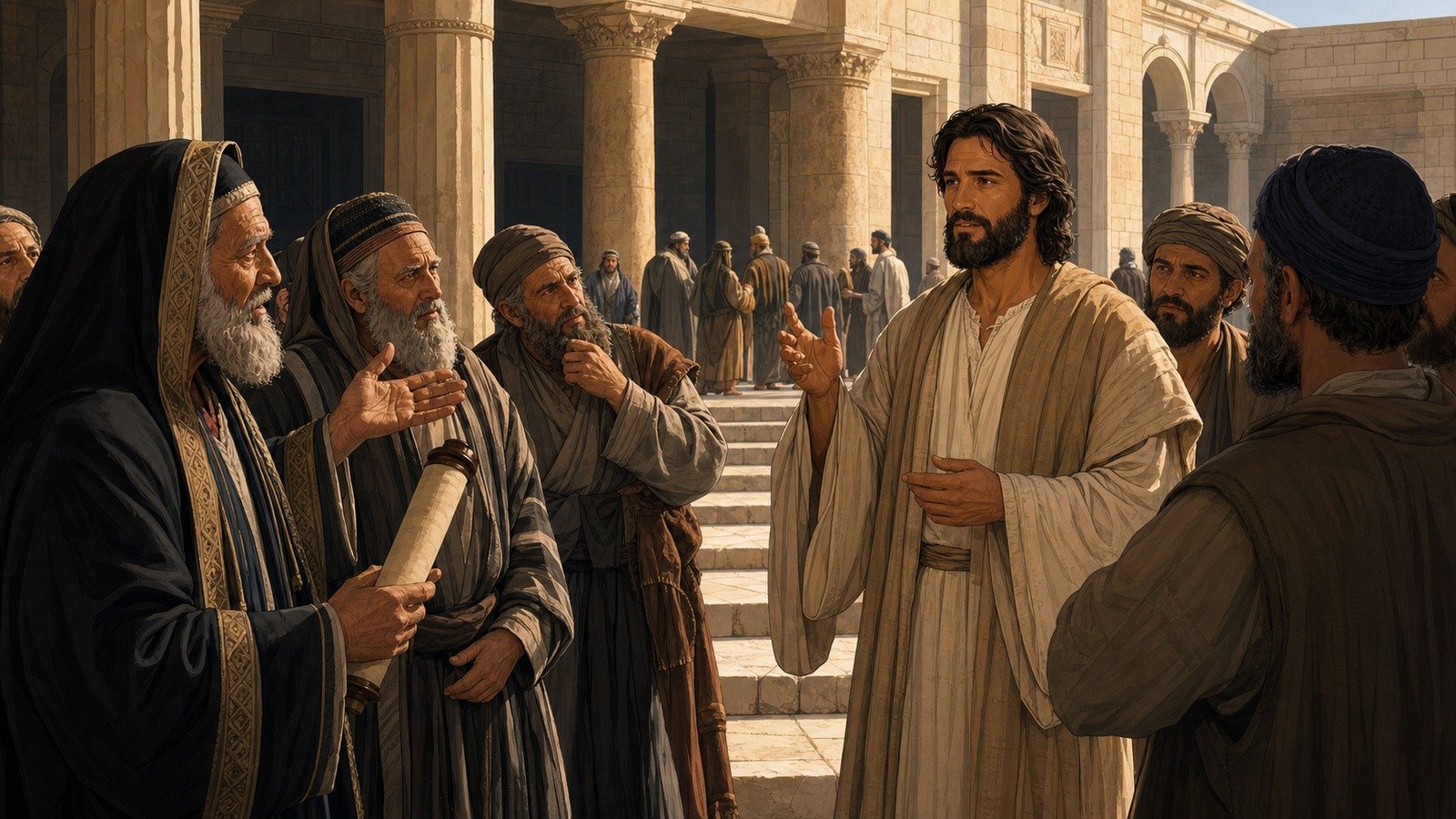
Sadducees, who deny bodily resurrection, pose a hypothetical case about a woman widowed by seven brothers in turn to make resurrection seem absurd; Jesus answers that resurrection life is not simply a continuation of earthly marriage arrangements.
Further context
3 min readThe Sadducees come next, and their question is designed to make the resurrection look ridiculous.
They need introducing, because they are the party modern readers know least. The Sadducees were drawn from the priestly aristocracy and the wealthy families of Jerusalem, they controlled the temple and supplied the high priest, they worked with the Roman administration because their position depended on stability, and they accepted only the five books of Moses as authoritative. On that basis they denied the resurrection of the dead, along with angels and spirits, since none of it is taught explicitly in those five books. Their opponents on this point were the Pharisees, who held all of it.
The case they put is drawn from the law of levirate marriage, which required a man to marry his brother's widow if the brother died childless, so that the first son of that union would carry the dead man's name and inherit his land. It is the mechanism behind the story of Ruth and Boaz, and behind an unpleasant episode in Judah's family.
Seven brothers, they say. The first marries and dies childless, the second takes her and dies, and so on through all seven. Finally the woman dies. Now then, at the resurrection, whose wife will she be, since the seven were married to her?
The answer comes in two parts and the first is blunt. You are in error because you do not know the Scriptures or the power of God.
At the resurrection people will neither marry nor be given in marriage; they will be like the angels in heaven. That does not say relationships end; it says the institution that exists to produce heirs and secure a line does not carry over into a state where nobody dies.
The second part is a piece of argument aimed precisely at their own position, using the only books they accepted. At the burning bush God says, I am the God of Abraham, the God of Isaac and the God of Jacob. He is not the God of the dead but of the living.
The whole weight rests on a present tense verb spoken to Moses centuries after all three men were buried.
Some of the teachers of the law respond: well said, teacher. And no one dared ask him any more questions.
The Sadducees disappear from history within forty years. Their standing rested entirely on the temple and its administration, and when the building burned in AD 70 there was nothing left for them to be. The Pharisees, whose religion lived in the law and the household, survived and became the foundation of rabbinic Judaism.
That the party who denied the resurrection did not outlive the institution it depended on is a historical fact rather than an argument, and it was noticed early by Christian writers who were not always careful about the difference.
Levirate marriage was still legally live in the first century, though rabbinic discussion of the period shows the obligation could be released through a ceremony, and its practical use was declining. The case put to him is therefore a textbook hypothetical rather than a situation anyone expected to face.
Seven husbands is the giveaway. The number is chosen to make the difficulty as ridiculous as possible, and it draws on a story in the book of Tobit where a woman loses seven husbands in succession.