

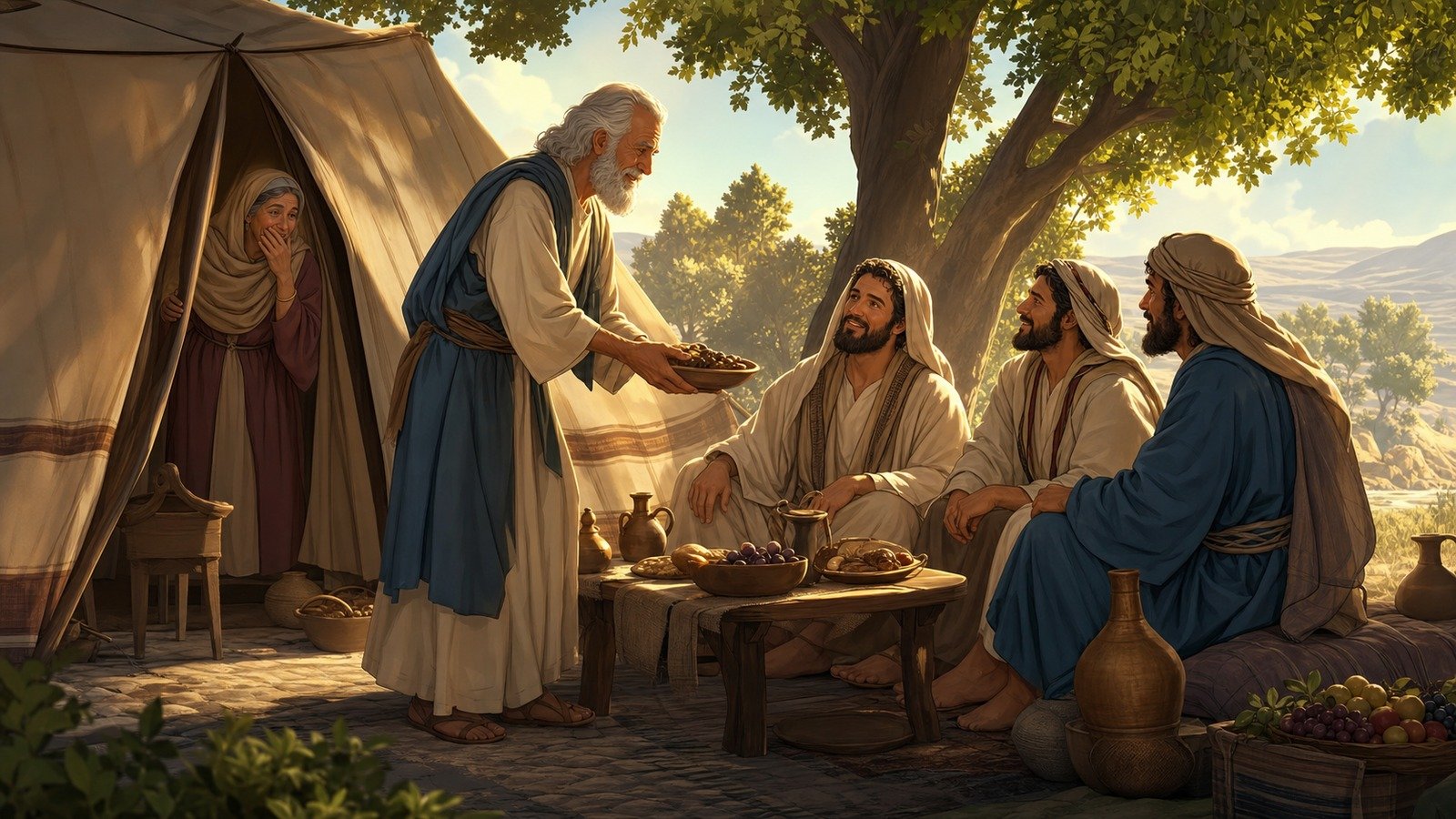
Three visitors, one identified as the Lord, tell Abraham that Sarah will bear a son within the year. Sarah, listening from inside the tent, laughs at the prospect.
Further context
2 min readThree men appear near the great trees of Mamre in the hottest part of the day, while Abraham is sitting at the entrance to his tent. He is told that the LORD appeared to him, and then that he looked up and saw three men, and the speech moves between singular and plural without anyone explaining the relationship. Two of the three go on to Sodom afterwards and are called angels there. Christians have understood the scene as a divine appearance accompanied by two messengers, and some have seen in the three visitors an anticipation of the Trinity, an association made famous by Andrei Rublev's fifteenth-century icon. The question is left open.
The hospitality is described in detail because the detail carries the point. He runs to meet them, bows to the ground, and offers a little water, a rest under the tree and a morsel of bread. He then hurries to Sarah and asks her to take three seahs of the finest flour, roughly twenty litres, and bake. He runs to the herd, picks out a choice calf and has a servant prepare it, and sets curds and milk in front of them while standing by as they eat. Understating the offer and then producing a feast was the convention, and the pace of the verbs, running and hurrying and quickly, is how the effort gets conveyed.
They then ask where Sarah is, using her name, which he has not told them. The announcement follows: this time next year she will have a son.
Sarah is listening at the tent entrance behind them. Her situation is stated without euphemism, that she was past the age of childbearing, and she laughs to herself and asks whether, worn out as she is and with her husband old, she will now have this pleasure. The question put in reply is what the whole scene is built towards: is anything too hard for the LORD?
What follows is short and very human. She denies laughing because she is afraid, and is told that she did laugh. Nothing is done about it, and the promise stands.
Her position in the scene reflects the conventions of the household rather than accidental exclusion. She prepares the bread and stays inside while the men eat under the tree, which is what the etiquette required, and it is why she is listening at the entrance rather than sitting with them. The visitors nonetheless ask for her by name, address the promise to her situation specifically, and speak to her directly when she denies laughing. The conversation reaches through the tent wall to the person it actually concerns.
Laughter runs through this stretch of the story as a deliberate thread. Abraham laughed at the same announcement a year earlier. Sarah laughs here. The son's name, Isaac, means he laughs, and when he is born she says that God has brought her laughter and that everyone who hears will laugh with her. The pun is built across four episodes, and it travels from disbelief to delight.
Much later, a letter urging Christians to show hospitality to strangers points back to this afternoon, noting that some have entertained angels without knowing it. That is precisely Abraham's position when he starts running.