
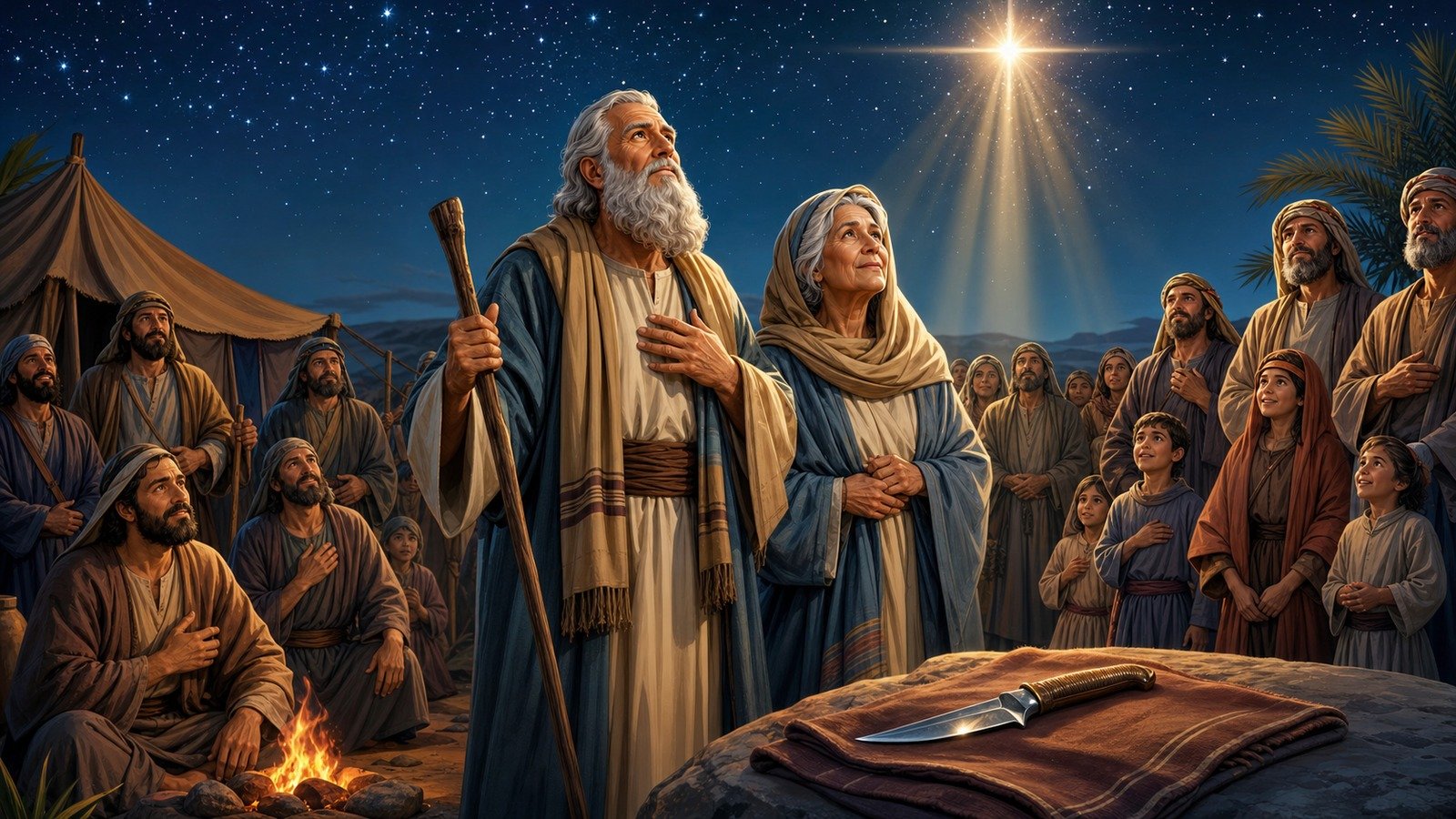
Thirteen years after Ishmael's birth, God renews his covenant with Abram, now 99, renaming him Abraham ("father of many") and Sarai as Sarah, and establishing circumcision as the covenant's physical sign for every male in his household.
Further context
2 min readThirteen years pass with nothing recorded in them. Abram is ninety-nine when God appears again and introduces himself with a title used here for the first time, God Almighty (El Shaddai). What it means is uncertain; a connection with the Akkadian word for mountain is the commonest suggestion, and the traditional English rendering comes through the Greek and Latin versions rather than from a secure Hebrew derivation.
Two names change. Abram, meaning exalted father, becomes Abraham, explained as father of many. Sarai becomes Sarah, both forms meaning princess. Renaming by a superior was an assertion of authority across the ancient world, and these new names commit the couple publicly to a promise that has so far produced one son by a slave.
The sign attached is circumcision, applied to every male at eight days old, and to every male in the household including those bought from foreigners. The practice was not unique to Israel. Egyptian tomb reliefs depict it, and Jeremiah lists Egypt, Edom, Ammon and Moab alongside Judah as peoples who practised it. The Philistines did not, which is why "the uncircumcised" works as a standing description of them. What is new is not the custom but the meaning attached to it: it becomes the mark of a covenant, and refusing it cuts a man off from the community.
Abraham's response to the announcement that Sarah will bear a son is to fall face down and laugh, asking whether a child will be born to a man of a hundred and whether Sarah will bear at ninety. The laughter draws no rebuke. He then asks that Ishmael might live under God's blessing, which reads as a request that the promise be routed through the son he already has.
The answer separates two things that are usually merged. Ishmael is blessed, will be fruitful, will father twelve rulers and become a great nation. The covenant, however, will be established with Isaac, a son not yet conceived, whose name is supplied in advance and means he laughs. Blessing and covenant are distributed differently, and the distinction is made carefully.
Two features here are easy to overlook. The covenant is called everlasting four times in seventeen verses, and the land is described as an everlasting possession, which is stronger language than anything used earlier. And the sign is applied to every male in the household, including servants born there and men bought with money, none of whom is descended from Abraham. From the outset the community carrying this covenant is defined by the mark rather than by blood alone.
Abraham circumcises every male in his household the same day: himself at ninety-nine, Ishmael at thirteen, and everyone born in the household or purchased.
Paul later builds an argument out of the order of these events. Abraham was credited with righteousness before circumcision was commanded, so circumcision is described as a sign and seal of a standing he already had. The sequence is the whole of the argument, which is why the fourteen-year gap between the two moments matters.