

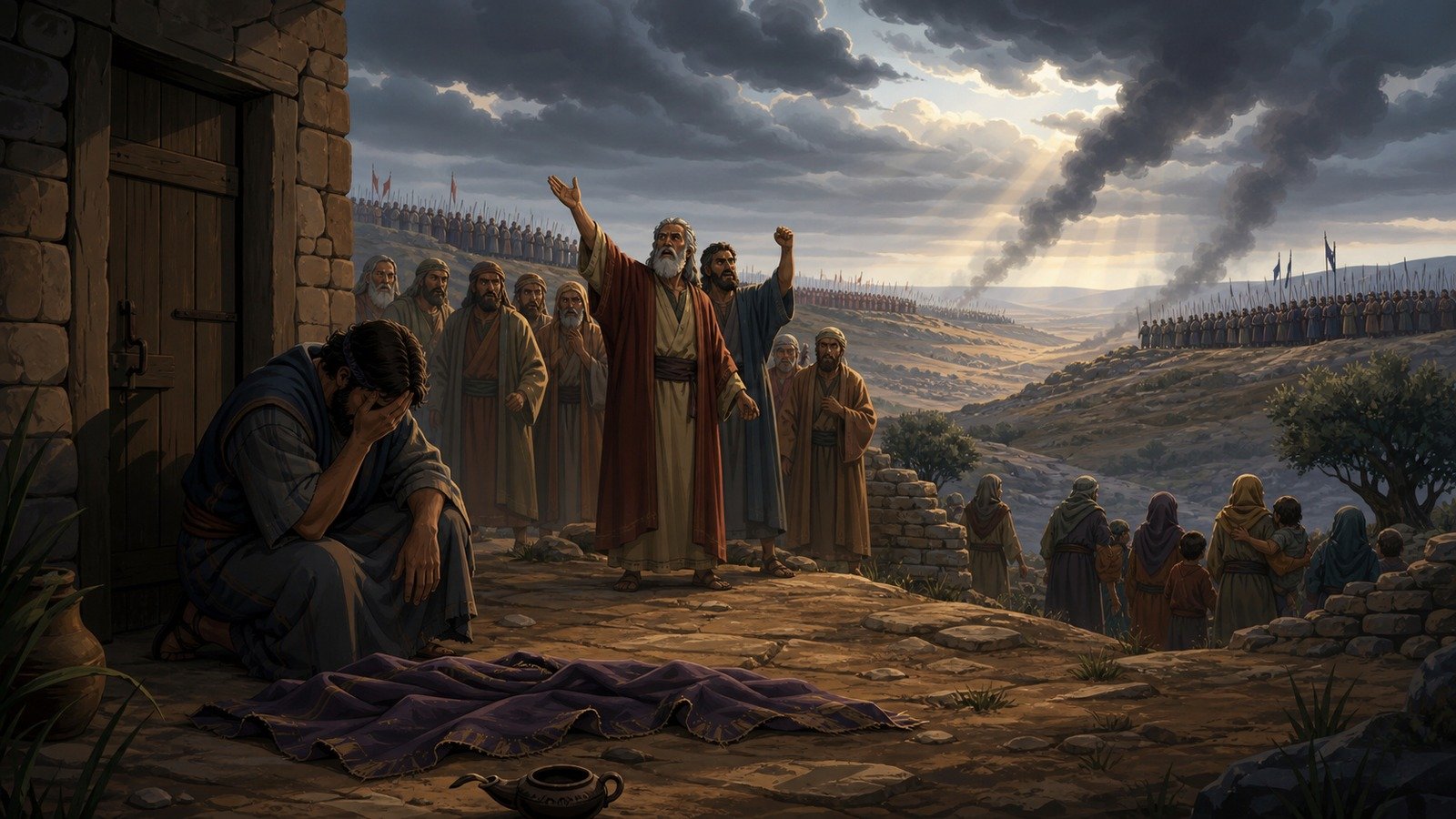
The brutal rape and murder of a Levite's concubine at Gibeah leads the other tribes to near-annihilate Benjamin in a civil war, then scramble to preserve the tribe's survival through further violence. The book closes on this account of Israel's moral collapse without a king.
Further context
2 min readThis is the worst thing in the entire period and it is told without a single word of comment from beginning to end.
A Levite living in the hill country of Ephraim takes a concubine from Bethlehem. She leaves him and goes back to her father, and after four months he goes to persuade her to return. Her father keeps delaying his departure with hospitality for several days, and they finally set out late in the afternoon.
They pass Jerusalem, still a Jebusite town, because the servant suggests stopping and the Levite refuses to spend the night in a city of foreigners. They go on to Gibeah, which belongs to Benjamin, and sit in the square because nobody offers them a place. An old man from Ephraim, living there as an outsider, eventually takes them in.
What happens that night deliberately repeats a scene from Genesis. Wicked men surround the house and demand the male guest. The host offers his own virgin daughter and the concubine instead, using almost the same words used at Sodom. The Levite pushes his concubine out of the door to them and shuts it, and they abuse her all night and let her go at dawn. She falls at the threshold with her hands on it, and in the morning he opens the door and tells her to get up, and she does not answer.
He puts her on his donkey, takes her home, cuts her into twelve pieces and sends them through every region of Israel. The whole nation assembles, four hundred thousand men, and what he tells them about that night omits the fact that he handed her over.
Benjamin refuses to surrender the men of Gibeah, and civil war follows. Israel is beaten twice with heavy losses before winning on the third attempt, and the tribe of Benjamin is reduced from twenty-six thousand fighting men to six hundred, with its towns burned.
Then Israel realises what it has done and holds a national mourning for the tribe it has just destroyed. Having sworn not to give their daughters to Benjamin, they solve the problem by destroying Jabesh Gilead for failing to attend the assembly and giving its four hundred surviving virgins to the survivors, and then by instructing the remaining Benjamites to abduct girls from a festival at Shiloh.
Two things about how this is told are worth stating. Everything in it deliberately echoes the destruction of Sodom, down to the wording of the offer made at the door, and the effect is to say that a town in Israel has become what Israel was sent to displace. And the woman is given no name, no words and no point of view; she is sent out, brought back on a donkey, spoken to once and divided into twelve pieces, and the man who did it addresses a national assembly without mentioning his own part in it.
The last sentence is the one that has run four times through the book: in those days Israel had no king; everyone did as they saw fit.