

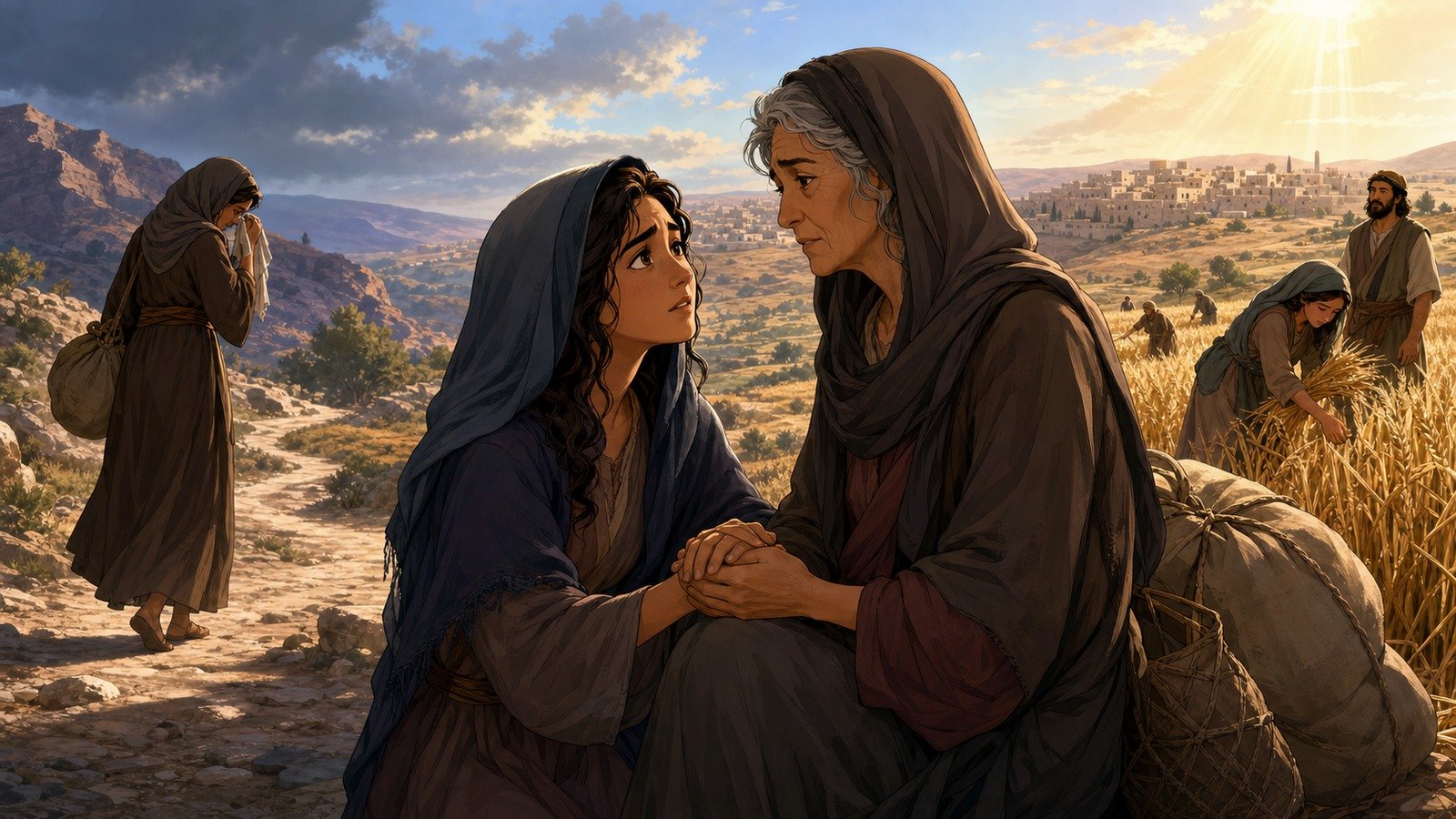
Famine drives Naomi's family to Moab, where her sons marry Moabite women before all three men die. Naomi returns to Bethlehem, and her Moabite daughter-in-law Ruth refuses to leave her, pledging loyalty in words that became one of Scripture's best-known statements of devotion.
Further context
2 min readA famine in Bethlehem drives a man called Elimelek, his wife Naomi and their two sons across the Jordan into Moab, which is roughly eighty kilometres away and belongs to a people Israel had fought and been forbidden to associate with. The move is a measure of how bad the famine was.
He dies there. The two sons marry Moabite women, Orpah and Ruth, and after about ten years both sons die as well, leaving three widows and no male relatives in a society where a woman's economic standing came entirely through a husband or a son.
Naomi hears the famine at home has ended and sets out to return, and tells her daughters-in-law to go back to their mothers' homes. Her argument is bleakly practical: she has no more sons to give them, she is too old to have a husband, and even if she married tonight and bore sons, would they wait until those boys grew up? Orpah kisses her and goes, and nothing critical is said about that. It was the sensible decision and the one Naomi urged.
Ruth's answer is the reason the story exists, and it is poetry rather than prose. Do not urge me to leave you or to turn back from you. Where you go I will go, and where you stay I will stay. Your people will be my people and your God my God. Where you die I will die, and there I will be buried. May the LORD deal with me, be it ever so severely, if even death separates you and me.
A Moabite woman is swearing by the God of Israel to a destitute Israelite widow with nothing to offer her.
They arrive at Bethlehem at the beginning of the barley harvest, and the whole town is stirred. Naomi tells them not to call her Naomi, which means pleasant, but Mara, which means bitter, because the Almighty has made her life very bitter. She says she went away full and the LORD has brought her back empty, and she says it standing next to the daughter-in-law who has just given up her country for her.
Ruth then goes out to glean, which is a legal right rather than charity: harvesters were forbidden to reap to the edges of a field or to go back for what they dropped, and the leftovers belonged to the poor, the widow and the foreigner. She happens to end up in a field belonging to Boaz, a relative of Elimelek, who notices her, tells his men to leave her alone, and instructs them to pull out stalks deliberately for her to find.
What he says to her explains why: I have been told all about what you have done for your mother-in-law since the death of your husband. The town has been talking, and what it has been saying is in her favour.