

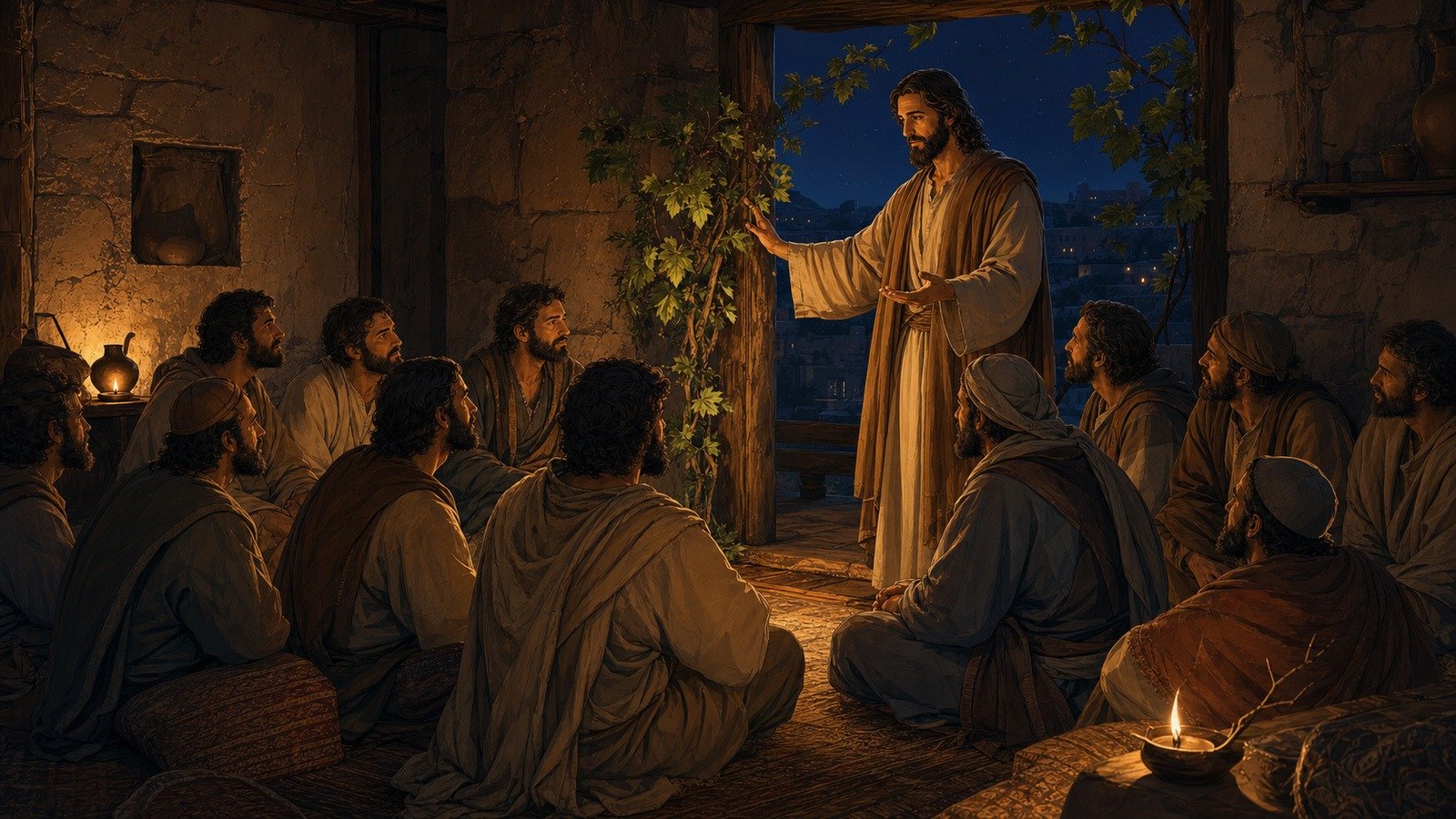
Jesus prepares the disciples for his departure, promising the Holy Spirit as an "Advocate" who will continue his work, describing himself as the true vine to which they must remain connected, and warning them plainly that the world will hate them as it hated him.
Further context
2 min readWhat Jesus says in that room after the meal runs to four chapters and it is addressed to eleven men who are about to lose everything they have organised their lives around.
It opens by naming the problem. Do not let your hearts be troubled. You believe in God; believe also in me. My Father's house has many rooms. I am going there to prepare a place for you.
Thomas objects that they do not know where he is going, so how can they know the way, and gets one of the most quoted sentences in the New Testament: I am the way and the truth and the life. Philip asks to be shown the Father, and is told that anyone who has seen him has seen the Father.
The promise that runs through the whole passage is of someone coming to replace him. The word used is paraklētos, which has no single English equivalent and has been rendered Comforter, Counsellor, Helper and Advocate. Its ordinary sense in Greek is someone called to your side, particularly in a legal setting: the person who stands with the accused and speaks for them.
I will ask the Father, and he will give you another advocate to help you and be with you for ever, the Spirit of truth. The word for another means another of the same kind.
What that advocate is described as doing is specific rather than atmospheric. He will teach them all things and remind them of everything he has said. He will testify about him. He will guide them into all truth. He will convict the world about sin and righteousness and judgement.
Then the image of the vine, which would have carried a political charge for that audience, since a golden vine hung over the entrance to the temple sanctuary and the vine was a national emblem struck on coins during both revolts against Rome.
I am the true vine and my Father is the gardener. Remain in me, as I also remain in you. No branch can bear fruit by itself; it must remain in the vine.
Alongside the comfort there is a warning delivered without softening. If the world hates you, keep in mind that it hated me first. They will put you out of the synagogue; in fact, the time is coming when anyone who kills you will think they are offering a service to God.
Within a few years that was happening, and the man who supervised it later wrote about it himself.
It ends: in this world you will have trouble. But take heart! I have overcome the world.
The vine passage carries a warning as well as a promise. Branches that bear no fruit are cut off, and ones that do are pruned so they will bear more, which is an accurate description of viticulture and an uncomfortable image either way.
He also gives a new commandment, and calls it that: love one another as I have loved you. The command to love a neighbour was already in the law; what is new is the standard attached, which had been demonstrated with a basin and a towel an hour or two earlier and was about to be demonstrated again.