

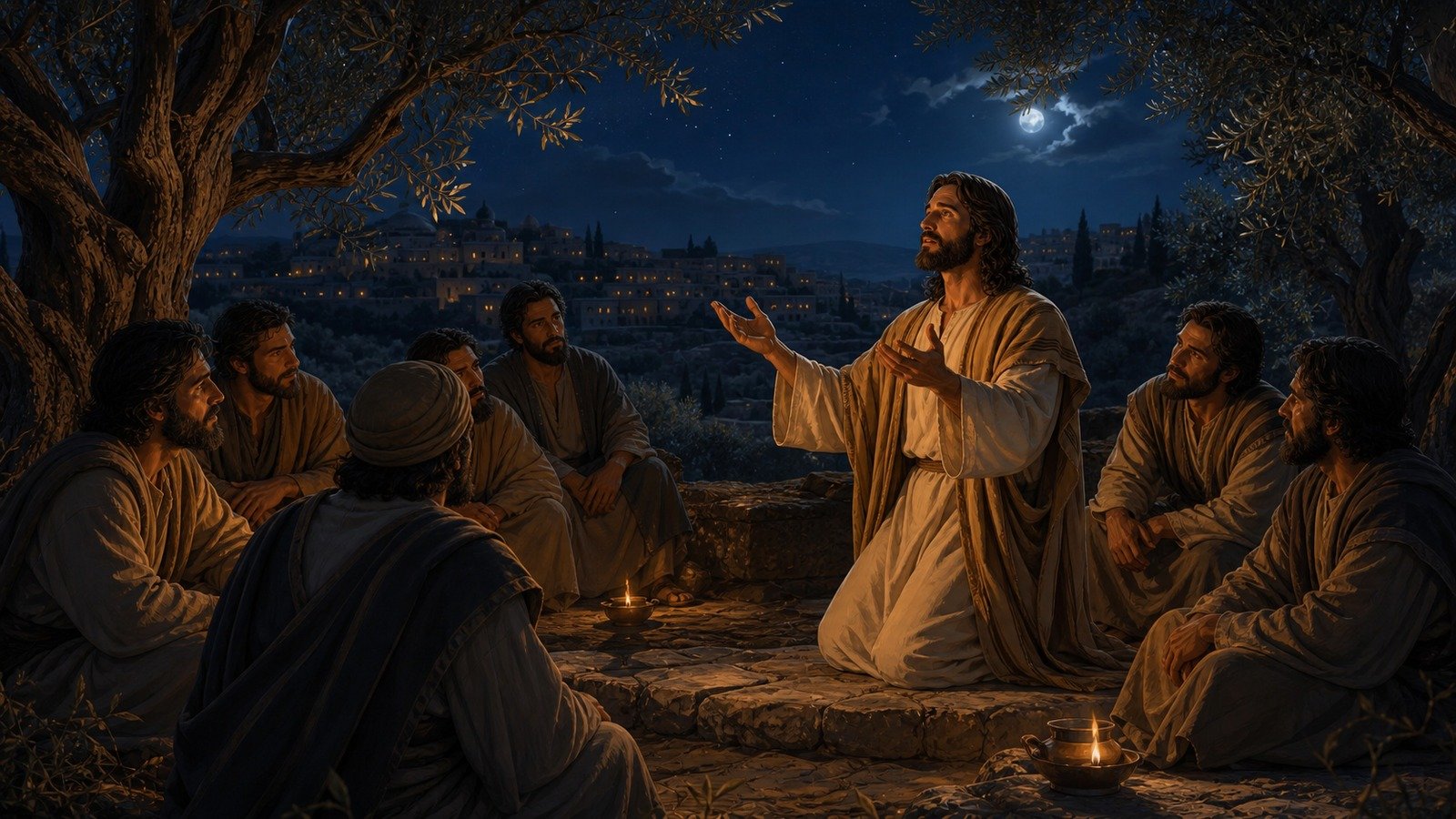
Jesus prays aloud in the disciples' presence, first for himself facing the cross, then for the disciples' protection and unity, and finally for all future believers, "that all of them may be one," closing his final teaching before the arrest.
Further context
2 min readJesus looks up towards heaven and prays aloud, with the eleven listening, and it is the longest of his prayers anyone recorded.
Praying with eyes raised rather than lowered was the ordinary Jewish posture, standing and looking up, and it means the disciples could see his face while he did it.
The prayer falls into three movements, and the order of them says something about what mattered to him that evening.
He prays first about himself, and briefly: Father, the hour has come. Glorify your Son, that your Son may glorify you. The hour is a phrase that has been running through the whole account, first as something that had not yet come, and now as something that has.
Then he prays for the eleven, at length. He asks that they be protected by the Father's name, that they may be one as we are one. He says he has kept them safe and none has been lost except the one doomed to destruction. He asks not that they be taken out of the world but that they be protected from the evil one. And he says something about their position that becomes the standing description of Christian life afterwards: they are not of the world, even as I am not of it, and yet they are being sent into it.
Sanctify them by the truth; your word is truth.
The third movement widens the circle. My prayer is not for them alone. I pray also for those who will believe in me through their message, that all of them may be one, Father, just as you are in me and I am in you.
The stated purpose of that unity is not comfort or efficiency. It is evidence: so that the world may believe that you have sent me.
That sentence has been quoted in every serious discussion of Christian division for four hundred years, usually by people on opposite sides of one. Whatever else it does, it makes the fractures between churches a matter the prayer itself treats as visible to outsiders and consequential.
It is called the High Priestly Prayer because of what he is doing in it. A high priest went into the sanctuary once a year carrying the names of the tribes on his breastpiece and made atonement for the people. This is a man about to be arrested, praying for the people he is leaving behind, hours before doing something he describes as being done on their behalf.
The prayer is the last thing recorded before they leave the room and cross the Kidron valley to the olive grove, which makes it the last thing said to the eleven before the arrest.
Its language about being in the world but not of it has become one of the standard framings of Christian life, and it has been used to justify withdrawal and engagement in roughly equal measure. What the prayer itself asks for is not removal but protection while they are sent in.
Nothing about the prayer suggests it was overheard by accident. He prays aloud, in their presence, about them, which is a way of telling them things that could not be said to them directly.