

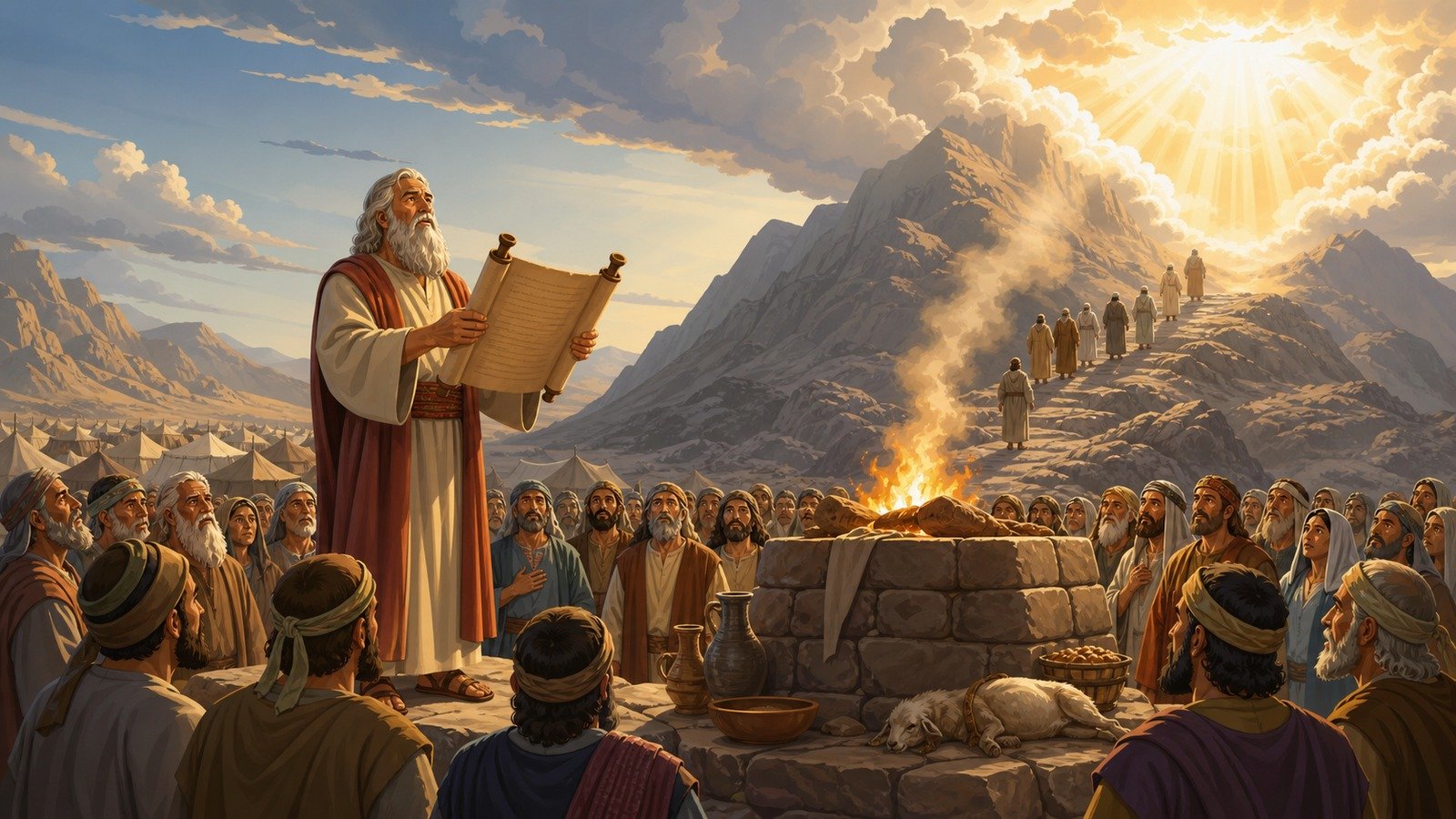
Further case law covering property, personal injury and social justice is given, and Israel formally accepts the covenant, sealed with sacrificial blood and a meal on the mountain in the presence of God.
Further context
2 min readThe Ten Commandments are principles. What follows them is case law, and the collection is called the Book of the Covenant when it is read out.
The form is the standard legal style of the ancient Near East: a situation, then its consequence. If a man does this, then that follows. The subjects covered are the ones a settled agricultural community actually litigates: the terms on which a Hebrew servant is released in the seventh year, compensation for injuries caused in a fight, an ox that gores a person, a pit left uncovered, a fire that spreads into a neighbour's field, theft and restitution, and the return of a borrowed animal that dies.
Comparison with the Code of Hammurabi, inscribed in Babylon in the eighteenth century BC, is instructive in both directions. The two share the form and several specific cases, including the goring ox, which appears in both with similar reasoning about whether the owner had been warned. The differences are structural. Hammurabi's penalties vary with the social rank of the victim, so that an offence against a nobleman costs more than the same offence against a commoner. These laws do not grade by class. Babylonian law imposes death for a range of property offences; these impose restitution for property and reserve death for offences against persons. The two systems weigh life and property differently.
The phrase best known from this section, eye for eye and tooth for tooth, is a limiting formula rather than a licence. Its function in a society where feud escalated was to cap retaliation at the level of the injury, and the provisions around it deal in compensation rather than mutilation.
Interleaved with the property law is a different kind of instruction, about the foreigner, the widow, the orphan and the poor. Do not oppress a foreigner; you yourselves know how it feels to be foreigners, because you were foreigners in Egypt. Do not charge interest to the poor. Return a cloak taken in pledge before sunset, because it is the only covering a man has to sleep in. The reason given is repeatedly the community's own recent experience.
The ratification is physical. Moses writes the words down, builds an altar with twelve stone pillars, and has young men offer sacrifices. He takes half the blood and puts it in bowls and splashes the other half against the altar. Then he reads the whole thing aloud and the people answer that they will do everything the LORD has said and will obey. He sprinkles the blood from the bowls over them and says, this is the blood of the covenant that the LORD has made with you.
Moses, Aaron, Nadab, Abihu and seventy elders then go up and see the God of Israel, with something like a pavement of lapis lazuli under his feet, as bright blue as the sky. God did not raise his hand against them, and they ate and drank.
Those words spoken over the blood are quoted in the letter to the Hebrews, and the same phrasing turns up at the Last Supper.