

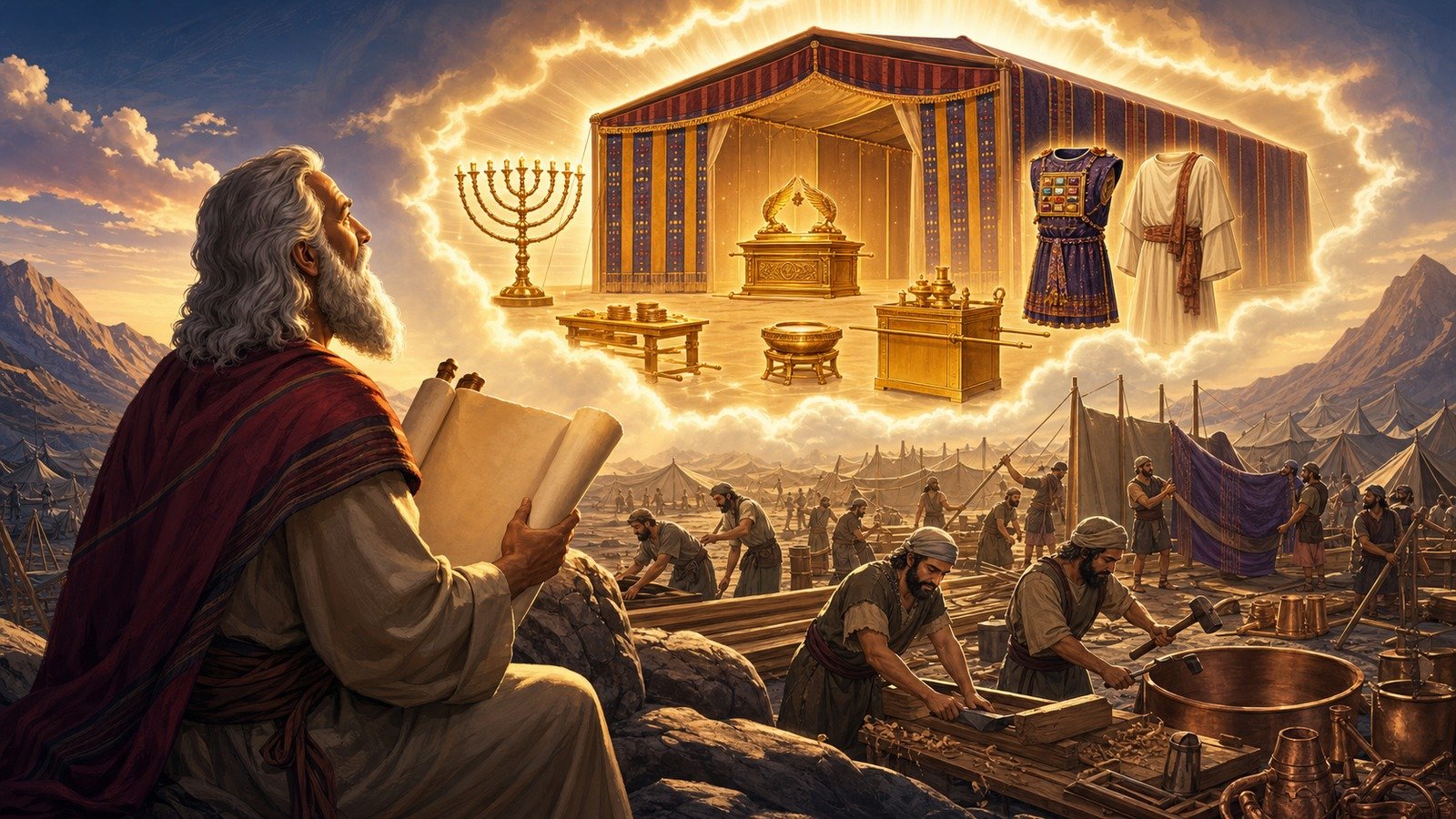
God gives Moses detailed instructions for a portable sanctuary, the ark of the covenant, its furnishings, the priestly garments and the appointment of skilled craftsmen, establishing the pattern for Israel's worship.
Further context
3 min readSeven chapters are given to the specification of a portable sanctuary, the tent Israel is to carry through the wilderness. The proportion is worth noticing: the creation of the world takes one chapter and the plagues take seven, and this tent takes seven and is then described all over again when it is built.
The materials come from voluntary contributions, and the list runs from gold, silver and bronze through blue, purple and scarlet yarn, fine linen, goat hair, ram skins, acacia wood, olive oil, spices and precious stones. The purpose is stated in one sentence: have them make a sanctuary for me, and I will dwell among them.
The instructions begin at the centre and work outwards. The ark is a chest of acacia wood overlaid inside and out with gold, two and a half cubits long, with rings and poles so that it is never carried by hand. Its lid, the atonement cover, has two cherubim of hammered gold facing each other with their wings spread over it, and that is where God says he will meet Moses and speak with him. Then a table for the bread of the Presence, and a lampstand hammered out of a single talent of pure gold, with six branches and almond-shaped cups.
The tent itself follows: ten linen curtains, a covering of goat hair over them, a framework of upright acacia frames set in silver bases, and a curtain of blue, purple and scarlet yarn separating the Holy Place from the Most Holy Place where the ark stands. Outside are the bronze altar and a courtyard enclosed by linen hangings.
The priestly garments are described in comparable detail: the ephod, a breastpiece set with twelve engraved stones for the twelve tribes, the Urim and Thummim placed inside it, a blue robe with pomegranates and gold bells around the hem, and a turban with a gold plate engraved with the words holy to the LORD.
Two features are easy to pass over. The whole thing is to be made exactly according to a pattern shown to Moses on the mountain, and Hebrews quotes that instruction when arguing that the sanctuary was a copy and shadow of something else. And the craftsmen are named and commissioned in language used nowhere earlier: Bezalel son of Uri is filled with the Spirit of God, with wisdom, understanding and knowledge in all kinds of crafts, and Oholiab is appointed to help him. The first people anywhere described as filled with the Spirit are a metalworker and a weaver.
The portability is the design principle and it is easy to lose among the gold and the embroidery. Every component is made to be dismantled, carried and reassembled: frames that slot into silver bases, curtains that hook together, poles left permanently in the rings of the ark and the altars so that nothing sacred is handled directly. A people with no land is given a sanctuary with no foundations. When Solomon eventually builds a fixed temple its proportions follow this plan at double the scale, and the tent itself is brought up and stored there.
The whole section is arranged as seven speeches, each opening with the same formula, and the seventh concerns the Sabbath. Seven speeches leading to rest mirror the seven days of creation, and the parallel is drawn tightly enough that many readers take the sanctuary to be presented as a world in miniature.