

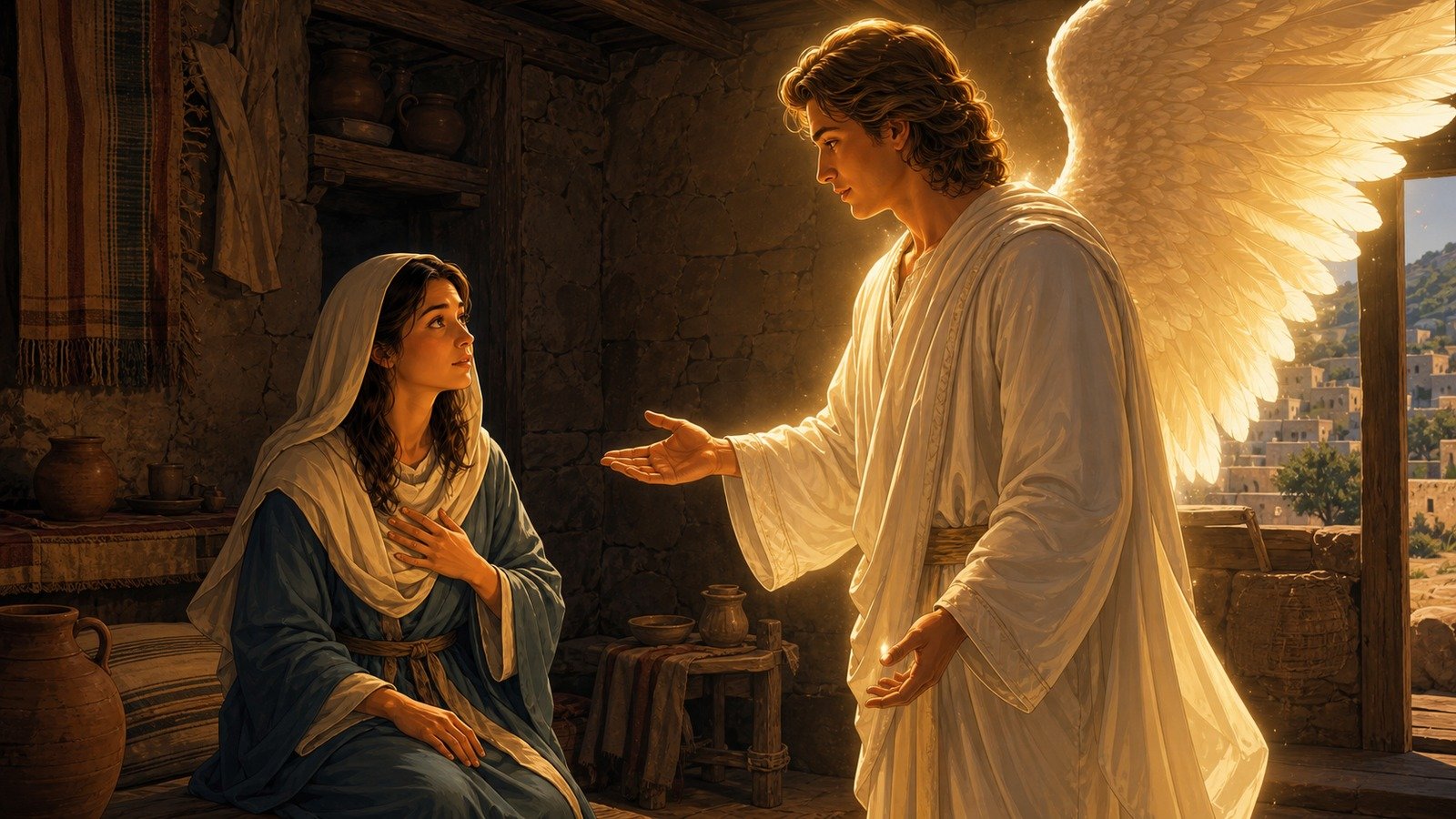
Six months into Elizabeth's pregnancy, Gabriel visits Mary, a young woman betrothed to Joseph, announcing she will conceive by the Holy Spirit and bear a son to be called Jesus, "the Son of the Most High." Mary consents: "I am the Lord's servant."
Further context
3 min readSix months later the same angel is sent to a town in Galilee called Nazareth, which is a village of a few hundred people, unmentioned in any earlier writing, in a district the Judeans looked down on.
Mary is pledged to be married to Joseph, a descendant of David. Betrothal in that society was a binding legal contract entered before the marriage itself and dissolvable only by divorce, and the woman was usually in her early or middle teens.
The greeting unsettles her before anything is announced: greetings, you who are highly favoured! The Lord is with you. She is greatly troubled and wonders what kind of greeting this might be, which is a reasonable response to being addressed that way by a stranger.
The message names the child, his descent and his throne. He will be great and will be called the Son of the Most High, and the Lord God will give him the throne of his father David, and he will reign over Jacob's descendants for ever, and his kingdom will never end. Every clause of that is drawn from the promise made to David a thousand years earlier, and it is being delivered in a village to a teenage girl.
Her question is not the same as Zechariah's, and the difference in the responses reflects it. He asked how he could be sure. She asks how it will happen, since she is a virgin, which is a request for information rather than for proof.
The answer describes the manner rather than the mechanism: the Holy Spirit will come on you, and the power of the Most High will overshadow you. The verb behind overshadow is the one used of the cloud that covered the tent of meeting in the wilderness. Then a sign she did not ask for: her relative Elizabeth is in her sixth month, and no word from God will ever fail.
Her reply is two sentences and they are the reason the scene has been painted more often than almost any other: I am the Lord's servant. May your word to me be fulfilled. The word she uses of herself means a female slave.
The name Gabriel means man of God or strength of God, and he appears in only two places in the Hebrew scriptures, both of them in Daniel, where he interprets visions about the timing of what is coming. The angel associated with a countdown turns up twice in six months in a hill village and a small town to announce that the waiting is over.
What she is agreeing to is not abstract. An unmarried pregnancy in that world exposed a woman to divorce, disgrace and, under the law as written, to worse. She says yes before Joseph has been told anything.
Nazareth in the first century was a village of perhaps a few hundred people in the Galilean hills, with no mention in any earlier source, and excavation there has found terraces, cisterns, tombs and rock-cut storage pits of the period and no public buildings at all.
Mary is described as pledged to be married, which in Jewish practice was a legally binding betrothal lasting about a year, during which the couple did not live together and which could only be ended by divorce.
The greeting she is given is one she cannot place: greetly favoured one, the Lord is with you. She was greatly troubled at his words and wondered what kind of greeting this might be.
Her question, how will this be, since I am a virgin, is answered with an explanation and then with evidence: Elizabeth, her relative, is already six months pregnant.
Her answer is one sentence: I am the Lord's servant. May your word to me be fulfilled.