

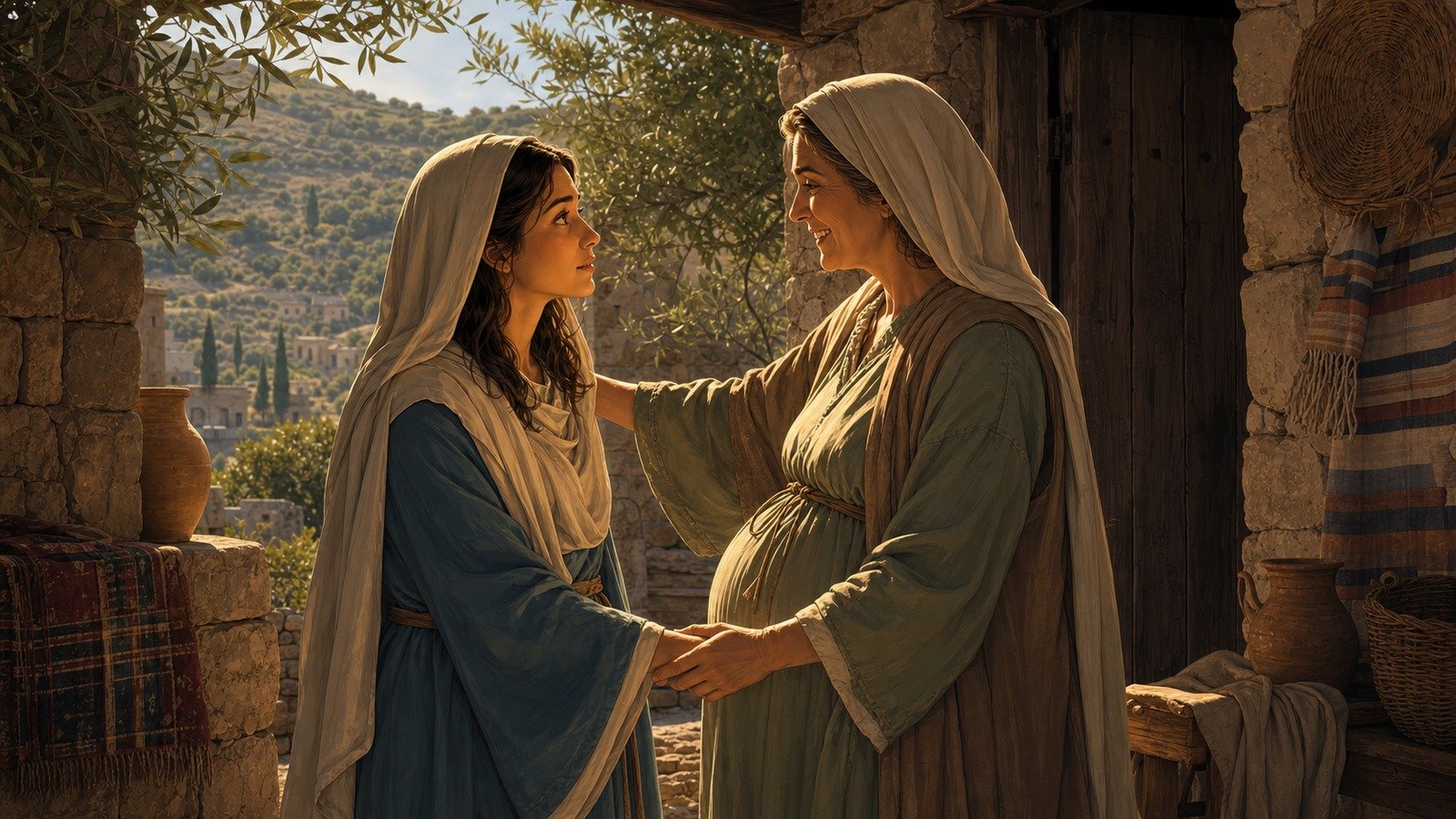
Mary travels to visit her relative Elizabeth; the unborn John leaps in the womb at Mary's greeting, Elizabeth blesses Mary as "the mother of my Lord," and Mary responds with a song of praise, the Magnificat, echoing the language of Hannah's earlier prayer.
Further context
3 min readMary goes in a hurry to a town in the hill country of Judea, which is somewhere between a hundred and a hundred and fifty kilometres south, and stays three months. A pregnant teenager travelling that distance to an older relative, in a hurry, is not hard to read.
The greeting produces two reactions at once. The child in Elizabeth's womb leaps, and Elizabeth is filled with the Holy Spirit and says three things in a loud voice: blessed are you among women, and blessed is the child you will bear; why am I so favoured, that the mother of my Lord should come to me; and blessed is she who has believed that the Lord would fulfil his promises to her.
That last line is the point of the visit. Somebody who has no way of knowing what happened confirms it, and the confirmation is about her believing rather than about her condition.
What Mary says in reply is a poem of about ten sentences and it is among the most politically explicit things anyone says in the New Testament. It is known as the Magnificat from the first word of its Latin version.
It opens personally: my soul glorifies the Lord and my spirit rejoices in God my Saviour, for he has been mindful of the humble state of his servant. Then it turns outward, and the verbs are in the past tense, describing as already done what has not yet happened.
He has performed mighty deeds with his arm; he has scattered those who are proud in their inmost thoughts. He has brought down rulers from their thrones but has lifted up the humble. He has filled the hungry with good things but has sent the rich away empty.
Those three couplets describe a reversal of the entire social order, and they are spoken in a country under Roman occupation, ruled by a client king who murdered his own family, by a girl from a village nobody had heard of. The song has been treated as seditious more than once: it was reportedly banned from public recitation under British rule in India, and in Argentina and Guatemala in the twentieth century.
Its closing lines tie it back a very long way: he has helped his servant Israel, remembering to be merciful to Abraham and his descendants for ever, just as he promised our ancestors.
The whole poem is built out of the Hebrew scriptures, and its closest model is the song Hannah sang when she handed over her son at the sanctuary at Shiloh, which also turns on the strong being disarmed and the hungry being fed.
The journey is not trivial. The hill country of Judea is somewhere between a hundred and a hundred and fifty kilometres south of Nazareth, four or five days on foot, and a young woman is described making it in a hurry.
Elizabeth's greeting has a detail that reads as observed rather than composed: the baby leapt in her womb, and she says so twice.
The Magnificat takes its name from the first word of the Latin version, and its content is much sharper than its usual musical settings suggest. He has scattered those who are proud in their inmost thoughts. He has brought down rulers from their thrones but has lifted up the humble. He has filled the hungry with good things but has sent the rich away empty.
Those are past tenses describing something not yet visible, spoken by a pregnant teenager in an occupied province.
She stays about three months and then goes home, which is roughly to the point where Elizabeth would give birth.