

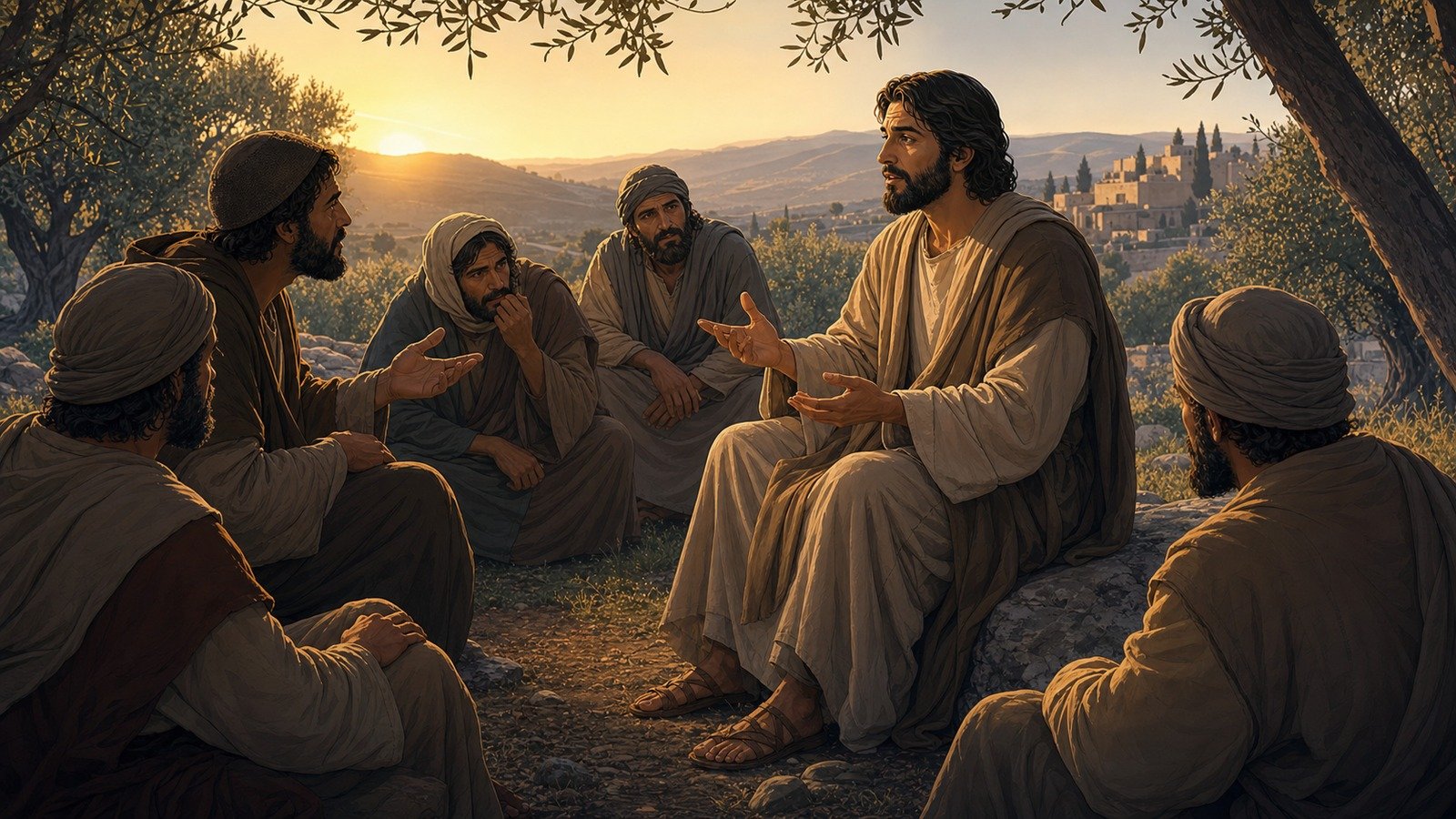
Asked by a disciple to teach them to pray, Jesus gives a version of the Lord's Prayer and follows it with teaching on persistence in prayer and God's reliability as a good father who gives good gifts to his children.
Further context
3 min readOne of the disciples watches Jesus praying and, when he has finished, asks to be taught how to do it, adding that John taught his disciples.
That request tells you something about the period. Teachers gave their followers a set form of prayer, and it functioned partly as an identity marker: you could tell which movement a man belonged to by what he said.
The prayer he gives is shorter here than the version in the Sermon on the Mount, and the differences between the two have been discussed since the early church, the likeliest explanation being that he taught it more than once and not always identically.
It opens with Father, and the Aramaic behind it is preserved elsewhere as abba, an ordinary domestic word used by children and adults alike for their own father. Jewish prayer did address God as Father of the nation; addressing him that way as an individual, and teaching a group of labourers and fishermen to do it, was not the common practice.
Hallowed be your name asks that God be treated as holy, and in Hebrew usage a name stands for the person and their reputation. Your kingdom come asks for his rule to arrive in full.
Give us each day our daily bread contains a Greek word (epiousios) that appears almost nowhere else in surviving Greek literature, and nobody is certain what it means. Bread for the coming day, bread necessary for existence, and bread for tomorrow have all been argued, and translators have been choosing between them for eighteen centuries.
Forgive us our sins, for we also forgive everyone who sins against us. The version in Matthew uses the word debts, and the two are the same in Aramaic, where sin was routinely spoken of as something owed.
Lead us not into temptation is the clause that has caused most difficulty, since it can be read as asking God not to do something he would not do anyway. The word covers both testing and enticement, and the request is most naturally understood as asking to be kept out of the situation altogether.
What follows is a story about a man knocking on a friend's door at midnight because a traveller has arrived and he has nothing to set before him. Refusing a guest food would have been a serious failure, and the whole village would know. The friend inside answers that the door is locked and the children are in bed with him, which describes a one-room house where everyone slept together and opening the door woke the household.
He gets what he needs, not from friendship but because of his shameless persistence, and the Greek word there means something closer to brazenness.
Then the promise: ask and it will be given to you, seek and you will find, knock and the door will be opened. And the comparison of a father who does not hand his son a snake when he asks for a fish.
Whether the two versions represent two occasions or one is a question about how the sayings were preserved. The shorter form here has five requests, the longer form in the Sermon on the Mount has seven, and the familiar ending about the kingdom, the power and the glory is absent from the earliest copies of both, having come in later from its use in worship, which is why modern Bibles put it in a footnote.
Its use as a set form began early. A manual of church practice from around the end of the first century already instructs Christians to pray it three times a day.