

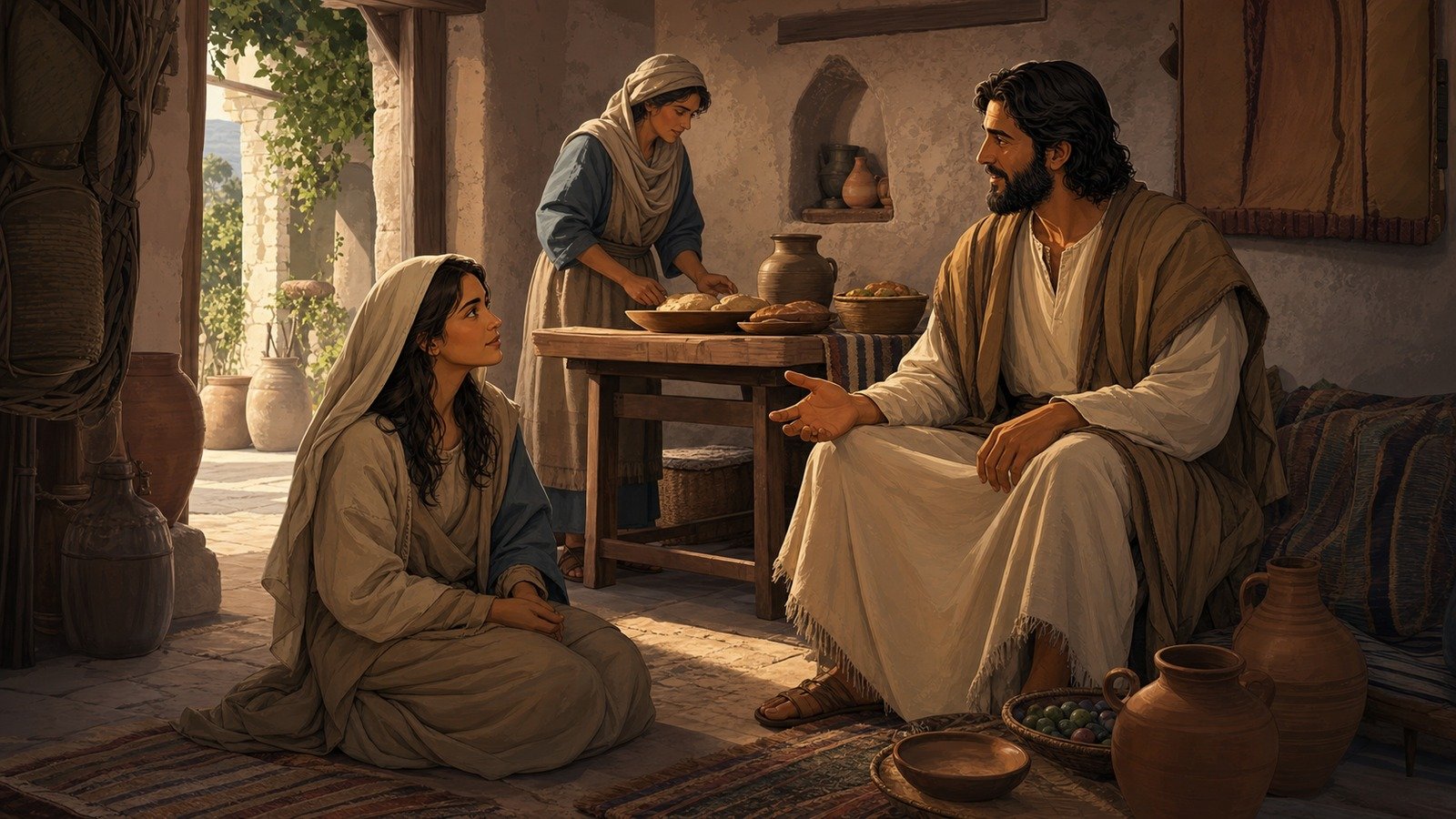
Visiting the sisters Mary and Martha, Jesus gently corrects Martha's anxious focus on hospitality tasks, commending Mary's choice to sit and listen to his teaching instead as "what is better."
Further context
2 min readBethany sat on the eastern slope of the Mount of Olives, about three kilometres from Jerusalem, close enough to walk in for a festival and far enough to sleep outside the city. It became the base for the final week, and the household of Martha, Mary and their brother Lazarus is the nearest thing to a home he is recorded as having in Judea.
Martha opens her home to him, and the phrasing puts her in charge of it, which suggests she was the elder or the widow of the house.
She is distracted by all the preparations that had to be made. The Greek word describes being pulled in several directions at once, and hospitality for a travelling teacher and his companions meant baking, drawing water, killing and preparing meat, and doing it all without notice.
Mary sits at the Lord's feet listening to what he says.
That posture is technical. Sitting at a teacher's feet is what a disciple did, and Paul describes his own training under Gamaliel in exactly those words. A woman taking that place was not usual, and there is rabbinic material of a later period expressing considerable hostility to teaching women the law at all. Nothing is said about it here, which is itself the point: she takes the position of a student and is not sent back to the kitchen.
Martha's complaint is addressed to him rather than to her sister, and it contains an accusation: Lord, do you not care that my sister has left me to do the work by myself? Tell her to help me.
The reply repeats her name, which in this idiom softens what follows. Martha, Martha, you are worried and upset about many things, but few things are needed, or indeed only one. Mary has chosen what is better, and it will not be taken away from her.
The wording of the middle clause varies among the ancient copies, some reading few things and some only one, and the difference has occupied editors for a long time. On the shorter reading it is close to a remark about the meal itself: one dish would have done.
Nothing here condemns the work. Martha's hospitality is the reason he is in the house, and elsewhere she is described plainly as loved. What is corrected is the anxiety, and the assumption that serving him entitled her to direct someone else's attention.
She appears again at her brother's tomb, and the confession she makes there is as full as Peter's.
Bethany's Aramaic name most probably meant house of the poor or house of affliction, and a suggestion that it was associated with the care of the sick has been made on that basis, though the evidence is thin. What is certain is that the household there was comfortable enough to accommodate a travelling group at short notice.
Mary appears three times in the record, and on every occasion she is at his feet: listening here, weeping at her brother's death, and pouring perfume over them a week before the crucifixion.