

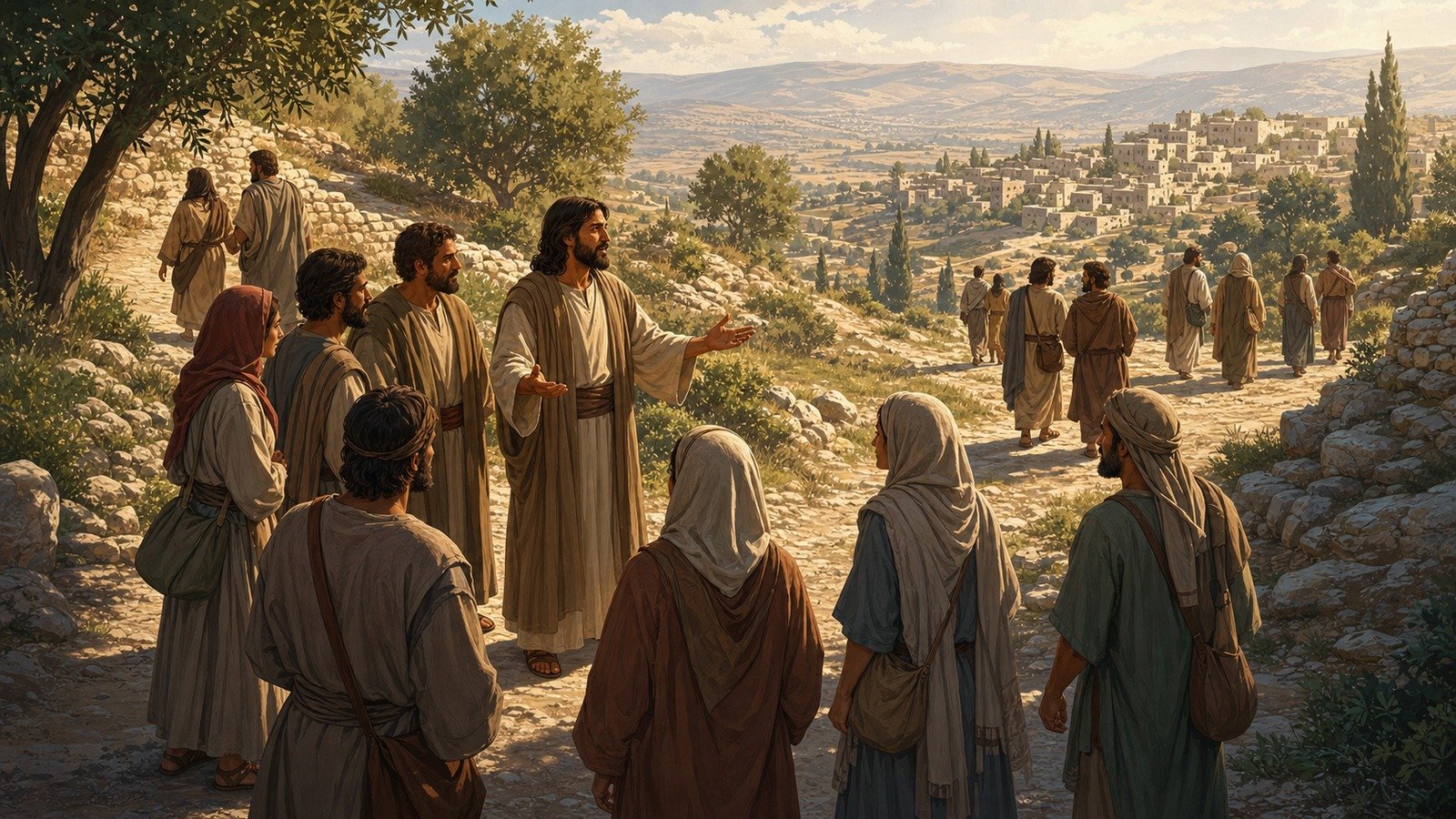
Jesus sends a much larger group of followers ahead of him in pairs to towns he intends to visit, extending the earlier mission of the Twelve; they return rejoicing that even demons submitted to them, and Jesus responds with a moment of prayerful joy at the Father's revelation to "little children."
Further context
2 min readA second mission, and a much larger one. The Twelve had been sent out earlier; now a further group goes ahead of Jesus in pairs to every town and place where he is about to go.
Whether the number is seventy or seventy-two depends on which ancient copies are followed, and they divide almost evenly. Both figures carry associations. Seventy elders were appointed to help Moses carry the burden of the people, and the nations of the world are listed as seventy in Hebrew and seventy-two in the old Greek translation, which is why some read this mission as pointing beyond Israel.
The instructions repeat the earlier pattern with additions. The harvest is plentiful but the workers are few; ask the Lord of the harvest to send out workers. Go, I am sending you out like lambs among wolves. Do not take a purse or bag or sandals, and do not greet anyone on the road.
That last instruction sounds rude and is practical. Eastern greetings were extended affairs involving enquiries after households and sometimes a shared meal, and a man in a hurry could lose half a day to one. Elisha had given a servant the same order when sending him ahead on an urgent errand.
The peace formula is given as something almost physical: when you enter a house, say peace to this house, and if someone who promotes peace is there, your peace will rest on them; if not, it will return to you.
Stay in one house, eat what is set before you, heal the sick and say the kingdom of God has come near to you. Eating what is put in front of you would matter enormously to men raised on food laws, and it is stated without qualification.
Three towns are then denounced by name: Chorazin, Bethsaida and Capernaum, all within a few kilometres of each other on the northern shore, all places where he had spent most of his working life. The comparison offered is with Tyre and Sidon, Phoenician cities the prophets had condemned, and with Sodom, and in each case the pagan city comes off better.
They return with joy: Lord, even the demons submit to us in your name.
The reply is one of the strangest sentences in the Gospels. I saw Satan fall like lightning from heaven. Then authority to trample on snakes and scorpions, and then a correction: do not rejoice that the spirits submit to you, but rejoice that your names are written in heaven.
The seventy-two are never named and are not heard from again as a group, which is a reminder of how much larger the following was than the Twelve. A list preserved elsewhere of men who had been with him from the baptism of John to the ascension produces at least a hundred and twenty in Jerusalem alone.
What they are sent to do is announce that he is coming, which makes this an advance operation rather than an independent mission. Every place they visit is a place he intends to reach, and the towns denounced by name afterwards are the ones that had already seen the most.